
These scenarios cost U.S. businesses staggering sums every year. IHL projected $1.70 trillion in worldwide retail inventory distortion costs in 2024, driven largely by stockouts and overstock situations that accurate tracking could prevent. Beyond the financial toll, poor inventory visibility creates operational chaos: wasted hours searching for materials, production delays from missing components, compliance failures during audits, and an inability to forecast accurately or plan capacity.
This guide will walk you through everything you need to know about inventory tracking-what it is, why it matters, the methods and systems available, and how to choose the right solution for your operation.
Key Takeaways
- Inventory tracking monitors quantity, location, status, and movement of goods to optimize stock levels and reduce waste
- Methods range from manual spreadsheets to automated barcode, RFID, QR code, and GPS systems
- Choose systems based on business size, inventory complexity, industry requirements, and integration needs
- Effective tracking reduces loss, improves fulfillment speed, and supports compliance and accurate financial reporting
- Successful implementation starts with assessing pain points and calculating total cost of ownership
What Is Inventory Tracking?
Inventory tracking refers to the systems and methods used to monitor your materials and products as they move through your supply chain. This includes tracking quantity, location, status, and movement of raw materials, work-in-process goods, finished products, tools, and equipment.
What Inventory Tracking Monitors
A comprehensive tracking system captures:
- Stock levels and reorder points - Real-time counts that trigger replenishment
- Item locations - Specific warehouses, zones, bins, shelves, or in-transit status
- Expiration dates - Important for perishables, pharmaceuticals, and food products
- Stock movement - Receiving, storage, production usage, and shipping events
- Discrepancies - Variances between recorded counts and actual physical inventory
Tracking vs. Management: Understanding the Difference
According to ASCM, inventory tracking is the process of recording and monitoring data, while inventory management uses that data to make strategic decisions about purchasing, forecasting, allocation, and fulfillment. Tracking is the foundation; management is the decision layer built on top.
Tracking Across Industries
Different sectors apply tracking in unique ways:
- Manufacturing - Tracking raw materials through production stages and finished goods through warehouses
- Construction - Monitoring tools and equipment across multiple job sites and vehicles
- Textile processing - Following garments through washing, sorting, and finishing operations
- Healthcare - Managing medical supplies, devices, and pharmaceutical inventory with strict compliance requirements
- Automotive repair - Controlling parts inventory and tracking customer vehicles through service workflows
Supporting Important Business Functions
Accurate tracking data enables:
- Financial reporting and inventory valuation - Essential for accurate balance sheets and cost of goods sold
- Tax compliance - Documented inventory positions for year-end reporting
- Demand forecasting and production planning - Historical movement patterns inform future needs
- Loss prevention and theft detection - Accountability at every transaction point
- Regulatory compliance - Audit trails for recalls, traceability requirements, and FDA/DSCSA regulations

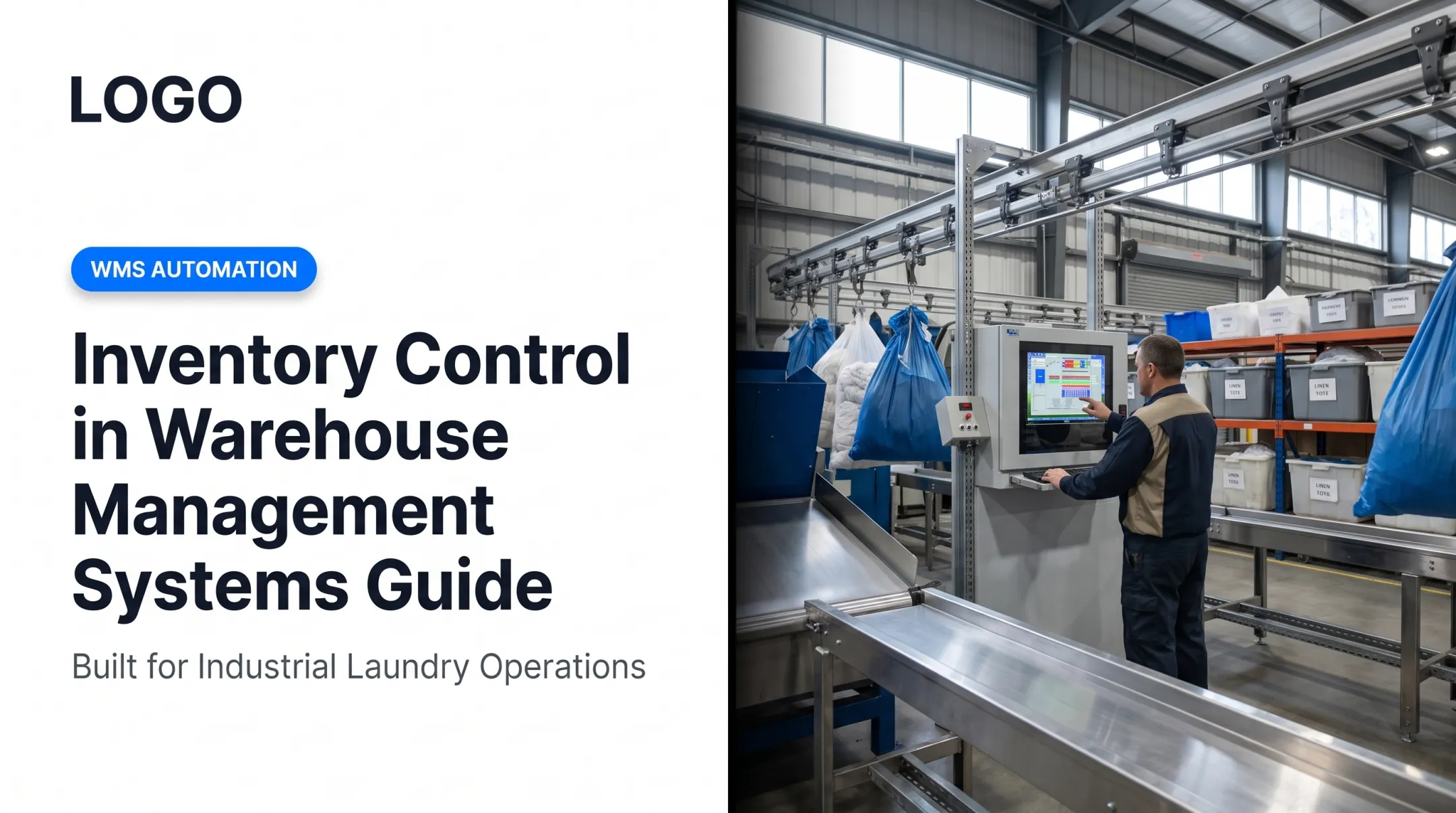
High-volume operations benefit most from integrated tracking systems that capture material movement through multiple automated stages. In textile services, for instance, advanced platforms can monitor items through washing, sorting, and finishing while simultaneously tracking equipment performance and process efficiency across distributed facilities.
Why Inventory Tracking Matters
Cost Reduction and Waste Prevention
Accurate tracking prevents expensive mistakes:
- Prevents overstocking - Reduces holding costs and eliminates obsolescence from slow-moving inventory
- Minimizes stockouts - Avoids lost sales, expedited shipping fees, and disappointed customers
- Identifies slow movers early - Enables markdown strategies before goods become unsalable
ISM reported in 2022 that most companies target carrying costs at 20%-30% of total inventory value. Tracking helps you stay within that range by eliminating excess.
Loss Prevention and Theft Deterrence
Inventory tracking creates clear accountability through documentation:
- Check-in/check-out records - Document who moved what, when, and where
- Quick detection of missing items - Regular cycle counts reveal discrepancies immediately
- Audit trails - Detailed transaction logs deter theft and support investigations
Operational Efficiency and Productivity
Efficient inventory management directly impacts your bottom line:
- Eliminates search time - Workers know exactly where to find items
- Speeds order fulfillment - Real-time location data enables faster picking and packing
- Improves receiving and put-away - Barcode scanning accelerates warehouse processes
- Optimizes space utilization - Data-driven slotting reduces wasted warehouse space
WERC's 2025 distribution center metrics report shows that best-in-class facilities complete dock-to-stock operations in under 3.5 hours. These efficiency gains translate directly into customer satisfaction.
Customer Satisfaction and Service Levels
Real-time inventory visibility improves every customer touchpoint:
- Prevents backorders and stockouts - Real-time data shows what's actually available
- Enables accurate delivery promises - No more guessing at ship dates
- Supports faster fulfillment - Efficient picking means orders ship sooner
- Reduces order errors and cancellations - Accurate counts prevent overselling
Compliance, Audit Readiness, and Financial Accuracy
Many industries face strict tracking requirements:
- FDA Food Traceability Rule - Additional recordkeeping for covered foods; compliance direction moved to July 20, 2028
- DSCSA prescription drug requirements - Electronic package-level identification and 24-hour reporting of illegitimate products
- FDA UDI medical device rule - Machine- and human-readable identifiers on labels and in GUDID database
Beyond regulatory compliance, tracking provides documentation for financial audits and supports warranty and recall processes. It also ensures accurate tax reporting and inventory valuation for financial statements.

Inventory Tracking Methods and Technologies
Manual Tracking Methods
Manual systems include pen-and-paper logs, card systems like Kanban visual signals, and spreadsheets.
Benefits:
- Zero or very low upfront cost
- No specialized equipment required
- Simple to understand and start using
Limitations:
- High labor requirements for counting and data entry
- Prone to transcription errors and omissions
- No real-time visibility into current status
- Difficult to scale as inventory grows
When manual methods work: Very small operations with under 50 SKUs, stable inventory, and single-location storage.
Barcode Scanning
Barcodes encode product data in 1D (traditional linear) or 2D (QR, DataMatrix) formats that scanners read and send to a database.
Benefits:
- Simple, inexpensive, and versatile
- Works with smartphones for 2D codes
- Mature technology with broad software support
- Low per-item cost
Limitations:
- Requires line-of-sight contact
- One-at-a-time scanning process
- Labels vulnerable to damage and wear
Typical applications: Retail POS, warehouse receiving and shipping, asset check-in/check-out, work order tracking.
Socket Mobile offers 1D/2D scanners starting at $285, making barcode tracking accessible for small operations. GS1 US pricing ranges from $30 for a single GTIN to $2,500 for 1,000 prefixes, plus annual renewals.
RFID (Radio Frequency Identification) Tracking
RFID tags use radio waves to transmit data to readers without line-of-sight or physical contact.
Benefits:
- Bulk scanning capability-Impinj's 2024 specification shows up to 1,000 items per second and read ranges up to 10 meters
- Works through obstacles, liquids, and packaging
- More durable than printed labels
- Enables real-time automated updates
Drawbacks:
- Higher cost per tag (though Impinj describes tags as costing pennies)
- Readers, antennas, and software require significant investment
- Metal and liquid interference can affect performance
- Privacy concerns in some applications
Best use cases: High-volume warehouses, expensive assets, supply chain visibility, retail inventory accuracy.
Zebra's 2024 global manufacturing survey found that 66% of manufacturers planned RFID implementation over the next five years. This reflects the technology's proven ROI in high-volume operations.

Beyond RFID, specialized environments demand even faster scanning. Advanced image-based code readers-like those in Softrol's garment sortation systems-capture items moving continuously through automated processes at rates exceeding 3,800 garments per hour.
QR Code Tracking
2D matrix codes store more complex data than traditional barcodes and can link directly to online resources.
Benefits:
- Smartphone scanning with no special equipment
- Can store URLs, images, and rich data
- Supports customer engagement and marketing
- Free to generate
Limitations:
- Requires internet connectivity for some functions
- Performance affected by lighting and camera quality
- Still requires manual individual scanning
Applications: Marketing campaigns, customer-facing package tracking, lightweight inventory systems, event check-in.
GPS and IoT Tracking
GPS devices and IoT sensors provide real-time location and status data for mobile assets.
Benefits:
- Real-time location tracking with map visualization
- Geofencing alerts when assets enter or leave zones
- Utilization and idle-time monitoring
- Works for vehicles, trailers, and heavy equipment
Limitations:
- Requires hardware installation on each asset
- Ongoing cellular connectivity and subscription costs
- Battery or power source requirements
- Limited indoor accuracy
Best applications: Fleet management, construction equipment, shipping containers, field service tools.
Samsara and Geotab offer comprehensive GPS tracking platforms, though pricing is quote-based and depends on fleet size and features.
Manual vs. Automated: Quick Comparison
| Factor | Manual | Automated (Barcode/RFID) |
|---|---|---|
| Upfront cost | $0-500 | $1,000-50,000+ |
| Accuracy | 60-80% | 95-99.9% |
| Speed | Minutes per item | Seconds or bulk |
| Scalability | Poor beyond 100 SKUs | Excellent |
| Real-time visibility | No | Yes |
| Integration | Manual export/import | Direct system sync |

Recommendation: Manual systems work for very small operations. Growing businesses with multiple locations or more than 100 SKUs should invest in automated tracking.
Types of Inventory Tracking Systems
Spreadsheets and Manual Systems
Many small businesses start with Excel or Google Sheets, organizing inventory data in columns for SKU, description, quantity, location, and reorder point.
Benefits:
- Familiar interface requires minimal training
- Low or zero cost
- Fully customizable to your needs
Limitations:
- Manual data entry creates error risk
- No real-time updates across multiple users
- Difficult to scale beyond a few hundred items
- No integration with accounting or sales systems
- Version control issues when multiple people edit
According to ASCM, periodic systems that update inventory only after manual counts are suitable for lower volumes or niche/high-ticket items but expose gaps where data becomes outdated between counts.
Standalone Inventory Tracking Software
Cloud-based or on-premise applications dedicated to inventory management provide focused functionality without the complexity of full ERP systems. These tools bridge the gap between basic spreadsheets and enterprise-level platforms.
Key features:
- Barcode and RFID scanning support
- Multi-location and multi-warehouse tracking
- Automated reorder points and purchase orders
- Reporting and analytics client workspaces
- Mobile access for warehouse workers
Mid-size businesses focused primarily on inventory operations benefit most from standalone systems-particularly those without complex manufacturing, multi-entity accounting, or advanced supply chain planning needs.
Pricing examples:
| Provider | Plan | Monthly Cost | Users | Key Limits |
|---|---|---|---|---|
| Zoho Inventory | Standard | $29 | 2 | 1 location, 500 orders/mo |
| Zoho Inventory | Enterprise | $249 | 10 | 10 locations, 15,000 orders/mo |
| Cin7 Core | Standard | $349 | 5 | 6,000 sales orders/year |
| Cin7 Core | Advanced | $1,199 | 15 | 120,000 sales orders/year |
Integrated ERP and Production Systems
For organizations needing unified systems across multiple business functions, integrated ERP platforms offer a comprehensive solution. Gartner defines ERP as a shared process and data model spanning finance, HR, distribution, manufacturing, service, and supply chain functions.
Benefits:
- Single source of truth eliminates data silos
- Automated data flow between functions (sales → inventory → accounting → purchasing)
- Advanced forecasting and planning capabilities
- Comprehensive reporting across the organization
These systems come with higher costs (typically enterprise-level pricing), longer implementation timelines (often 6-12+ months), and more complex configuration requirements.
In specialized industries like textile services and industrial laundries, integrated plant management systems track materials through production stages while monitoring equipment performance. Softrol Systems' Total Plant Management platform illustrates this approach, combining inventory tracking with real-time visibility into process efficiency and machine utilization across multiple facilities.

Cin7 lists 700+ integration connections including QuickBooks, Shopify, and Amazon, while their Omni tier for enterprise-scale operations requires custom quotes.
How to Choose the Right Inventory Tracking System
Assess Your Business Needs and Pain Points
Start with a thorough assessment of your current situation:
Document your tracking challenges:
- Where do stockouts occur most frequently?
- How often do you discover inventory discrepancies?
- How much time do workers spend searching for items?
- Do you face duplicate purchase issues?
- Are compliance or audit requirements causing stress?
Determine inventory complexity:
- How many SKUs do you manage?
- How many storage locations, warehouses, or sites?
- What product types (perishables, serialized items, bulk materials)?
- What is your daily/weekly transaction volume?
Consider growth trajectory:
- Will you add locations in the next 2-3 years?
- Are you expanding product lines?
- Will transaction volume double? Triple?
Evaluate industry-specific needs:
- Do you need lot or serial number tracking?
- Are expiration dates important?
- Do regulations require specific traceability or reporting?
Evaluate Features, Integration, and User Experience
With a clear picture of your challenges and growth plans, you can match them to specific system capabilities:
Must-have features:
- Barcode, RFID, or QR code scanning support
- Mobile access for warehouse or field workers
- Multi-location and bin-level tracking
- Automated reorder point alerts
- Reporting and audit trail capabilities
- Lot/serial number and expiration tracking (if applicable)
Integration requirements:
- Confirm connectors to your accounting software (QuickBooks, Xero, NetSuite)
- Verify e-commerce platform integration (Shopify, WooCommerce, Amazon)
- Check ERP and production system compatibility
- Understand API access for custom integrations
User experience factors:
- Is the interface intuitive for your team's skill level?
- What training and onboarding resources does the vendor provide?
- Does the vendor offer implementation assistance?
- What support channels are available (chat, phone, knowledge base)?
Consider Total Cost of Ownership and Scalability
Total cost of ownership extends beyond the purchase price. NIST defines TCO as quantifying costs across acquisition and all downstream activities, which for inventory systems includes:
Upfront costs:
- Software licenses or first-year subscription
- Barcode scanners, printers, or RFID readers
- Labels, tags, and consumables
- Implementation, setup, and configuration fees
Ongoing costs:
- Monthly or annual subscription fees
- Maintenance and support contracts
- Training for new employees
- Additional users, locations, or transaction capacity
- System upgrades and updates
Beyond obvious line items, factor in less visible expenses:
- Downtime during implementation and data migration
- Data cleanup before migration
- Custom integration development or middleware
- IT staff time for troubleshooting and maintenance
Gartner research identifies legacy integration and middleware as common cost overruns in enterprise systems, making pre-purchase integration validation important.
Scalability tests:
- Can the system handle 2-3x your current SKU count?
- What happens when you add locations or warehouses?
- Are there hard limits on users, transactions, or storage?
- Do you have to migrate to a new platform as you grow, or does the system scale smoothly?
Plan limits reveal scalability costs-some vendors jump from 1 to 10 locations or from 50 to 15,000 orders across pricing tiers, creating significant cost increases as you grow.

Common Challenges and Solutions
Implementation Hurdles
Key obstacles during deployment:
- Data migration from old systems (spreadsheets, legacy software)
- Staff resistance to new technology and workflows
- Operational disruption during transition
- Unclear project scope and timeline
Proven approaches:
- Phased rollout - Implement one location or department at a time
- Thorough planning and testing - Pilot the system with a small group before full deployment
- Clear communication - Explain benefits and involve staff in the process
- Hands-on training - Practice real scenarios, not just software demos
Planning carefully matters: Gartner research shows that by 2027, more than 70% of recently implemented ERP initiatives will fall short of original business goals. Data governance and legacy integration remain the biggest roadblocks.
Once your system is live, maintaining data integrity becomes the next hurdle.
Data Accuracy and Synchronization
Typical problems:
- Discrepancies between physical counts and system records
- Delays updating inventory across multiple locations
- Errors from manual data entry or skipped scans
Solutions:
- Regular cycle counts - Count a portion of inventory daily or weekly instead of relying only on annual counts
- Automated scanning at every transaction - Receiving, movement, picking, and shipping
- Real-time synchronization - Cloud systems update instantly across all locations
- Periodic reconciliation - Investigate and resolve variances promptly
Real-time data capture systems help maintain accuracy across distributed facilities. Softrol's LOIS system demonstrates this approach in textile operations, providing remote access to plant performance data across multiple production stages.
Technology only works when your team uses it consistently.
User Adoption and Training
Typical barriers:
- Staff unfamiliar with scanning technology
- Inconsistent system usage (some workers bypass it)
- Lack of accountability for inventory accuracy
Solutions:
- Comprehensive hands-on training - Include role-based workflows and exception handling
- Clear standard operating procedures - Document when and how to scan items
- Accountability measures - Assign inventory ownership to specific individuals or teams
- Ongoing refresher training - Reinforce best practices and introduce new features
Strong vendor support makes adoption easier. For example, Cin7 offers 24/7 chat support and self-guided training resources to help teams master their platform.
Frequently Asked Questions
What is a good tool inventory and tracking system?
A good tool tracking system provides real-time visibility of location and custody, supports barcode or RFID scanning for check-in/check-out, and integrates with existing business systems. The best choice depends on tool volume, user count, and specific needs like maintenance schedules and loss prevention.
What is the difference between inventory tracking and inventory management?
Inventory tracking is the process of monitoring and recording quantity, location, and status of items as they move through your operation. Inventory management uses that tracking data to make strategic decisions about purchasing, forecasting, allocation, and fulfillment. Tracking provides the information; management makes the decisions based on it.
What are the main methods for tracking inventory?
The primary methods are manual tracking (spreadsheets, paper logs), barcode scanning, RFID technology, QR codes, and GPS/IoT tracking for mobile assets. Most businesses use a combination depending on inventory type-such as barcodes for warehouse items and GPS for vehicles.
How much does an inventory tracking system cost?
Costs vary widely based on system type, features, and business size. Standalone cloud software ranges from $0-$249/month for small operations to $349-$1,199/month for mid-market businesses. Enterprise ERP and RFID systems require custom quotes, with total costs including hardware, implementation, training, and support.
Can inventory tracking systems integrate with ERP or production software?
Yes, most modern systems integrate with ERP, accounting, e-commerce, and production platforms through APIs or built-in connectors. Integration eliminates duplicate data entry and enables automated workflows. Validate specific integrations before purchasing.
What are the benefits of real-time inventory tracking vs. periodic tracking?
Real-time tracking provides instant visibility as transactions occur, enabling immediate decision-making and preventing stockouts. Periodic tracking relies on manual counts at intervals, which is less expensive but creates gaps where data may be outdated or inaccurate.
Ready to improve your inventory accuracy and operational efficiency? Start by documenting your current pain points, calculating the cost of inventory errors, and evaluating systems that match your volume and complexity. Whether you choose barcode scanning, RFID, or an integrated ERP platform, the right tracking system will pay for itself through reduced waste, faster fulfillment, and better decision-making.