
Introduction
A hospital sends 500 uniforms out for cleaning. Three days later, only 480 come back, and nobody knows where the rest went. This scenario plays out daily in industrial and institutional laundries across the country.
Adventist Health West's linen director once tracked losses reaching up to $1 million per year before implementing better management systems, cutting that figure to around $600,000 annually (American Laundry News, 2025). Multiply that kind of exposure across the industry, and the cost of poor visibility becomes obvious: lost inventory, delayed deliveries, frustrated customers.
This guide breaks down the technology, benefits, and best practices behind seamless supplier-to-customer tracking, including how automation platforms like Softrol's Total Plant Management support plants trying to close these visibility gaps.
Key Takeaways
- Seamless tracking connects supplier intake through customer delivery, giving plant managers real-time visibility at every stage
- RFID, barcode/image-based readers, and rail automation form the backbone of modern textile tracking
- Remote monitoring tools cut labor costs by reducing manual counts and re-sorting
- Choosing the right system comes down to three factors: integration with existing plant software, scalability as volume grows, and fit with your daily garment throughput
What Is Supplier-to-Customer Tracking in Textile Services?
Supplier-to-customer tracking means continuously monitoring garments and linens from the moment they arrive (whether from a supplier or customer pickup) through washing, sorting, finishing, and final delivery. It's not a single scan at drop-off and another at pickup. It's a connected chain of visibility.
This matters more for industrial laundries than it does for generic parcel tracking. A package moves point A to point B. A hospital gown or uniform gets processed dozens of times a month, mixed with thousands of similar items, and needs to return to the right customer, not just a customer.
Simple inventory counts fall short: they only tell you what you have, not where it is or how fast it's moving. True end-to-end visibility tracks item location, processing stage, and delivery status simultaneously.
Why Traditional Tracking Methods Fall Short
Manual tracking creates predictable failure points:
- Sorting errors from human miscounts during high-volume shifts
- Lost garments with no record of last known location
- Disconnected systems between wash aisle and sortation, meaning nobody has the full picture
- No real-time alerts, so problems surface only after a customer complains
Industry expert Sampson Linus of Ecolab noted that RFID bulk reading reduces time spent manually sorting and counting items, directly cutting down human tracking errors (American Laundry News, 2025). That said, manual tracking isn't automatically a failure. One Arizona facility manages several linen categories with spreadsheets and reports minimal loss. The suitability of manual methods depends heavily on scale and item volume.
Core Technologies Powering Seamless Tracking
Barcode and Image-Based Code Readers
Barcodes assign a permanent serial number to each garment, but they require line-of-sight scanning, meaning pieces get handled individually. That slows things down and, in healthcare settings, increases worker exposure to soiled textiles.
Advanced image-based code readers solve this differently. Softrol's camera-based reader system, paired with Pan-N-Zoom technology, was introduced in 2021 specifically to maximize garment sortation induction efficiency. At Aramark's Nashville facility, opened in 2022 to serve more than 2,000 customers, this reader system supported high-speed, high-volume semi-automatic sortation with automatic primary and final induction.
RFID Tagging
Where barcodes need individual handling, RFID tags don't need direct line-of-sight and can read multiple items simultaneously. Softrol's SofTrak Garment Tracking System uses RFID labels or barcodes for individual-item identification, feeding into inventory, customer history, and delivery modules.
The scale difference is significant:
| System | Throughput |
|---|---|
| SoftSort with RFID/barcode | Up to 3,800 garments/hour |
| Manual sorting equivalent | Far lower, labor-intensive |
At Aramark's Sacramento facility, this technology helped reduce sorting labor from 10 employees to two while processing over 40,000 garments daily.

Rail Automation and Real-Time Visualization
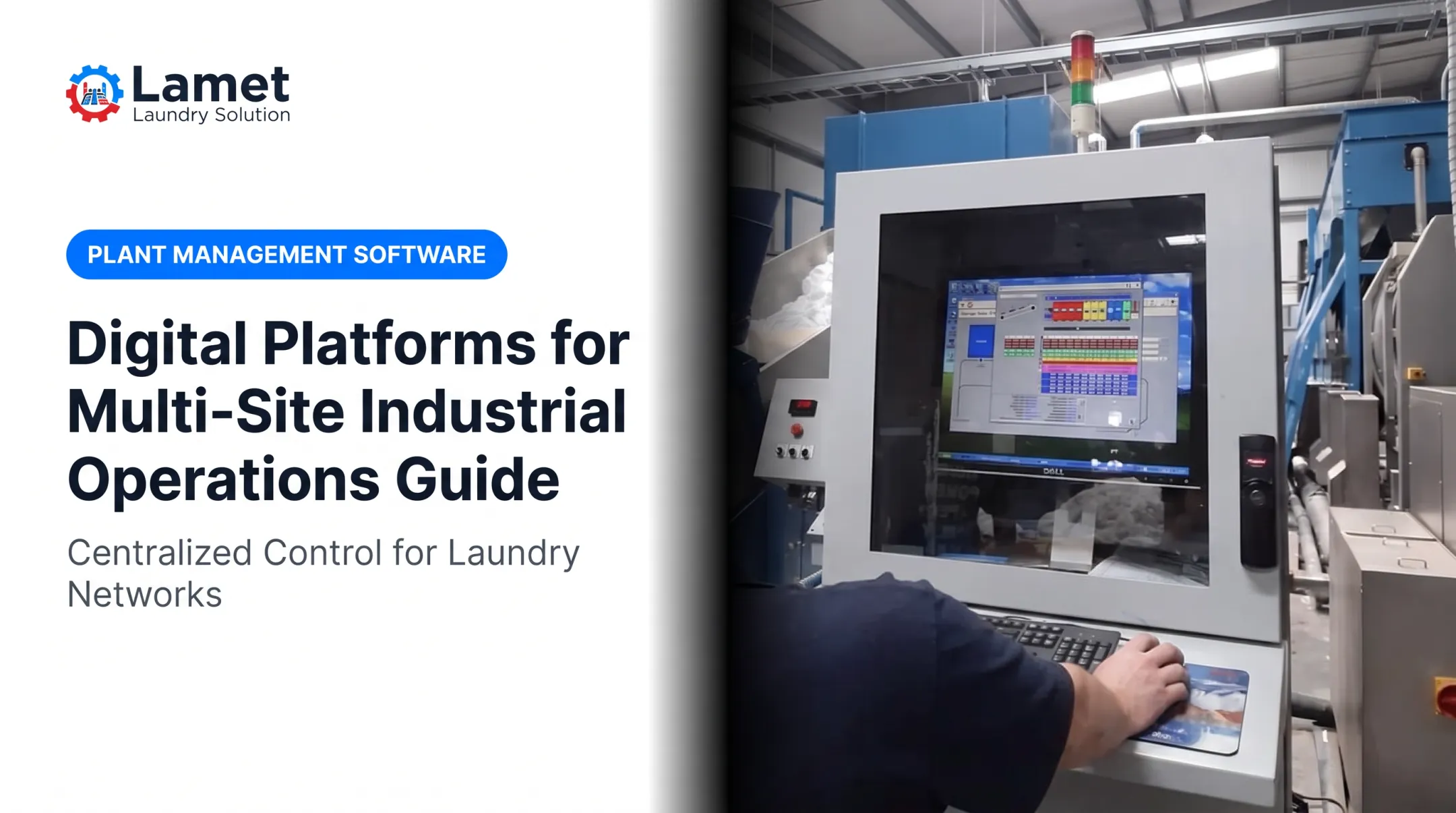
Pan-N-Zoom, built into Softrol's LOIS Rail software, gives operators a real-time, to-scale view of the rail system through touchscreen interfaces. They can pan and zoom into specific components, check item-level data, and monitor system health for preventative maintenance.
A US case from Textile Care Services in Rochester, Minnesota, documented by TRSA, showed overall efficiency up 10-15% following an ETECH rail-system upgrade as part of a broader $10 million plant investment (TRSA, 2025).

Remote Access Platforms
That same visibility extends beyond the plant floor: systems like Softrol's LOIS let managers check plant performance from a smartphone, tablet, or browser, anywhere. Documented metrics include operator work, machine utilization, dryer turn times, and non-credited loads, all viewable across multiple sites from a single account.
Chemical and Process Control Integration
Tracking doesn't stop at movement. Chemical systems like Softrol's ChemPulse integrate with production data so chemical requests get generated automatically instead of relying on manual selection. In one case, ChemPulse delivered 13 chemicals across eight dye machines for Gildan Activewear, supporting consistent processing at scale.
Key Benefits of End-to-End Tracking Solutions
- Increased plant efficiency: Automated identification speeds up sortation induction without slowing the line
- Reduced labor costs: RFID scanning eliminates manual counts; SoftSort has shown up to 77% lower sorting labor than manual methods
- Improved oversight: Real-time alerts flag issues as they happen, not after delivery
- Greater customer satisfaction: Time-stamped delivery records build accountability and reduce disputes over missing items
Time-stamped return and delivery data can also increase customer confidence, reducing resistance to legitimate loss charges, according to a 2025 American Laundry News report. That transparency matters most in healthcare and hospitality accounts, where trust drives contract renewals.

Implementing a Supplier-to-Customer Tracking System
Assessing Your Current Plant Workflow
Start by mapping the actual path garments take, from receiving dock through wash, sort, and shipping. Identify exactly where visibility disappears. Is it during transfer between wash aisle and sortation? During manual counts before shipping?
Choosing the Right Technology Mix
Not every plant needs the same setup:
- High-volume operations with mixed garment types often benefit from RFID
- Facilities needing individual serial tracking may lean on barcode systems
- Camera-based readers work well where speed and line continuity matter most
Whichever hardware you choose, it should feed into a plant management system that ties tracking data back to productivity reporting, not just a standalone scanner network. Softrol's Total Plant Management platform, for example, consolidates wash aisle, sortation, and shipping data into a single entry point, so tracking information supports real decisions rather than sitting in an isolated log.

Change Management and Staff Training
Rollout success depends on people, not just hardware. Train wash aisle, sortation, and shipping teams in phases rather than all at once. Give operators time with the system before full deployment, and keep vendor support accessible during the transition.
How Softrol Supports Seamless Plant-to-Customer Visibility
Softrol's Total Plant Management software acts as a single entry point, pulling data into one client workspace from:
- Soil sort operations
- Wash aisle equipment
- Garment sort systems
- Shipping and tracking
- Utility monitoring
Instead of checking five separate systems, managers see bottlenecks in one place.
For remote visibility, LOIS lets managers check plant performance and shipment status from any location, monitoring multiple sites from one account. Combined with advanced image-based code readers and Pan-N-Zoom rail technology, the platform is built to maximize garment sortation induction efficiency.
Softrol has spent over 34 years serving Fortune 1000 industrial and institutional laundries, including Aramark Uniform Services, Crown Health Care Laundry Services, and Gallagher Uniform. That history shows up in the details: turnkey automation designed specifically for wet-process textile operations, not generic warehouse tracking retrofitted for laundries.
Frequently Asked Questions
What is the most effective way to track logistics?
Combining real-time technologies like RFID, rail automation, and automated code readers with a centralized software platform works best. This approach eliminates manual data gaps and gives instant visibility into location and status.
What technologies are used in supply chain tracking?
Core technologies include RFID, barcode and image-based readers, IoT sensors, and centralized management software that pulls data from all these sources into one view.
How does real-time tracking reduce labor costs in a laundry or textile plant?
Automation reduces manual counting, re-sorting, and error correction. Some facilities have cut sorting labor by up to 77% compared to fully manual methods, freeing staff for higher-value work.
Can small or mid-sized industrial laundries benefit from automated tracking systems?
Yes. Modular systems like SofTrak let smaller operations start with core tracking functions, such as garment tracking or invoicing, and add modules as volume grows.
How does remote access to plant data improve decision-making?
Managers can monitor performance and receive alerts from anywhere, allowing faster response to delays, equipment issues, or bottlenecks without being on-site.
What should businesses look for when choosing a tracking solution provider?
Look for integration capability with existing equipment, industry-specific experience in textile services, scalability as volume grows, and ongoing support after installation.