Introduction
Industrial laundry managers face an ongoing challenge: Are facilities running at peak efficiency, or silently losing productivity to undetected bottlenecks and idle machines?
Without real-time visibility, managers discover problems only after shifts end—when they've already lost labor hours and missed production targets.
According to the International Labour Organization, labor productivity per hour worked in EU-27 economies decreased by 0.1% annually over 2021-2023, compared to 1.0% growth over 2010-2019.
This productivity slowdown makes operational efficiency more critical than ever for industrial facilities competing on tight margins.
Productivity monitoring software—specifically Enterprise Management Systems (EMS) designed for industrial operations—provides the solution.
This guide covers:
- What EMS is and how it functions in laundry and textile services
- Core features that deliver measurable value
- Benefits you can expect from implementation
- How to select the right system for your operation
TLDR
- Collects real-time data from machines, processes, and personnel to identify inefficiencies and boost performance
- Delivers live dashboards, automated alerts, trend analysis, equipment tracking, and remote multi-site access
- Textile services operations achieve reduced labor costs, higher throughput, proactive maintenance scheduling, and fewer unplanned downtime events
- Prioritize systems purpose-built for your industry with proven integration capabilities and scalable reporting tools
- Clear employee communication and compliance with applicable privacy regulations are essential for legal and ethical implementation
What Is Productivity Monitoring Software?
Productivity monitoring software in industrial settings is a system that collects, analyzes, and reports performance data across machines, processes, and personnel to help managers identify inefficiencies and improve output.
This differs from office-based employee computer surveillance tools, which represent only one narrow application of monitoring technology.
Industrial vs. Office Monitoring
Industrial productivity monitoring extends far beyond simple time-tracking or attendance software. Instead of just logging hours worked, these systems measure:
- Throughput rates across production lines
- Equipment utilization percentages for machinery
- Process cycle times from start to finish
- Overall plant efficiency metrics
The focus shifts from monitoring individual computer activity to understanding how entire production systems perform.
Evolution of Industrial Monitoring
Industrial monitoring has evolved significantly from its manual origins. Early systems relied on paper logs and stopwatch tracking, requiring supervisors to physically observe operations and manually record data.
Modern EMS platforms use automated sensor-based systems that feed data into centralized dashboards in real time, eliminating human error and providing instant visibility into plant performance.
Relevance to Laundry Operations
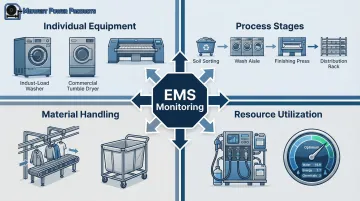
For laundry and textile services operations, EMS monitors the complete production cycle—from soil sort through wash aisle, finishing, and distribution.
The system captures data at every stage to pinpoint exactly where time and resources are lost:
- Excessive idle time between wash cycles
- Bottlenecks in the finishing department
- Inefficient material handling workflows
- Delays in distribution processes
Dual-Audience Functionality
EMS serves two distinct management audiences simultaneously. Operational floor managers need granular, real-time efficiency data to respond to immediate production issues. Executive leaders require high-level plant performance metrics for strategic decisions about capital investments, staffing models, and facility expansion.
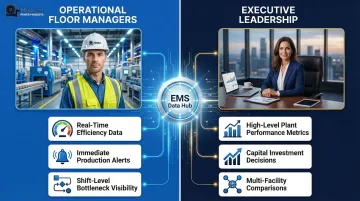
Quality EMS platforms deliver both views from the same underlying data.
Core Features of Effective Productivity Monitoring Software
Real-Time Production Dashboards
Quality EMS provides a live view of plant activity displayed on centralized dashboards accessible from any device. Managers can identify and respond to slowdowns the moment they occur rather than discovering losses after the shift ends.
For industrial laundry operations, real-time visibility reveals:
- When washers go idle unexpectedly
- When finishing throughput drops below target
- When material handling systems experience delays
- Current operator output and cycle completions
Automated Alerts and Notifications
Modern systems push alerts when operational thresholds are breached:
- Machine idle time exceeding acceptable limits
- Process efficiency falling below target percentages
- Production targets at risk of missing shift goals
- Equipment anomalies indicating potential failures
Softrol's LOIS (Laundry Operation Information System) delivers these alerts via email notifications and mobile dashboards, enabling managers to monitor multiple facilities remotely.
Historical Data and Trend Reporting
Reviewing performance over time identifies patterns and supports data-backed decisions:
- Shift-to-shift comparisons to identify when performance varies
- Weekly and monthly throughput trends
- Equipment utilization history to inform maintenance scheduling
- Operator productivity analysis to optimize staffing
This historical perspective helps managers distinguish between one-time anomalies and systemic issues requiring process changes.
Equipment-Level and Process-Level Tracking
Granular monitoring at both the individual machine level and broader process stage level is critical:
- Individual washers, dryers, and finishing equipment separately
- Broader process stages (soil sort, wash aisle, finishing, distribution)
- Material handling system performance
- Chemical consumption and resource utilization
This pinpoints exactly where bottlenecks occur instead of showing only aggregate plant performance.
Integration with Plant Controls and Equipment
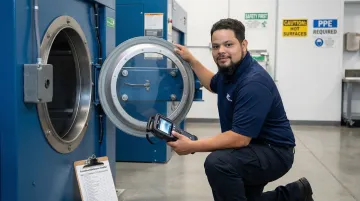
Capturing accurate data requires direct connection to plant systems. Leading productivity monitoring platforms connect directly to machine controls and chemical dispensing systems, capturing data automatically rather than relying on manual entry. This eliminates reporting errors, ensures data accuracy, and reduces the administrative burden on operators who would otherwise spend time logging information manually.
Remote Access Capability
Modern industrial operations often span multiple shifts and multiple facilities. Remote access enables managers to:
- Review plant data from outside the facility
- Receive alerts regardless of physical location
- Generate reports without being on the production floor
- Manage multi-plant operations from a centralized interface
This capability is particularly valuable for regional managers overseeing multiple facilities and executives who need visibility without constant site visits.
Key Benefits of Productivity Monitoring Software for Industrial Laundry Operations
Reduced Labor Costs
EMS data exposes exactly where labor hours are consumed inefficiently—overstaffing on low-volume shifts, underutilized operators during production gaps, or excessive time spent on manual tracking tasks.
This visibility lets managers align staffing with actual production demand rather than relying on historical assumptions.
Organizations using workforce analytics see measurable returns. According to Forrester's 2025 Total Economic Impact study on workforce analytics, companies achieved up to 10% reduction in employee attrition and 65% efficiency gains in business reporting.
For a composite organization of 5,000 employees, this contributed to a 3-year risk-adjusted Net Present Value of $5.95 million.
For laundry operations measuring productivity in Pounds Per Operator Hour (PPOH), even modest improvements translate directly to bottom-line savings. Identifying and eliminating just 30 minutes of unproductive time per operator per shift can add significant capacity without additional equipment investment.
Increased Plant Throughput and Uptime
Labor efficiency connects directly to equipment performance. Real-time monitoring and automated alerts reduce the time between a problem occurring and a manager responding. This minimizes unplanned downtime.
When a washer goes idle due to a loading delay, immediate notification allows quick intervention rather than discovering the issue an hour later during a floor walk.
Understanding machine utilization rates also enables proactive maintenance scheduling. Rather than waiting for equipment to fail, managers can schedule maintenance during planned downtime based on actual usage patterns captured by the EMS.
Data-Driven Operational Decisions
EMS replaces gut-feel management with objective data. Managers can use performance reports to:
- Justify capital investments with utilization data showing capacity constraints
- Restructure workflows based on actual bottleneck analysis
- Set realistic production targets backed by historical evidence
- Evaluate the ROI of process improvements with before-and-after comparisons
This data-driven approach reduces the risk of costly mistakes based on assumptions rather than facts.
Improved Management of Multi-Shift and Multi-Facility Operations
Centralized dashboards and remote access tools give plant managers and executives visibility across shifts and locations without needing to be physically present. Key advantages include:
- Consistent performance standards across the organization
- Early identification of facility-specific issues
- Fair performance comparisons between locations
- Rapid knowledge transfer of best practices from high-performing to underperforming sites
For organizations operating multiple facilities, this centralized visibility is essential for maintaining operational consistency and identifying opportunities for improvement.
How Productivity Monitoring Software Works in Practice
Data Collection Layer
EMS gathers information through multiple channels throughout the plant:
- Sensors on equipment monitoring machine status and cycle completion
- Machine control interfaces capturing operational parameters
- Operator input terminals recording production counts and job information
- Automated systems tracking material movement and resource consumption
These multiple data sources create a comprehensive view of plant operations, eliminating blind spots that single-point monitoring creates.
Data Processing and Analysis Layer
The EMS platform aggregates, normalizes, and analyzes raw plant data to generate meaningful metrics:
- Pieces per hour or pounds per hour throughput rates
- Equipment efficiency percentages based on actual runtime vs. available time
- Shift productivity scores comparing actual output to target
- Resource consumption rates per unit of production
Raw operational data becomes actionable intelligence—turning machine signals into management decisions.
Reporting and Action Layer
Once processed, data reaches decision-makers through multiple channels:
- Live dashboards displaying current plant status
- Automated alerts pushed via email or SMS when thresholds are breached
- Scheduled reports delivered daily, weekly, or monthly
- On-demand analysis tools to investigate downtime or quality issues
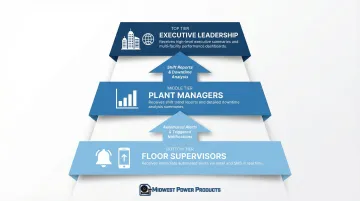
The right information reaches the right people at the right time: immediate alerts for floor supervisors, trend reports for plant managers, and executive summaries for leadership.
How to Choose the Right Productivity Monitoring Software for Your Facility
Assess Industry-Specific Functionality
Prioritize systems purpose-built for your operational environment rather than generic productivity tools. For laundry and textile services operations, evaluate whether the software understands:
- Laundry-specific workflows from soil sort through distribution
- Equipment types common in industrial laundry (tunnel washers, batch washers, finishing equipment)
- Production metrics relevant to the industry (PPOH, pieces per hour, utilization rates)
Softrol's Total Plant Management software is designed specifically for the textile services industry, capturing laundry-specific metrics like PPOH and utilization rates without extensive customization. This industry focus means the system tracks what matters most to laundry operations from day one.
Evaluate Integration Depth with Existing Equipment
EMS value depends heavily on how well it connects with the machines and controls already in your plant.
During vendor evaluation, assess:
- Whether the system can interface with your current wash aisle equipment
- Integration capabilities with chemical dispensing systems
- Compatibility with material handling infrastructure
- Whether implementation requires equipment replacement or works with existing machinery
Systems that require a complete technology overhaul create significant implementation costs and disruption. Look for solutions that can retrofit to existing equipment and capture data without replacing functional machinery.
Consider Scalability and Support
Assess vendor track record, post-installation support quality, and whether the system can scale to meet future needs:
- Can the system expand to additional facilities as your organization grows?
- Does the vendor provide 24/7 technical support for production environments that run around the clock?
- What is the vendor's history of system updates and feature enhancements?
- Are training and ongoing user support included in the implementation?
These factors often determine long-term ROI more than the initial purchase price.
A lower-cost system that requires extensive internal IT support or lacks scalability can become more expensive over time than a higher-priced solution with comprehensive vendor support.
Legal and Ethical Considerations When Implementing EMS
Employee Transparency and Consent
Regardless of whether EMS monitors machines or tracks operator-level productivity data, employees should be informed about what's being collected, why, how it will be used, and who has access.
Key transparency requirements include:
- What data is being collected
- Why it is being collected
- How it will be used
- Who has access to the data
This transparency protects the organization legally and builds the workforce trust needed for successful adoption. Deloitte's 2024 Human Capital Trends research that workforce turnover is nearly twice as high at companies using monitoring as surveillance compared to those that do not, highlighting the importance of transparent implementation.
Regulatory Compliance
Monitoring practices must comply with applicable labor laws and privacy regulations that vary by country, state, and industry. Non-compliance can result in significant fines, legal action, and workforce distrust.
Key considerations include:
United States: The Electronic Communications Privacy Act (ECPA) generally permits business-purpose monitoring, but states like New York, Connecticut, and Delaware require explicit notice to employees about monitoring practices.
European Union: GDPR requires strict lawful basis for monitoring (often "legitimate interest"), transparency about data collection, and Data Protection Impact Assessments for high-risk processing. In 2023, the French regulator CNIL fined Amazon France Logistique €32 million for excessive monitoring of scanner inactivity and speed.
Employers should consult legal counsel when deploying systems that capture individual-level performance data, particularly in jurisdictions with strict employee privacy protections.
Compliance is not optional—it's essential for avoiding costly legal action and maintaining workforce trust.
Frequently Asked Questions
What is productivity monitoring software?
Productivity monitoring software collects and analyzes performance data from machines, processes, or personnel to help managers identify inefficiencies and drive improvements. Industrial systems focus on equipment utilization and process efficiency rather than computer activity.
Is it illegal for employers to use employee monitoring software?
Employee monitoring is generally legal on company-owned systems with legitimate business purposes, but legality varies by jurisdiction. Employers should inform employees of monitoring practices and consult legal counsel to ensure compliance with applicable laws.
How does productivity monitoring software improve laundry plant efficiency?
EMS surfaces real-time data on machine utilization, throughput rates, and process bottlenecks. This allows managers to respond faster to slowdowns, schedule proactive maintenance, and optimize staffing based on actual performance data rather than assumptions.
What types of data does productivity monitoring software track in industrial operations?
Common data points include equipment uptime and utilization rates, pieces or pounds processed per shift, cycle times for individual machines, operator productivity metrics, chemical or resource consumption, and material handling system performance.
Can productivity monitoring software integrate with existing laundry equipment and controls?
Industrial EMS systems interface directly with existing machine controls and plant infrastructure, minimizing disruption during implementation. Buyers should confirm compatibility with their specific equipment to avoid costly retrofits or equipment replacement.
What is the difference between productivity monitoring software and a total plant management system?
Productivity monitoring software typically focuses on measuring and reporting performance data. A total plant management system integrates monitoring with control functions, material handling coordination, and operational management across the entire facility—providing a more comprehensive operational platform beyond just performance measurement.