Introduction
Industrial laundries, healthcare facilities, and uniform rental operations face a common challenge: RFID asset tracking promises substantial efficiency gains, but organizations struggle to pin down total costs. Expenses include hardware, software, installation, and ongoing maintenance, making accurate budgeting difficult.
A passive UHF tag might cost $0.50, but reader infrastructure, middleware licensing, and system integration can push total deployment costs into six figures.
Despite the complexity, organizations across textile services, healthcare linen management, and warehouse operations are adopting RFID at scale. ROI varies significantly based on asset volume, facility size, and loss rates.
This article breaks down implementation costs, compares active vs. passive RFID systems, identifies hidden ongoing expenses, and shows how to calculate payback period. We focus specifically on textile and laundry environments, where every untracked garment translates directly to revenue loss.
Key Takeaways
- Passive tags cost $0.10–$10 each, but reader infrastructure drive total costs higher than tag expenses
- System costs span readers, antennas, integration software, installation labor, and annual support—far beyond tags alone
- Most operations achieve payback within 18–36 months through labor reduction and shrinkage control
- Laundry operations see clear ROI by eliminating replacement costs, delivery errors, and customer disputes
- Integration with management software transforms tracking data into actionable operational intelligence
The Full RFID Asset Tracking Cost Breakdown
Four cost categories define a complete RFID system: tags, reader hardware, software, and deployment services. Most organizations budget for tags alone, then face unexpected costs when they discover the full infrastructure required. Understanding each component prevents budget surprises and enables realistic ROI planning.
RFID Tag Costs
Passive UHF tags form the foundation of most laundry RFID deployments. Standard UHF passive tags run $0.05–$0.50 each in bulk, with individual catalog prices around $0.06–$0.09 per unit. Volume significantly impacts per-tag economics: quantities of 1,000 may cost $0.15–$0.25 each, while orders of 100,000+ can drop to $0.05–$0.10.
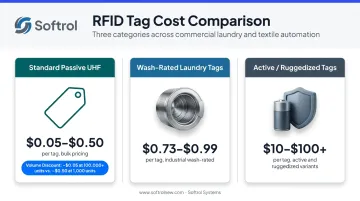
Laundry and industrial environments demand specialized tags. Wash-rated laundry tags cost $0.73–$0.99 and are marketed for 200+ industrial wash cycles, withstanding high heat, moisture, and chemical exposure. Ruggedized or metal-mount passive tags range from $1.00–$10.00+ depending on encapsulation and environmental rating.
Active RFID tags—battery-powered beacons that transmit signals over long distances—start around $10 and can exceed $100 depending on range, sensor features, and form factor. Active tags suit high-value assets requiring real-time location across large facilities, but their economics rarely justify use for high-volume textile tracking.
Reader and Hardware Costs
Passive RFID systems require denser reader infrastructure than active systems. Fixed UHF readers range from $256–$3,816, with mainstream industrial readers typically exceeding $1,500.
Antennas cost $78–$673.50 each, and most fixed readers require 2–4 antennas to cover entry/exit chokepoints or conveyor zones.
Handheld RFID readers run $541–$4,431, with rugged models designed for daily plant use typically exceeding $2,000. Supporting infrastructure adds cost: PoE switches (for powering readers over Ethernet), cabling, reader mounts, and network integration hardware rarely appear in initial hardware quotes.
Active RFID systems reduce reader density but shift cost to the tags. Fewer fixed readers are needed because battery-powered tags transmit over longer distances—often configured around 100 meters to balance range and battery life.
Software Costs
Beyond hardware, software transforms raw tag reads into actionable tracking data. RFID software ranges from basic tag-reading applications to enterprise platforms connecting tracking data to ERP and plant management systems.
Software costs break down across three tiers:
- Entry-level SaaS platforms: Starting at $49/month (e.g., Asset Vue Lite) for basic tracking
- One-time software packages: $499–$1,999 (e.g., TagMatiks) for standalone installations
- Enterprise warehouse systems: $10,000–$100,000 for software licenses
- Middleware and integration: $5,000–$50,000 annually for connecting RFID data to existing systems
- Cloud hosting: $1,000–$10,000 per month for enterprise deployments
Laundry operations integrating RFID with plant management systems should model annual software maintenance at 15–20% of license cost. Softrol's Total Plant Management system, for example, integrates RFID tracking data with production workflows to provide unified visibility across the entire operation.
Installation and Deployment Costs
RFID implementation requires services beyond hardware and software purchases.
Site surveys and RF analysis ensure readers are positioned to avoid interference and maximize read rates—though specific cost benchmarks vary by integrator. Reader installation, calibration labor, and network configuration typically represent significant project costs.
System integration with existing software—such as connecting RFID tracking data to laundry plant management or ERP systems—can range from $10,000–$100,000 depending on the complexity of data flows and middleware requirements. Staff training is often underestimated, as operators, supervisors, and IT staff all require hands-on instruction.
Passive RFID installations demand more tuning and calibration than active systems, as read zones must be precisely defined to avoid stray reads or missed tags. Pilot deployments covering one dock, door, or process typically cost $15,000–$50,000 and allow organizations to validate ROI assumptions before committing to full-scale deployment.
Active vs. Passive RFID: How Tag Choice Shapes Your Budget
The fundamental cost tradeoff in RFID systems is straightforward. Passive RFID systems have low per-tag costs but require expensive, dense reader infrastructure, while active RFID systems have high tag costs but need fewer, less expensive readers.
| Attribute | Passive UHF | Active RFID | Semi-Passive (BAP) |
|---|---|---|---|
| Tag Cost | $0.05–$10 | $10–$100+ | $2–$10 per tag |
| Read Range | 5–30 feet typical | Up to 100+ meters | Extended passive range |
| Battery | None | 2–7 year lifecycle | Supports sensors/memory |
| Infrastructure Cost | High (dense readers) | Lower (fewer readers) | Moderate |
| Best Use Case | High-volume textiles, portals | Real-time location, yards | Cold chain, sensors |
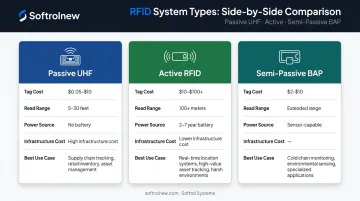
Understanding these differences is critical when planning infrastructure. Passive UHF tags read at roughly 5–30 feet in typical conditions, requiring fixed or handheld readers at every chokepoint: conveyor entries, sort stations, delivery dock doors, and stockroom gates.
This reader density drives infrastructure costs well beyond tag expenses.
Active RFID tags can be read from hundreds of meters but are often configured around 100 meters to conserve battery. Fewer readers cover larger zones, reducing initial infrastructure investment.
However, battery lifecycle management becomes an ongoing operational cost. Active tags suit high-value mobile assets—carts, containers, or equipment—where real-time location justifies the premium.
Semi-passive (battery-assisted passive) tags offer a middle option. They use battery power to extend read range or support sensors (temperature, shock, tamper) while relying on reader activation for communication.
Semi-passive tags are relevant for pharmaceutical tracking, cold chain monitoring, or high-value asset protection but are rarely cost-effective for textile volume tracking.
When each type makes financial sense:
- High-volume, moderate-value assets tracked at defined chokepoints (garments, linens, uniforms, totes) work best with passive tags
- High-value assets requiring real-time location across open facilities (mobile carts, containers, tooling) justify active tags
- Assets requiring environmental monitoring or tamper evidence (pharmaceuticals, specialty inventory) benefit from semi-passive tags
Hidden and Ongoing Costs to Budget For
RFID project proposals often exclude recurring costs, creating budget surprises in year two. Annual software maintenance typically runs 15–20% of the initial license cost, while hardware support contracts add 10–15% of hardware cost per year. For a $50,000 software license and $100,000 hardware deployment, expect $7,500–$10,000 in annual software support and $10,000–$15,000 in hardware warranty renewals.
Beyond software and hardware support, active tag battery replacement represents both direct cost and labor. Battery lifecycles range from 2–7 years depending on transmission frequency, environmental conditions, and battery quality.
At scale, battery service can dominate operational labor: tracking which tags need replacement, managing field service visits, and updating system records.
Tag replenishment budgets vary from $2,000–$50,000 annually depending on volume, tag durability, and replacement cycles. Cheap passive tags may appear cost-effective upfront but create hidden expenses.
Poor-quality tags lead to:
- Inconsistent read rates requiring manual intervention
- Short lifespans in demanding environments (heat, moisture, chemicals)
- Accelerated replacement cycles that compound costs
- Limited vendor support when issues arise
- Rework that negates apparent savings
Cloud hosting fees are material for enterprise deployments. Warehouse RFID platforms can run $1,000–$10,000 per month for cloud infrastructure, particularly when supporting multi-site access, real-time dashboards, and historical data retention.
How to Calculate Your RFID Asset Tracking ROI
Use this framework to quantify RFID return on investment:
(Annual savings from RFID − Annual system cost) ÷ Total investment = ROI %
Before running the calculation, measure each savings category specific to your operation.
Labor and Operational Savings
RFID reduces manual counting, receiving verification time, and inventory audit labor. While vendor sources claim dramatic improvements, focus on documented accuracy gains.
GS1/Auburn Project Zipper found inventory accuracy rising from 63% to 95% and order accuracy of 99.9% with EPC/RFID versus 31% accuracy under barcode-only processes, based on data from 8 brand owners and 5 retailers.
Labor savings come from eliminating manual steps:
- Receiving time reduction through automated bulk reading at dock doors
- Inventory count acceleration—handheld readers capture hundreds of tags in seconds versus manual visual counting
- Sort station automation reducing labor per garment processed
- Delivery verification without manual manifest checking
To calculate your savings, start by tracking current labor hours for these tasks. Apply conservative reduction estimates of 30–50% in counting and audit time, then multiply by your hourly labor cost for annual savings.
Shrinkage and Loss Reduction
Asset shrinkage represents direct financial loss, particularly in high-volume textile environments.
TRSA states merchandise expenditures can represent up to 25% of annual textile service costs, making loss control a primary ROI lever.
Quantify annual shrinkage using these steps:
- Calculate your current loss rate (percentage of inventory lost, stolen, or misrouted annually)
- Multiply by unit replacement cost and total inventory volume
- Compare against RFID system cost and expected loss rate reduction
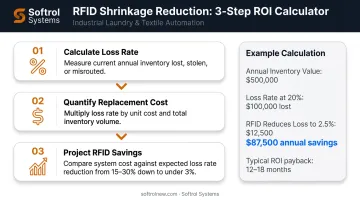
Industry examples suggest loss rates dropping significantly with RFID—vendor sources cite reductions from 15–30% loss to under 3%—but validate against your own baseline loss data before projecting ROI.
Payback Period and Timeline
Most operations achieve RFID ROI within 18–36 months, with larger and more asset-intensive operations often reaching payback faster. Textile operations with high replacement costs, frequent customer disputes from delivery errors, or significant labor devoted to manual inventory reconciliation see faster returns.
Pilot programs covering one zone or door typically cost $15,000–$50,000 and allow validation of ROI assumptions before full deployment. Piloting one process—such as a single conveyor exit point or delivery dock—reduces financial risk and provides real operational data for ROI modeling.
RFID Asset Tracking in Textile and Laundry Operations
Industrial laundries and textile services face a unique ROI case: garments, linens, and uniforms cycle continuously between facilities and customer locations, making shrinkage, loss, and mis-routing directly measurable costs. Every untracked piece represents replacement expense, potential customer dispute, and operational inefficiency.
RFID enables each item to be tracked from induction through sorting to delivery and return.
RFID tags designed for laundry environments withstand 200+ industrial wash cycles, enduring high temperatures, moisture, and chemical exposure that would destroy standard labels. Fixed readers at conveyor entry/exit points and sort stations capture movement data automatically, replacing manual counts and visual audits. Operators no longer hand-count carts or manually verify delivery manifests—the system reads tags in bulk as items pass through reader zones.
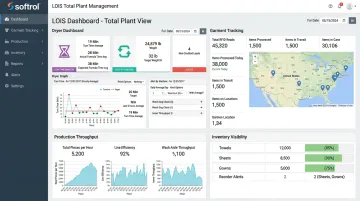
This tracking capability becomes even more powerful when integrated with plant management software. When garment tracking data flows into a centralized system, operations managers gain real-time visibility into production throughput, sort accuracy, and inventory levels.
Platforms like Softrol's Total Plant Management and LOIS (Laundry Operation Information System) connect tracking data to plant-wide performance visibility, helping laundry operators move from reactive management to data-driven decisions.
Measurable outcomes laundry operations should target in their ROI calculation:
- Reduction in linen replacement purchases – track annual replacement spend before and after RFID; quantify savings from reduced loss and extended usable lifecycle
- Improved sort accuracy rates – measure mis-sort frequency and rework labor; calculate time saved per shift
- Reduction in customer complaints from delivery errors – quantify dispute resolution labor and potential revenue impact from service failures
- Labor hours saved in manual inventory reconciliation – track weekly or monthly hours devoted to physical counts and manual data entry before RFID; measure reduction post-deployment
The RFID market is projected to reach $40.9 billion by 2032 from $15.8 billion in 2023, driven largely by adoption in logistics, healthcare, and textile services.
For laundry operators, the question is not whether RFID works—it's whether the measurable savings from loss control, labor reduction, and accuracy improvement justify the investment in your specific operation.
Frequently Asked Questions
How much does RFID asset tracking cost?
Small RFID deployments typically run $50,000–$150,000, while large enterprise implementations range from $350,000–$1M+, covering tags, readers, software, and installation. Per-tag costs range from under $1 for passive UHF labels to $10–$100 for active beacon tags.
Can RFID be used for asset tracking?
Yes, RFID is one of the most widely adopted technologies for asset tracking across industries—healthcare, warehousing, retail, and textile services. Tags and readers automatically identify, locate, and log asset movement without line-of-sight scanning, enabling bulk reads and real-time visibility that barcode systems cannot match.
What is the typical ROI payback period for RFID asset tracking?
Most operations recover their RFID investment within 18–36 months, driven by labor savings, inventory accuracy improvements, and reduced asset loss. Asset-intensive industries like industrial laundry often see faster payback due to high garment replacement costs and the direct revenue impact of delivery accuracy.
What is the cost difference between passive and active RFID tags?
Passive tags typically cost $0.10–$10 each depending on ruggedness, while active tags range from $10–$100+. However, passive systems require more expensive, denser reader infrastructure, while active systems offset higher tag costs with simpler, less costly reader setups. The total system cost tradeoff depends on asset volume, facility size, and tracking requirements.
What ongoing costs should I expect after RFID implementation?
Annual software maintenance runs 15–20% of license cost, hardware support contracts add 10–15%, and tag replenishment ranges from $2,000–$50,000 annually. Active tag battery replacement and periodic tag refresh cycles also contribute. Include these recurring costs in your ROI model from the start.
Is RFID asset tracking worth it for smaller operations?
Smaller operations can validate ROI through a phased approach—starting with a pilot covering one zone or workflow, typically $15,000–$50,000. The case is strongest for high-value, frequently moved, or shrinkage-prone assets. Measure baseline loss rate, labor hours, and error frequency before deployment.