Introduction
Labor shortages, rising utility costs, and higher throughput demands are squeezing industrial laundries and textile service operations from every direction. Many plant managers struggle with equipment that almost fits their workflow, but not quite.
"Custom material handling" gets thrown around as a buzzword in trade publications. Its real value shows up somewhere less glamorous: fewer jammed rails, safer carts, and a production report that matches what actually happened on the floor.
This article breaks down the measurable benefits of custom-engineered systems versus generic equipment, using operational outcomes plant managers already track daily.
Key Takeaways
- Custom systems fit your product mix and volume, not a generic spec sheet
- Throughput, labor cost, and safety metrics improve when equipment matches real workflow
- Generic equipment creates hidden costs: damage, downtime, and wasted floor space
- Real-time data visibility compounds the gains from custom-built equipment
- High-volume sorters and irregular-load laundries see the strongest ROI
What Is Custom Material Handling?
Custom material handling means equipment, rail and conveyor systems, sorting technology, and software configured for a specific facility's product mix, volume, and physical footprint. It's not a modified version pulled from a generic catalog.
For textile services, this typically looks like:
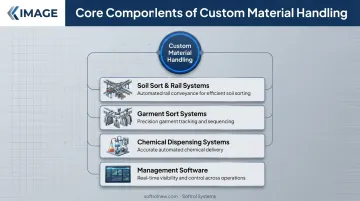
- Soil sort and rail systems built around actual sling volume and washer sequencing
- Garment sort systems sized to daily piece counts, not a standard throughput tier
- Chemical dispensing systems configured for the formulas a plant actually runs
- Management software that reflects the shifts, product lines, and reporting structure already in place
You'll find custom-engineered handling most often in industrial laundries, uniform and linen services, healthcare and hospitality laundry operations, and manufacturing plants dealing with atypical loads or tight floor space. The equipment is secondary to the outcome it produces: efficiency, safety, and cost control that hold up under daily production volume.
Key Advantages of Custom Material Handling Solutions
The advantages below tie directly to metrics most facilities already track weekly: throughput, labor cost per unit, error rates, and uptime. None of this is abstract. It shows up on the production report.
Increased Operational Efficiency and Throughput
Custom-built rail systems, sorters, and carts are sized to match your actual product flow. Generic equipment, sized for a hypothetical "average" plant, creates mismatches that slow everything down: bottlenecks at transfer points, carts that hold too little or too much, and manual re-handling that eats labor hours.
A properly configured system reduces touches per item and increases units moved per trip. Softrol's Rail Automated Material Handling System, for example, is built to move up to 13,500 pounds per hour using melonited round rail technology, with automatic sequencing into continuous batch washers so loads don't sit waiting for a manual handoff.
On the sorting side, garment sort systems configured to actual daily piece counts change the math entirely. Softrol's AutoSort system processes up to 3,800 garments per hour, scaling to daily capacities between 5,000 and 50,000 garments depending on configuration. Those numbers only mean something when they're matched to a plant's real volume rather than a catalog tier.
Why this matters: Fewer bottlenecks and fewer manual touches mean faster order fulfillment. Labor pressure is already the top driver of automation investment: in a 2023 American Laundry News reader survey, 60% of respondents cited labor as their leading reason to automate, well ahead of cost or general efficiency gains.
KPIs impacted:
- Throughput rate and cycle time
- Units processed per labor hour
- Space utilization on the plant floor
This advantage is highest where SKU or product variability is high, floor layouts are tight, or seasonal volume swings hit hard. Healthcare and uniform rental operations feel this the most, since turnaround windows leave little room for equipment that fights the workflow instead of supporting it.
Reduced Labor Costs and Improved Worker Safety
Custom equipment is designed around specific tasks, not generalized ones. That distinction matters more than it sounds.
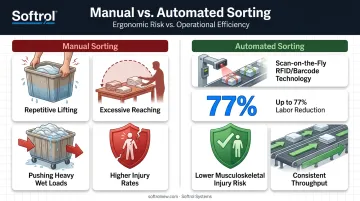
Manual laundry handling carries documented ergonomic risk. OSHA's hospital laundry guidance identifies excessive pushing, reaching, and lifting wet, heavy loads as direct causes of back and shoulder musculoskeletal disorders. Recommended controls include low-resistance cart wheels, waist-to-chest handle height, and automatic dumping (the exact kind of design work that gets skipped when equipment is bought off a generic spec sheet).
Automation removes many of these physical demands entirely. Softrol's AutoSort system, for instance, is documented to cut sorting labor by up to 77% compared to manual sorting, using scan-on-the-fly RFID and barcode technology so workers aren't manually routing individual garments.
Chemical dispensing systems in the Catalyst line automate volumetric injection, removing the need for staff to measure or pour chemicals by hand, a task with both ergonomic and exposure risk.
Fewer manual handling steps translates into:
- Lower injury risk, particularly for repetitive strain and lifting-related MSDs
- Reduced overtime from short-staffed shifts
- Lower turnover in physically demanding roles
KPIs impacted:
- Labor cost per unit processed
- Injury and incident rate
- Absenteeism
- Turnover
Multi-shift, labor-intensive environments see the biggest payoff here, where physical demand and headcount pressure compound each other daily.
Better Visibility, Control, and Scalability
Custom systems integrate with plant management software to expose real-time data most generic equipment simply can't produce. That's the difference between reacting to a problem and catching it early.
Softrol's Total Plant Management platform pulls data from multiple production points simultaneously, tracking machine utilization, operator productivity, and throughput against capacity from a single entry point. Paired with LOIS (Laundry Operation Information System), managers get real-time alerts sent directly to email and can monitor multiple sites from one account.
For rail systems specifically, LOIS Rail's Pan-N-Zoom technology lets operators view the entire rail layout to scale and zoom into individual components to check I/O status and system health.
Why this matters: Real-time visibility replaces reactive firefighting with data-backed decisions on staffing and maintenance. Managers overseeing multiple shifts or locations no longer need to walk the floor to know what's happening on it.
KPIs impacted:
- Equipment uptime
- Mean time to detect and resolve issues
- Ability to scale operations without adding proportional oversight labor
Multi-location operators and fast-growing chains benefit most, since scaling shouldn't require a proportional increase in oversight headcount.
What Happens When Custom Solutions Are Missing or Ignored
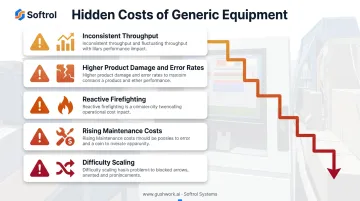
Generic, one-size-fits-all equipment doesn't fail immediately. It fails slowly, in ways that are easy to write off as normal operating friction until the costs add up.
Common consequences include:
- Inconsistent throughput from equipment mismatched to actual load types or volumes
- Higher product damage and error rates, especially when post-sort mixing forces lighter textiles through wash formulas meant for heavier soils
- Reactive firefighting, where staff build workarounds instead of trusting the equipment
- Rising maintenance costs as generic equipment wears down faster under non-standard use
- Difficulty scaling without integrated data to support oversight
The chemistry side illustrates this well.
A TRSA healthcare textile report found one central laundry achieved up to 20% lower textile-replacement costs after improving wash formulas and process controls tied to better sorting practices.
Poor equipment fit shortens textile life while slowing overall throughput.
How to Get the Most Value from Custom Material Handling Solutions
Custom equipment delivers the most value when it starts with an actual site assessment, not a product catalog conversation. An experienced provider evaluates real layout, volume, and workflow before designing anything.
A few practices separate facilities that see lasting ROI from those that don't:
- Start with a workflow assessment, not a purchase order. Layout, peak volume, and product mix should drive the design, not the reverse.
- Review outcomes against KPIs regularly — throughput, labor cost per unit, and uptime — rather than treating installation as a one-time event.
- Pair equipment with data visibility. Softrol's approach combines custom rail, sort, and chemical systems with Total Plant Management and LOIS, so plant managers see the results continuously instead of discovering problems weeks later.
These practices point to a single idea: custom material handling performs best when it's managed as an ongoing operational process, revisited and adjusted as your facility's volume and layout evolve.
Conclusion
The value of custom material handling comes down to matching equipment to operational reality: your actual volume, layout, and product mix. That precision tightens control and consistency, while cutting the safety risks generic equipment can't address.
These gains compound over time, especially when custom equipment is paired with data visibility tools like Softrol's LOIS platform and regular performance reviews rather than left untouched after installation.
Treat custom material handling as an ongoing strategy rather than a single purchase, and the returns keep showing up long after the install crew leaves.
Frequently Asked Questions
What are the benefits of custom material handling solutions?
Key benefits include higher throughput, lower labor and injury-related costs, reduced product damage, and better scalability compared to generic equipment. The gains show up directly in daily production and labor reports.
What are the 4 types of material handling equipment?
The four common categories are storage and handling equipment, engineered systems (like rails and conveyors), industrial trucks, and bulk material handling equipment. In textile services, engineered systems and storage equipment matter most.
What are the four objectives of material handling?
The core objectives are improving efficiency and throughput, protecting worker safety, reducing handling and life-cycle costs, and optimizing space and capacity. Every custom design decision should map back to one of these.
What are the 10 principles of material handling?
These are ten established design principles: planning, standardization, work design, ergonomics, unit load, space utilization, system integration, automation, environmental responsibility, and life-cycle cost. They guide equipment design without pushing customization for its own sake.
How is custom material handling equipment different from standard equipment?
Engineers design custom equipment around a facility's specific load types, dimensions, and workflow. Standard equipment serves general-purpose use, often requiring workarounds to fit a unique operation.
Is investing in custom material handling worth the cost?
Upfront costs run higher than off-the-shelf equipment. However, the long-term ROI from reduced damage, lower labor costs, and improved throughput typically outweighs that initial investment for facilities with unique operational needs.