So teams improvise. They build spreadsheets to patch gaps. They hire people to manually re-enter data between disconnected systems. They accept inefficiencies as "just how things work."
Industry-specific custom software flips that script. Instead of forcing your operations to bend around a generic tool, the software gets built around your exact processes, compliance requirements, and performance targets.
This guide covers which industries benefit most, what separates good custom software from mediocre custom software, what the development process actually looks like, and how to pick a partner who won't disappear after the invoice clears.
Key Takeaways
- Off-the-shelf software forces workarounds that drain time, budget, and accuracy
- Healthcare, manufacturing, textile services, logistics, and finance share complexity that favors custom software
- The best solutions blend automation and real-time visibility with your existing equipment
- Discovery and partner selection matter more than the coding itself
- Total cost of ownership, not sticker price, determines whether custom software pays off
Why Generic Software Falls Short for Specialized Industries
Off-the-shelf software is built for the widest possible audience. That's the whole business model: one product, sold to thousands of companies, covering the workflows most businesses share.
The problem is that "most businesses" doesn't include yours if you're managing wash-aisle chemical dosing, tracking pounds-per-operator-hour on a plant floor, or sequencing production across a dozen SKUs with wildly different specs. Generic tools handle the common 80%. The remaining 20% (the part that actually differentiates your operation) gets left to manual workarounds.
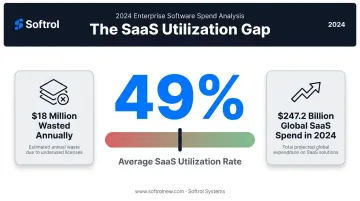
Those workarounds aren't free. Zylo's 2024 SaaS Management Index, based on more than 30 million licenses and $34 billion in managed spend, found that the average organization wastes $18 million annually in unused software licenses. Utilization across the average SaaS portfolio sits at just 49%. That gap signals a deeper problem: tools that don't quite fit, no matter the company's size.
The scaling problem compounds this. As operations grow, generic SaaS platforms hit functional ceilings. You add another module, another integration, another workaround, and licensing costs climb along with it.
Gartner forecast worldwide SaaS spending to reach $247.2 billion in 2024, a 20% jump from the prior year. That growth reflects businesses paying more for tools that still don't do what they actually need.
Custom software flips the cost curve. Upfront development costs more than a subscription. But over time:
- No recurring per-seat licensing fees that grow every year
- Fewer manual labor hours spent bridging system gaps
- Fewer costly errors from re-entering data across disconnected tools
- Software that scales with new facilities or product lines instead of against them
There's a competitive angle too. When your software encodes proprietary workflows your competitors can't access, you gain capabilities they cannot replicate on the same generic platform everyone else uses.
Industries That Benefit Most from Custom Software Development
Certain industries share a profile: complex regulatory requirements, high-volume operations, specialized equipment, and workflows that shift based on customer or production variables. That combination makes them poor fits for generic software and strong candidates for purpose-built solutions.
Healthcare
Healthcare software has to handle HIPAA compliance, EHR interoperability, and the connective tissue between billing, clinical records, and patient scheduling. That integration has to work natively, not as a bolt-on afterthought. Adoption of certified EHRs is nearly universal, but that doesn't mean systems actually talk to each other well.
Top use cases include:
- EHR systems built for specific care settings
- Patient portals with integrated scheduling
- Automated billing and claims processing
- Hospital and clinic management platforms
Manufacturing & Industrial Operations
High-mix, low-volume production, unpredictable supply chains, and IoT-connected equipment all demand software that understands production logic, not a generic project management tool repurposed for the plant floor.
That mismatch shows up most clearly in downtime economics, which vary sharply by sector. Siemens' 2024 study of 181 maintenance and engineering professionals found downtime costing $2.3 million per hour in large automotive plants, compared to roughly $36,000 per hour in FMCG facilities. Predictive maintenance tied into custom monitoring software showed potential to cut unplanned downtime by up to 50%.
Common applications include:
- Predictive maintenance dashboards tied to IoT sensor data
- Production scheduling that adapts to real-time supply changes
- Equipment monitoring systems that flag failures before they cause downtime
- Quality control tracking across high-mix production runs
Textile Services & Industrial Laundry
Industrial laundries run on a layer of complexity most software vendors have never seen up close: wash-aisle controls, chemical dispensing calibration, garment sortation logic, and real-time performance data spread across multiple production lines. A generic ERP has no concept of pounds-per-operator-hour or continuous batch washer sequencing.
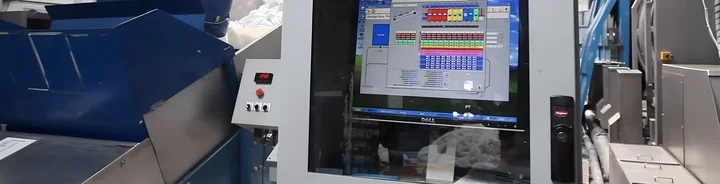
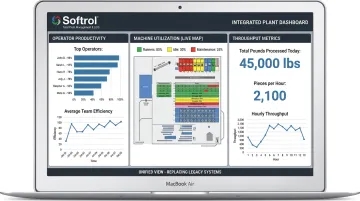
Softrol Systems has spent over 35 years building software specifically for this gap. Its Total Plant Management software and LOIS (Laundry Operation Information System) give plant managers a single integrated view of material handling, process control, and plant performance data, pulling operator productivity, machine utilization, and throughput into one dashboard instead of five disconnected ones.
Logistics & Transportation
Route optimization, fleet management, live shipment tracking, and warehouse automation generate data flows too specific and too time-sensitive for generic tools. McKinsey estimated that blind handoffs across mid- and last-mile logistics waste $45 billion to $66 billion annually in B2B operations alone, with digitization capable of cutting that waste by up to 40%. Custom platforms unify routing, tracking, and compliance documentation into one operational system instead of three separate logins.
Finance & Professional Services
Finance needs speed and airtight security at the same time. Fraud detection, compliance automation, and transaction analysis all have to be built around specific regulatory frameworks, such as FCA rules in the UK or GDPR across Europe. A generic accounting package was never designed to satisfy those requirements out of the box.
Key Features of Effective Industry-Specific Custom Software
Not all custom software delivers the same value. The best industry-specific solutions share a handful of capabilities that separate transformative systems from those that only marginally improve on what came before.
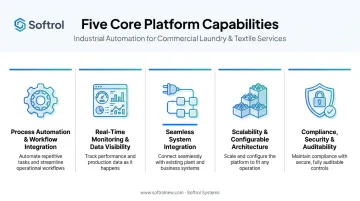
Process Automation and Workflow Integration
Purpose-built automation eliminates manual data entry and connects software directly to the equipment already running your operation. In an industrial laundry setting, for example, chemical dispensing systems using flow-meter-based injection technology eliminate manual dosing calculations entirely, feeding delivery data straight into plant reports.
Real-Time Monitoring and Data Visibility
Live dashboards matter most when you can't physically stand on the floor. Multi-site operations need automated alerts for anomalies and historical data for trend analysis, not a weekly export someone has to remember to run.
Seamless Integration with Existing Systems
Good custom software doesn't demand you rip out legacy infrastructure. It should integrate with:
- Existing ERP and MES platforms
- IoT-connected sensors and equipment controls
- Third-party APIs already in use
This preserves the capital you've already invested while extending what that equipment can actually do.
Scalability and Configurable Architecture
Scalable custom software is modular. Adding a new facility, product line, or metering point shouldn't require rebuilding the core system. It should mean plugging in another module instead. Contrast that with off-the-shelf software, where growth often forces an expensive platform migration.
Compliance, Security, and Auditability
Industries under strict regulatory frameworks (healthcare, finance, food processing, chemical-handling operations) need compliance built in from the start. That means role-based access controls, audit trails, and documented data security protocols, not features added after a near-miss.
The Custom Software Development Process: What to Expect
Custom software doesn't start with code. It starts with understanding.
Discovery and Requirements Analysis
Effective development begins with detailed, often on-site consultation. This phase includes:
- Mapping existing workflows to understand daily operations
- Identifying bottlenecks that limit throughput or efficiency
- Defining compliance requirements specific to your industry
- Establishing measurable performance goals for the new system
Skip this step, and you get software that technically works but doesn't fit: the exact problem you were trying to solve in the first place.
Design, Development, and Iterative Testing
Once requirements are locked, development proceeds in structured phases with prototypes reviewed by the people who'll actually use the system daily. Testing needs to happen under real-world conditions, including equipment integration, edge cases, and peak load, not just a clean sandbox environment that never encounters a jammed conveyor or a chemical delivery failure.
Implementation, Training, and Ongoing Support
Deployment isn't the finish line. Successful rollouts include staff training, phased implementation to minimize disruption, and a defined support structure for updates after launch. This matters most in industrial environments, where downtime translates directly into lost production dollars, not just an inconvenience.
How to Choose the Right Industry-Specific Software Partner
Domain expertise in your specific industry outweighs general software development skill as the top qualification.
A partner who has already worked in your sector understands regulatory constraints, operational limits, and the language of your workflows — without needing a crash course first. That knowledge shows up in fewer scoping mistakes and faster time to value.
Beyond expertise, look for a partnership approach rather than a transactional one:
- Time invested understanding your business culture before proposing solutions
- Regular milestone reviews that keep communication open from kickoff through delivery
- Ongoing support after installation, including troubleshooting and system updates
Softrol Systems follows this model, staying engaged with customers from initial consultation through long-term operational partnership.
Finally, check the track record:
- Request verifiable case studies from comparable projects
- Look for long-standing customer relationships spanning multiple years
- Ask for references from companies operating at a similar scale and complexity
A vendor with 35 years in one industry has seen problems a generalist firm hasn't encountered yet.
Frequently Asked Questions
Which type of software is designed for a particular task or industry?
Industry-specific or vertical software centers on the unique workflows, compliance requirements, and operational realities of a particular sector, rather than serving a broad, general audience.
What are examples of custom software?
Examples include EHR systems in healthcare, wash-aisle control and Total Plant Management software in textile services, predictive maintenance platforms in manufacturing, and fraud detection systems in finance.
How much does custom software development cost in 2026?
Costs range widely by complexity: simple internal tools can run under $30,000, while enterprise-grade platforms often exceed $200,000 and take 12-24 months. Total cost of ownership frequently favors custom builds over compounding SaaS fees at scale.
How long does it take to develop industry-specific custom software?
Straightforward internal tools may take 3-6 months. Fully integrated industrial automation or enterprise-grade platforms can take 12 months or longer, depending on integration complexity and rollout scope.
Can custom software integrate with existing industrial equipment and legacy systems?
Yes. Modern custom software integrates with existing ERP systems, IoT-connected equipment, legacy machinery controls, and third-party APIs, preserving your existing infrastructure investment instead of replacing it.
What is an example of a software package used in industrial operations?
Softrol's Total Plant Management system and LOIS (Laundry Operation Information System) unify material handling, process control, and plant performance data into a single operational platform for industrial laundry facilities.