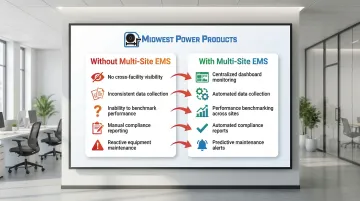
Multi-site energy management systems address these challenges by centralizing monitoring and control across dispersed facilities. Organizations face practical obstacles: buildings with different HVAC systems, inconsistent data collection methods, aging building automation systems that don't communicate, and the complexity of rolling out improvements across dozens or hundreds of locations simultaneously.
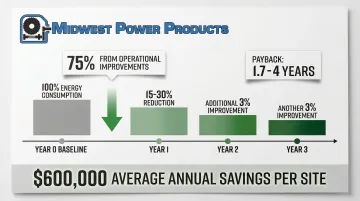
The business case for addressing these challenges is compelling. Organizations implementing multi-site ISO 50001 energy management standards achieve average annual savings of $600,000 per site, with energy performance improvements of 5% year over year. These aren't theoretical projections—they're verified results from organizations that have implemented structured energy management across multiple facilities.
TL;DR
- Multi-site EMS platforms centralize energy monitoring across facilities with single-dashboard visibility
- Successful implementations require 12-24 months baseline data, executive sponsorship, and infrastructure assessments
- Phased rollout: audit, select technology, pilot at 1-2 sites for 90-120 days, then scale systematically
- Organizations achieve 15-30% energy savings with 2-4 year payback periods, 75% from operational changes
- Best practices: standardize equipment, benchmark cross-site, automate alerts, integrate with procurement
When Should You Use a Multi-Site Energy Management System?
Multi-site EMS becomes economically justified when organizations operate three or more facilities with combined annual energy spending exceeding $500,000.
At this threshold, the platform costs—typically $2-8 per square foot for implementation plus $0.10-0.30 per square foot annually for software—deliver measurable returns through reduced consumption, improved operational efficiency, and avoided equipment failures.
The strongest business case emerges when organizations lack comparative visibility across locations. If you can't answer questions like "Which of our facilities consumes the most energy per square foot?" or "Why does our Phoenix location use 40% more energy than our similarly-sized Dallas facility?" you're operating blind. Multi-site EMS provides the normalized benchmarking data needed to identify outliers and investigate root causes.
Regulatory reporting requirements provide another compelling driver. Federal agencies are mandated to use ENERGY STAR Portfolio Manager for benchmarking metered buildings, while many states and municipalities require annual energy disclosure for commercial buildings. A centralized EMS automates this compliance burden.
Understanding when multi-site EMS makes sense requires recognizing when it doesn't.
When multi-site EMS is often misused:
- Single-building operations - The overhead of enterprise platforms outweighs benefits for standalone facilities
- Facilities without existing metering infrastructure - Installing submeters and sensors represents 40-60% of total project costs; if you lack basic utility data, address metering first
- Organizations without resources to act on insights - Technology generates alerts and identifies opportunities, but requires staff to investigate anomalies and implement improvements
Operational contexts where multi-site EMS delivers exceptional value:
- Retail chains with standardized store formats where deviations from expected consumption patterns signal equipment failures or operational issues
- Healthcare systems operating 24/7 with critical environmental controls where energy costs represent significant operating expenses but can't compromise patient care
- Educational campuses with varied building types (classrooms, dormitories, laboratories) and occupancy patterns that require sophisticated scheduling
- Manufacturing operations where energy represents 20%+ of production costs and demand management directly impacts profitability
The industrial laundry sector demonstrates specialized applications. While general EMS platforms monitor HVAC and lighting, industrial operations require process-specific monitoring.
For example, Softrol's UtiliPulse system tracks electricity, natural gas, and water consumption alongside operational metrics like wash temperatures and heat reclamation system performance, providing the granular data needed to optimize energy-intensive wash operations.
What You Need Before Implementing a Multi-Site EMS
Organizational Buy-In
Executive sponsorship is non-negotiable. Multi-site EMS implementations typically require 6-12 months from contract signing to full deployment, with ongoing resource allocation for system management, data analysis, and continuous improvement.
Without C-suite commitment, projects stall when competing priorities emerge.
Build cross-functional team commitment from:
- Facilities management - Day-to-day operation and alert response
- Finance - Savings validation and capital approval
- Operations - Ensures measures don't disrupt business
- IT - Network infrastructure, security, and integration
Establish clear expectations upfront: achieving ISO 50001 certification alongside EMS deployment typically requires 12-18 months.
Organizations like 3M have reduced implementation timelines from 18 months for initial sites to 3-8 months for subsequent facilities by standardizing processes.
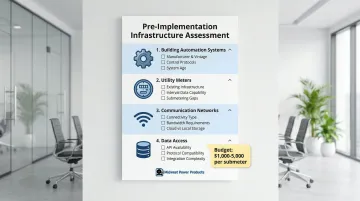
Technical Infrastructure Assessment
Conduct a comprehensive inventory across all sites to determine integration complexity:
Building automation systems (BAS): Document the manufacturer, vintage, and communication protocols of existing controls. BACnet holds over 60% global market share and is supported by major vendors like Siemens, Schneider Electric, and Honeywell.
Legacy proprietary systems may require gateway devices to translate data for modern EMS platforms.
Utility meters: Identify existing metering infrastructure. Monthly billing data provides the minimum baseline, but 15-minute interval meters enable peak demand analysis and time-of-use optimization. Budget $1,000-5,000 per meter for submetering installations where gaps exist.
Communication networks: Verify network connectivity and bandwidth at each site. Cloud-based EMS platforms require reliable internet connections; facilities with limited connectivity may need local edge computing with periodic cloud synchronization.
Data access capabilities: Determine whether you can access existing BAS data automatically through software or if manual data collection is required.
Open protocols and RESTful APIs dramatically reduce integration costs compared to proprietary systems requiring custom development.
Specialized industries like industrial laundry often use proprietary protocols. Softrol's PulseNet system, for example, uses a proprietary communication architecture optimized for laundry equipment. When evaluating EMS platforms, verify compatibility with industry-specific control systems or budget for middleware integration layers.
Energy Baseline Data
With your infrastructure documented, the next step is establishing energy baselines. ENERGY STAR Portfolio Manager requires 12 consecutive months of energy data to generate valid benchmarking scores.
DOE FEMP guidelines recommend 12-24 months of pre-installation data to establish baseline models that account for seasonal variations.
Minimum data requirements:
- Monthly utility bills (electricity, natural gas, water) for all facilities
- Building characteristics: square footage, operating hours, occupancy counts
- Weather data for each location (often available through NOAA or utility providers)
- Major equipment inventories (HVAC capacity, lighting types, process equipment)
Enhanced data for sophisticated analysis:
- 15-minute interval demand data to identify peak usage patterns
- Equipment runtime logs from existing BAS
- Production volumes or occupancy metrics to normalize consumption
- Historical maintenance records correlating equipment failures with energy spikes
Accurate baselines must account for independent variables. A manufacturing facility's energy consumption naturally increases with production volume; a retail store's HVAC load varies with foot traffic and outdoor temperature.
Without normalizing for these factors, you can't distinguish genuine efficiency improvements from operational changes.
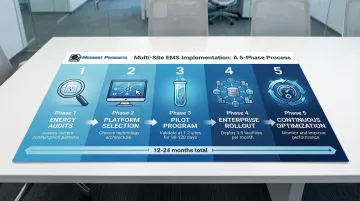
How to Implement a Multi-Site Energy Management System (Step-by-Step)
Rushing or skipping implementation phases results in poor data quality, low user adoption, and failure to achieve projected savings.
Organizations that deploy to all sites simultaneously without piloting often discover integration issues, workflow problems, or user interface shortcomings only after significant investment.
Conduct Comprehensive Energy Audits Across Sites
Site-by-site assessments identify current consumption patterns, waste sources, equipment conditions, and quick-win opportunities.
Nearly 75% of energy savings in Superior Energy Performance certified facilities come from low-cost operational improvements rather than capital-intensive retrofits, yielding average payback periods of just 1.7 years.
Audit objectives:
- Quantify energy consumption by system (HVAC, lighting, refrigeration, process equipment)
- Identify operational inefficiencies: simultaneous heating and cooling, excessive outdoor air intake, equipment running during unoccupied hours
- Document equipment age, condition, and maintenance history
- Benchmark each facility against similar buildings using ENERGY STAR Portfolio Manager
Prioritize sites for initial implementation based on:
- Facilities with highest consumption per square foot (greatest savings potential)
- Sites with planned capital improvements (opportunities to integrate EMS with equipment upgrades)
- Moderate operational complexity (balance learning opportunities with manageable implementation risk)
- Locations where efficiency improvements deliver meaningful portfolio-wide results
Before selecting a platform, document existing control systems meticulously. Record communication protocols (BACnet, Modbus, LonWorks), controller models, network architecture, and integration points. This inventory becomes the foundation for platform selection and implementation planning.
Select the Right Platform and Technology
Platform architecture fundamentally impacts scalability, security, and total cost of ownership.
Cloud-based platforms:
The cloud segment accounts for the largest revenue share in 2025, driven by organizations seeking scalability across dispersed portfolios. Cloud platforms offer:
- Automatic software updates and feature additions
- Accessibility from any device with internet connectivity
- Elastic computing resources that scale with portfolio growth
- Lower upfront costs (SaaS subscription model vs. perpetual licenses)
On-premise platforms:
On-premise solutions remain prevalent in sectors requiring strict data sovereignty, such as manufacturing and defense.
Benefits include:
- Complete control over data storage and security
- Independence from internet connectivity
- Customization flexibility for specialized requirements
- One-time licensing costs (though ongoing maintenance fees apply)
Hybrid architectures leverage local edge computing for reliability combined with cloud processing for analytics, offering advantages of both approaches.
Critical platform capabilities:
- Open protocol support - Verify compatibility with BACnet, Modbus, LonWorks, and other protocols used in your facilities to avoid vendor lock-in
- RESTful APIs - Enable integration with third-party systems including utility billing platforms, maintenance management systems, and business intelligence tools
- Multi-site dashboards - Provide portfolio-wide visibility while allowing drill-down to individual facilities and equipment
- Automated reporting - Generate scheduled reports for stakeholders without manual data compilation
- Anomaly detection - Use machine learning to identify consumption patterns that deviate from expected baselines
- Role-based access control - Allow distributed facility teams to view their locations while corporate teams see enterprise-wide performance
In specialized industries, evaluate platforms with domain-specific capabilities.
Industrial laundry operations, for instance, benefit from systems like Softrol's LOIS that provide 24/7 monitoring of critical plant functions with real-time alerts sent directly to email addresses, enabling immediate response to operational issues that impact both productivity and energy consumption.
Launch a Pilot Implementation
Select 1-2 representative sites that balance complexity—not your simplest facility (insufficient learning opportunities) nor your most challenging (excessive implementation risk).
The pilot validates platform functionality, user workflows, and integration processes before enterprise rollout.
Pilot phase activities:
- Hardware installation - Deploy necessary submeters, sensors, and communication gateways
- Data integration - Configure connections to existing BAS, utility meters, and other data sources
- Baseline monitoring - Collect 30-60 days of data to establish pre-optimization performance
- User training - Educate site personnel on system operation, alert response, and reporting tools
- Initial optimization - Implement identified efficiency measures and measure results
Run the pilot for 90-120 days minimum. This duration captures seasonal variations and allows sufficient time to:
- Validate data accuracy and identify collection gaps
- Refine alert thresholds to minimize false positives
- Test user workflows and identify training needs
- Measure preliminary savings and adjust financial projections
- Document lessons learned for enterprise rollout
One quick-service restaurant chain's pilot revealed that behavior-based checklists failed due to high staff turnover, leading them to prioritize automation over manual procedures. Without this pilot learning, they would have deployed an ineffective approach across hundreds of locations.
Roll Out Enterprise-Wide
Deploy to remaining sites in phases, typically 3-5 facilities per month.
Aggressive timelines overwhelm implementation teams and increase error rates; overly conservative schedules delay savings realization and lose organizational momentum.
Standardized deployment process:
- Use proven installation procedures and configuration templates from the pilot
- Leverage integration methods validated during initial implementation
- Maintain consistent hardware specifications across similar facility types
- Document deviations required for unique locations
Access architecture:
- Centralized monitoring - Corporate energy teams view portfolio-wide performance, identify underperforming sites, and track progress toward enterprise goals
- Distributed site-level access - Facility managers see their locations with appropriate control permissions
- Role-based permissions - Prevent unauthorized setpoint changes that degrade savings
Training programs for all user levels:
- Executives - Dashboard overview, KPI interpretation, and business case validation (1-2 hours)
- Energy managers - Advanced analytics, optimization strategies, and reporting tools (1-2 days)
- Site personnel - Daily operations, alert response, and basic troubleshooting (4-8 hours)
3M reduced implementation timelines from 18 months for their first site to 3-8 months for subsequent facilities by developing internal expertise and standardized deployment tools. This acceleration delivered faster ROI while maintaining quality.
Establish Ongoing Monitoring and Optimization Processes
Technology deployment is the beginning, not the end. Sustained savings require continuous monitoring, proactive issue resolution, and organizational commitment to acting on system insights.
Automated alert configuration:
- Equipment failures (unexpected shutdowns, runtime anomalies)
- Energy anomalies (consumption exceeding expected patterns)
- Setpoint deviations (unauthorized temperature or schedule changes)
- Threshold exceedances (demand approaching utility penalty levels)
Configure thresholds carefully to balance sensitivity. Overly sensitive alerts generate false positives that train users to ignore notifications; insufficiently sensitive settings miss actionable issues.
Regular performance reviews:
- Weekly site-level reviews - Facility managers investigate alerts, verify corrective actions, and identify emerging issues
- Monthly portfolio-level reviews - Corporate teams compare actual vs. expected consumption, identify underperforming sites, and share best practices across locations
Continuous improvement protocols:
- Use insights to inform capital planning, prioritizing investments with highest energy savings potential
- Adjust operational schedules based on actual occupancy patterns rather than assumptions
- Train staff on energy-efficient behaviors identified through data analysis
- Document and replicate successful strategies from top-performing facilities
Organizations implementing ISO 50001 energy management systems achieve persistent annual efficiency gains greater than 3%, demonstrating that structured optimization processes prevent savings degradation over time.
Where Multi-Site Energy Management Systems Are Commonly Used
Retail Chains
Retail operations prioritize refrigeration monitoring and lighting schedules across standardized store formats. A supermarket chain implemented real-time metering across 240 stores managing 520,000 square meters to identify equipment failures and optimize performance. Food Lion deployed comprehensive planning across 1,000+ stores to achieve a 20% greenhouse gas reduction goal.
Retail EMS deployments focus on:
- Walk-in cooler and freezer temperature monitoring to detect failing compressors
- Lighting schedules coordinated with operating hours
- HVAC setpoint management during unoccupied periods
- Benchmarking similar store formats to identify outliers
Healthcare Systems
Hospitals and clinics operate 24/7 with strict humidity and temperature requirements for patient care and medical equipment. Energy efficiency measures must never compromise indoor air quality or critical system redundancy.
Apollo Hospitals reported 30% utility savings after deploying cloud EMS for medical equipment scheduling and cogeneration optimization.
Healthcare EMS priorities include:
- Critical system redundancy monitoring to ensure backup capacity
- Operating room and clean room environmental controls
- Cogeneration system optimization for simultaneous power and heating
- Energy-intensive equipment scheduling (sterilizers, imaging systems, laundry)
Healthcare laundry operations benefit from specialized monitoring capabilities. Softrol's UtiliPulse monitors temperatures and flows for heat reclamation systems alongside wash equipment, enabling facilities to optimize energy consumption across both clinical and support services.
Educational Campuses
Universities and school districts manage multiple buildings with varied usage patterns—classrooms occupied during specific hours, dormitories with evening and weekend loads, laboratories requiring continuous ventilation. Portfolio Manager allows tracking at both individual building and campus levels, essential for institutions with diverse facility types.
Educational EMS emphasizes:
- Occupancy-based scheduling that aligns HVAC operation with class schedules
- Dormitory setback during academic breaks
- Laboratory fume hood optimization to reduce excessive air changes
- Central plant optimization for campuses with district heating and cooling
Manufacturing Facilities
Energy typically represents 20% of manufacturing operating costs, making efficiency critical. General Electric identified 572 projects worth $6.4 million in savings through systematic operations leadership programs. 3M deployed ISO 50001 across 56 global sites, achieving $24 million in savings and 4.7% efficiency improvement.
Manufacturing EMS integrates:
- Process equipment monitoring to correlate production with energy consumption
- Demand management to avoid utility penalty charges during peak periods
- Compressed air system leak detection and optimization
- Production scheduling to shift energy-intensive operations to off-peak hours
Industrial laundries represent specialized manufacturing operations where wash equipment, dryers, and material handling systems consume significant energy.
Softrol's LOIS system provides 24/7 monitoring of critical plant functions with multi-site access capabilities. Corporate teams can monitor performance across multiple laundry facilities from a single platform while facility managers focus on their individual locations.
Commercial Real Estate and Government
Tower Companies achieved 13.2% electricity reduction across three multi-tenant office buildings using real-time energy management. Multi-tenant properties benefit from demonstrating sustainability leadership to attract tenants while reducing operating expenses.
Government facilities face federal mandates for energy benchmarking and efficiency improvements. Federal agencies must use ENERGY STAR Portfolio Manager for tracking metered buildings. Energy Savings Performance Contracts funded $5.7 billion in federal efficiency improvements between FY2005 and FY2017, demonstrating the scale of government sector investment.
Best Practices for Multi-Site Energy Management Success
Standardize Equipment and Systems
Deploy consistent equipment specifications across similar facility types whenever possible. Standardization delivers:
- Simplified monitoring - Technicians familiar with one location quickly understand others
- Reduced training complexity - Staff learn one system rather than multiple platforms
- Bulk purchasing discounts - Volume commitments lower equipment costs
- Accelerated troubleshooting - Solutions developed at one site apply across portfolio
If standardization isn't feasible due to existing infrastructure, document differences meticulously and provide site-specific training materials.
Implement Cross-Site Benchmarking
Raw consumption data misleads without normalization. A 100,000 square foot warehouse in Phoenix naturally consumes more cooling energy than an identical facility in Seattle.
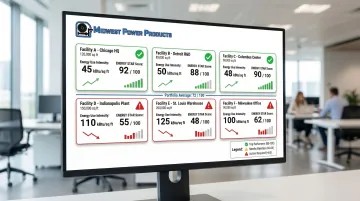
ENERGY STAR Portfolio Manager calculates 1-100 scores by comparing buildings against national datasets, adjusting for factors like operating hours, worker density, and climate.
Effective benchmarking metrics:
- Energy Use Intensity (EUI) - kBtu per square foot annually, normalized for weather
- Cost per unit - Energy cost per square foot, per occupant, or per production unit
- Performance rankings - Identify top and bottom quartile performers within your portfolio
Investigate variance root causes systematically. If one facility outperforms others substantially, document operational practices and replicate across similar locations. For underperforming facilities, audit for equipment failures, operational inefficiencies, or deferred maintenance.
Integrate Energy Procurement with Management
Coordinate demand response participation, time-of-use rate optimization, and renewable energy purchasing with real-time consumption data. Potential peak demand savings from commercial sector demand response programs reached approximately 5,837 MW in 2020.
Procurement integration strategies:
- Automated demand response - Pre-program load shedding when utility signals peak pricing events
- Time-of-use optimization - Shift energy-intensive operations to off-peak hours when rates are lower
- Renewable energy purchasing - Size power purchase agreements based on actual consumption patterns
- Utility incentive capture - Identify and apply for rebate programs based on verified savings data
Establish Clear Governance Structure
Define roles and responsibilities explicitly:
- Corporate energy manager - Sets portfolio-wide strategy, establishes KPIs, and reports progress to executives
- Regional managers - Coordinate implementation across assigned geographies, share best practices, and provide technical support
- Site facility managers - Execute daily operations, respond to alerts, and implement identified improvements
Maintain regular communication cadence: weekly site-level check-ins, monthly regional reviews, and quarterly enterprise meetings. Accountability requires visibility—publish performance rankings and recognize top performers.
Leverage Financing Mechanisms
Capital constraints should not prevent implementation. Multiple financing mechanisms eliminate upfront costs and tie payments to verified savings:
Energy Savings Performance Contracts (ESPCs): Partner with Energy Service Companies that finance projects using guaranteed future savings. ESPCs funded $5.7 billion in federal efficiency improvements from FY2005-FY2017, with documented success across public sector facilities.
Energy-as-a-Service (EaaS): Convert capital expenditures to operational expenses through service agreements. Particularly effective for organizations with capital constraints or preference to preserve cash for core business investments.
Utility incentive programs: Many utilities offer rebates covering 20-30% of installation costs. NYSERDA's Real Time Energy Management program provided incentives covering up to 30% of installation and service fees, improving ROI.
Conclusion
Multi-site energy management success requires organizational discipline, consistent data practices, and commitment to acting on insights. Even the most advanced platform delivers zero value when teams ignore alerts, leave opportunities unimplemented, or fail to use performance data for decisions.
Organizations achieve persistent annual efficiency gains greater than 3% when they treat EMS as a strategic investment rather than a technology project. Success requires sustained executive sponsorship, dedicated resources, and cross-functional collaboration that extends well beyond initial implementation.
These implementation requirements deliver compelling returns. Organizations typically see payback periods of 1.7 years for operational improvements and annual savings of $600,000 per site for ISO 50001 implementations, while protecting margins against rising energy costs.
Beyond financial returns, multi-site EMS demonstrates sustainability leadership, supports corporate environmental commitments, and creates competitive advantage through operational excellence.
Frequently Asked Questions
What is the typical ROI timeline for a multi-site energy management system?
Most organizations achieve 2-4 year payback periods with 15-30% energy savings, though projects focusing on operational improvements average just 1.7 years. Timeline varies based on current efficiency levels, energy rates, and deployment scope.
Can we integrate an EMS with our existing building automation systems?
Modern platforms support open protocols including BACnet (which holds over 60% global market share), Modbus, and LonWorks, enabling integration with most existing systems. Older proprietary systems may require gateway devices for compatibility.
How much does a multi-site energy management system cost?
Implementation costs range from $2-8 per square foot with ongoing fees of $0.10-0.30 per square foot annually. Total upfront costs typically range from $50,000 to $500,000, though financing mechanisms like ESPCs and EaaS eliminate capital requirements.
What size organization benefits most from a multi-site EMS?
Organizations with 3+ buildings and $500,000+ annual energy spend see meaningful returns. Facilities with consumption exceeding 0.27 trillion Btu annually (approximately $1.9 million) can expect paybacks under two years, particularly in energy-intensive sectors like manufacturing and healthcare.
Do we need dedicated staff to manage a multi-site EMS?
Organizations typically need 0.5-1.0 FTE per 20-30 buildings for system management, data analysis, and continuous improvement. Cloud platforms reduce technical expertise requirements, and you can choose between internal staff or third-party service providers.
How do we get executive buy-in for a multi-site EMS investment?
Build a business case showing projected savings from current energy spend, risk mitigation from equipment failure prevention, and sustainability impacts. Compare financing options (ESPC, EaaS, utility incentives) that minimize upfront costs, and quantify the cost of inaction—rising energy prices and preventable equipment failures.