Introduction
Operations teams juggling customer accounts across spreadsheets, email threads, and three different software logins know the drill. A missed follow-up here, a billing error there, and a customer who's called twice this week because nobody can see their full history.
As customer volumes grow, this patchwork approach doesn't just slow things down. It breaks down entirely, and the market reflects that urgency: according to MarketsandMarkets, the global CIS software market was valued at $1.61 billion in 2024, growing to $1.79 billion in 2025.
A Customer Information System (CIS) solves this by centralizing customer data, automating routine workflows, and giving every department the same real-time view of an account.
Whether you're billing utility customers for metered usage or tracking garment orders through an industrial laundry, the underlying problem looks similar across industries.
This guide breaks down the top CIS platforms for 2025, the features that separate a functional system from a genuinely useful one, and how to match a platform to your operational context.
Key Takeaways
- A CIS centralizes contact info, billing history, and account records in one platform
- Modern CIS platforms automate billing, trigger alerts, and integrate with ERP and CRM systems
- The right CIS fits your industry — utility billing tools won't suit an industrial laundry
- Prioritize scalability, automation depth, integration capability, and compliance when shortlisting
- Softrol's LOIS shows how a purpose-built CIS can outperform generic platforms in specialized operations
What Is a Customer Information System (CIS)?
A Customer Information System is software that collects and organizes customer data (sales transactions, billing records, service interactions, account history) into a single accessible platform. Unlike tools built for prospecting, a CIS is fundamentally a post-sale system. It exists to manage active accounts, not chase new ones.
CIS vs. CRM vs. CDP
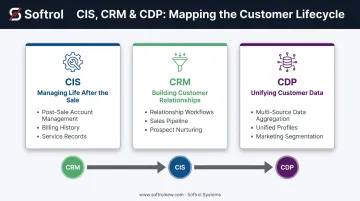
These three categories get confused constantly, but they solve different problems:
- CIS: Manages post-sale accounts, billing, service history, and operational data — the system of record for existing customers
- CRM: Tracks relationship workflows across sales, marketing, and service, often starting before a deal closes
- CDP: Aggregates data from multiple sources into a unified customer profile, typically for marketing segmentation
Gartner's Market Guide for Utility Customer Information Systems frames it clearly: a CIS handles internal and customer-facing account operations for processes like meter-to-cash billing, a distinctly operational function, not a relationship-management one.
Some platforms blend CRM and CIS functions. Salesforce Service Cloud, for instance, layers case management on top of customer records. But the core distinction holds: a CRM asks "how do we grow this relationship?" A CIS asks "how do we service this account correctly, today?"
Industry-Specific vs. General-Purpose CIS
CIS platforms range from broad enterprise tools to deeply specialized systems:
- Utility companies need meter-to-cash billing, rate management, and service order tracking
- Industrial laundries need garment order tracking, production status visibility, and delivery scheduling
- Manufacturers need customer data tied directly to production and inventory workflows
The more specialized your operational data model, the less a generic CIS will fit without heavy customization.
Top Customer Information System Software Solutions for 2025
These platforms were selected on data management depth, automation, integration ecosystem, industry fit, and verified customer adoption. Only one is a native, purpose-built CIS for its industry; the rest are strong customer-management platforms best paired with dedicated billing or operational systems.
Softrol LOIS (Laundry Operation Information System)
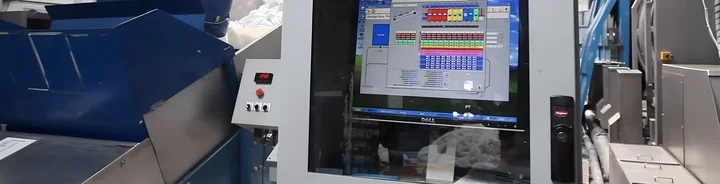
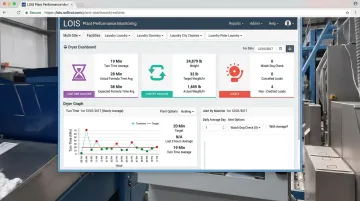
Softrol Systems has built industrial automation technology for the textile services industry since 1987, and LOIS (the Laundry Operation Information System) is its purpose-built platform for real-time plant visibility. Rather than trying to be a general CIS, LOIS focuses on what industrial laundries actually need: live production data, employee performance tracking, and equipment status, accessible from a browser on any device.
What sets LOIS apart is its native integration with Softrol's own hardware. No middleware sits between LOIS and wash aisle controls, garment sortation systems, or rail automation. The data flows directly. The LOIS Rail module adds Pan-N-Zoom visualization, letting plant managers zoom into individual rail components to check status and request replacement parts on the spot.
LOIS also supports multi-site access from a single login, which matters for regional operators managing several plants. Fortune 1000 companies including Aramark Uniform Services and Mission Linen Uniform Service operate at this scale, where visibility across facilities isn't optional.
| Best For | Industrial laundries, uniform rental companies, textile services, and healthcare laundry operations |
| Key Features | Real-time plant performance monitoring, browser-based remote access, email alerts, Total Plant Management integration, Pan-N-Zoom rail visualization |
| Deployment | On-premise or cloud, integrated with Softrol's automation hardware |
Salesforce Service Cloud (Now Agentforce Service)
Salesforce's service platform, rebranded Agentforce Service and formerly known as Service Cloud, gives enterprise teams a unified console for managing customer accounts, service cases, and omnichannel communication. It's widely adopted across retail, finance, and healthcare, and Salesforce has been named a Leader in Gartner's Magic Quadrant for Customer Engagement Center for over a decade running.
The platform differentiates through AI-assisted service tools (Einstein) and a large integration marketplace: AppExchange lists more than 7,000 apps and certified consulting partners. That flexibility lets teams customize workflows for their industry, though it's positioned around case, knowledge, and incident management rather than native billing or metering functionality.
| Best For | Mid-to-large enterprises across retail, finance, healthcare, and services |
| Key Features | Case management, AI-assisted service, workflow automation, Customer 360 profiles, AppExchange integrations |
| Deployment | Cloud-based (SaaS); tiered pricing by edition — check current rates on Salesforce's website |
Oracle Utilities Customer Cloud Service
Oracle Utilities Customer Cloud Service (CCS) is the closest thing to a native, industry-built CIS on this list. It manages meter-to-cash workflows end to end, covering customer care, metering, rate calculation, service orders, and bill payment within a single system built for regulated utility environments.
Oracle was named a Leader in the 2024 IDC MarketScape for Utilities Customer Information Systems and Billing Solutions, and utilities like Gas South have implemented CCS specifically to automate billing services and cut operational costs. Its Rate Cloud Service lets utilities configure and test complex rate structures before going live, which matters enormously in regulated billing.
| Best For | Electric, water, and gas utility providers; large regulated service organizations |
| Key Features | Rate management, billing automation, service order management, payment processing, analytics dashboards |
| Deployment | Cloud-based (SaaS); enterprise licensing — contact Oracle's sales team for pricing |
SAP Customer Experience (SAP CX)
SAP CX connects customer data directly to SAP's ERP backbone, making it a natural fit for manufacturers and industrial service organizations that need customer orders synced with production and inventory in real time. Versuni, a domestic appliance manufacturer, used SAP CX to build a B2B self-service ordering portal tied directly into its ERP data.
The platform's biggest strength is that native ERP link, which lets order-to-cash data flow without the manual reconciliation that plagues disconnected systems. SAP has also been named a Leader in Gartner's Magic Quadrant for Digital Commerce for ten consecutive years. It's less suited to organizations that need a stand-alone billing CIS rather than ERP-linked commerce.
| Best For | Manufacturers, industrial service companies, and enterprises already using SAP ERP |
| Key Features | Customer data management, order-to-cash integration, service management, real-time analytics, ERP synchronization |
| Deployment | Cloud and hybrid options; enterprise licensing — contact SAP for current pricing |
Pipedrive
Pipedrive is a sales CRM, not a full CIS, and it doesn't pretend otherwise. For small and mid-sized businesses that need accessible contact management, deal tracking, and billing-adjacent record-keeping without enterprise complexity, it's a practical entry point. Its Marketplace offers more than 500 out-of-the-box integrations, covering payments, email, and eSignature tools.
G2 included Pipedrive in its Best Sales Software Products list, and Forbes Advisor has recognized it across five CRM categories, including small-business and simple CRM. That's solid validation for sales-pipeline management. Just don't expect native billing or service-operations functionality; you'll need to pair it with dedicated systems for that.
| Best For | Small to mid-sized businesses across sales-driven service industries |
| Key Features | Contact management, deal pipeline tracking, document management, automation workflows, reporting dashboards, 500+ integrations |
| Deployment | Cloud-based (SaaS); tiered pricing plans — check current rates on Pipedrive's website |
Key Features to Look for in a CIS
The Non-Negotiables
Every effective CIS, regardless of industry, needs these baseline capabilities:
- Centralized contact and account management
- Interaction history tracking across every touchpoint
- Billing and payment data storage
- Document management for contracts, invoices, and service records
- Reporting dashboards that don't require a data analyst to interpret
Without these, you're not looking at a CIS. You're looking at a spreadsheet with a login screen.
Automation and Integration Separate the Winners
Basic CIS tools store data. Strong ones act on it. Look for platforms that auto-trigger alerts, sync with ERP or operational systems, and cut down manual data entry.
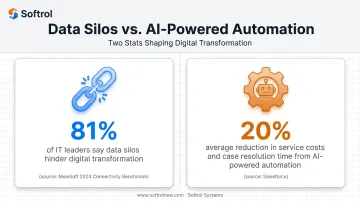
This matters more than it might sound. MuleSoft's 2024 Connectivity Benchmark, based on responses from 1,050 IT leaders, found that 81% said data silos were actively hindering their organization's digital transformation efforts. A CIS that doesn't integrate cleanly with your other systems just adds another silo.
Automation's payoff is measurable too. Salesforce reports that service teams using AI-powered agents expect an average 20% reduction in service costs and case resolution times — a reasonable benchmark for what integrated automation should deliver, even if results vary by implementation.
Security and Compliance Aren't Optional Extras
Any platform handling customer billing data needs, at minimum:
- Role-based access controls limiting visibility by job function
- Encryption in transit and at rest
- Multi-factor authentication
- Audit logging for sensitive account activity
- Compliance alignment with GDPR, CCPA, or relevant industry standards
Don't take a vendor's word for it. Ask for documentation showing how each control is implemented, not just whether it appears on a feature list.
How We Chose the Best CIS Software
We evaluated each platform against five criteria:
- Industry fit and deployment context
- Depth of automation and integration
- Scalability
- Verified customer adoption
- Security and compliance capabilities
Brand recognition and raw feature counts didn't factor in. A platform with 200 features you'll never use isn't better than one with 20 that match your workflow.
The most common selection mistake we see is choosing a CIS based on price or popularity alone, without checking whether it maps to your operational data model. A utility billing platform built for meter-to-cash workflows is a poor fit for tracking garment orders through an industrial laundry, and a general-purpose CRM will struggle with regulated rate calculations.
The right question is which CIS fits your specific operations, not which one is the most popular. Those answers often differ significantly.
Conclusion
The most feature-rich CIS on the market isn't automatically the right one for your business. The right platform is the one that centralizes your specific operational data, connects to the systems you already run, and gives your team real-time visibility to act before small issues become customer complaints.
Before committing to a platform, ask:
- Does it support your actual billing or operational workflows?
- Can it scale as your customer base grows?
- Will it meet your data privacy obligations?
If those questions sound familiar, here's where Softrol's LOIS platform fits: for textile services companies, uniform rental operations, and industrial laundries, it was built around exactly this kind of operational reality. It delivers remote access to plant performance data, real-time alerts, and integration with Total Plant Management. If that sounds like your operation, contact Softrol to see how it fits.
Frequently Asked Questions
What is the difference between a CIS and a CRM?
A CIS manages post-sale account data, including billing, service history, and interactions, while a CRM focuses on pre-sale pipeline management and prospect nurturing. Both may overlap, but each serves a distinct primary role.
What is CRM software in customer service?
CRM software in customer service gives support teams visibility into a customer's history, preferences, and past interactions, enabling faster and more personalised responses. It complements a CIS's account management functions rather than replacing them.
What is an example of a customer information system?
Oracle Utilities Customer Cloud Service manages utility billing and service orders, Softrol's LOIS tracks plant performance and production data for industrial laundries, and Salesforce Service Cloud handles enterprise-level customer accounts across industries.
What features should a customer information system have?
At minimum, a CIS should include:
- Centralised contact and account records
- Billing and payment data management
- Interaction history tracking and automation for routine tasks
- Reporting dashboards and integrations with other business systems
How does a CIS improve operational efficiency?
A CIS cuts manual data entry and breaks down departmental silos by automating billing and alert workflows. The result: fewer errors, faster resolutions, and more time for high-value work.
Is a CIS the same as a utility billing system?
No. A utility billing system is one application of CIS technology, handling meter reads, rate calculations, and invoicing. A CIS is the broader category, with billing systems as a specialised subset for regulated environments.