Operational efficiency software has shifted from competitive advantage to survival imperative. With manufacturers facing a projected 1.9 million unfilled jobs by 2030 and hiring difficulty increasing 36% since 2018, companies cannot hire their way out of inefficiency. They must leverage technology that automates workflows, provides real-time visibility, and optimizes resource utilization across manufacturing and industrial operations.
This article examines operational efficiency software tools built for industrial rigor—systems that integrate directly with operational technology, deliver measurable ROI, and solve the specific challenges facing manufacturers in 2025.
TLDR
- Automation and real-time monitoring reduce downtime costs while compensating for labor shortages
- Industry-specific tools deliver 21-26% OEE improvements and 40% maintenance cost reductions
- Essential capabilities: OT/IT integration, predictive alerts, audit-ready reporting, multi-site scalability
- Implementation takes 4-8 weeks (cloud) or 9-24 months (enterprise rollouts)
- Prioritize proven industry track record over feature checklists when selecting tools
What is Operational Efficiency Software and Why It Matters
Operational efficiency software includes systems that streamline workflows, reduce waste, automate repetitive tasks, and provide actionable insights for performance improvement in manufacturing and industrial settings.
Unlike general business productivity tools, these platforms integrate directly with shop floor equipment—PLCs, SCADA systems, and sensors—to provide real-time control and visibility into physical production processes.
Industry-Specific vs. General Business Tools
The distinction between operational efficiency software and general business applications is critical. According to ISO 22400 and IEC 62264 standards, Manufacturing Execution Systems (MES) manage, monitor, and synchronize real-time physical processes that transform raw materials into finished goods.
These systems bridge the gap between the shop floor (Operational Technology) and the top floor (Enterprise Resource Planning).
General business software handles administrative tasks like project coordination, document management, and financial reporting. Operational efficiency software differs fundamentally, requiring capabilities such as:
- Connect directly with machinery and control systems
- Process real-time sensor data from production equipment
- Execute automated responses to production conditions
- Maintain data integrity in harsh industrial environments
- Support compliance requirements specific to manufacturing
Core Capabilities
Modern operational efficiency platforms deliver five essential capabilities:
Process Automation: Eliminates manual data entry, automates work order routing, and executes predefined responses to production conditions. Rockwell Automation case studies document 100% data accuracy improvements and the ability to scale without additional headcount.
Real-Time Data Collection: Captures production metrics, equipment status, and quality parameters continuously. This visibility enables operators to address micro-stops and potential failures before they cause extended outages.
Performance Analytics: Transforms raw data into actionable insights through OEE tracking, trend analysis, and bottleneck identification. Facilities using real-time analytics see productivity improvements of 10-25% and 18% better OEE.
Alert Systems: Provides automated notifications for exceptions, equipment failures, and process deviations. Predictive maintenance tools improve downtime forecasting accuracy by 85% and reduce unplanned downtime by 50%.
OT/IT Integration: Connects shop floor systems with enterprise platforms following the ISA-95 framework, enabling seamless data flow from sensors to business intelligence systems.
Business Outcomes
These capabilities translate directly into measurable business impact. Organizations implementing operational efficiency software achieve:
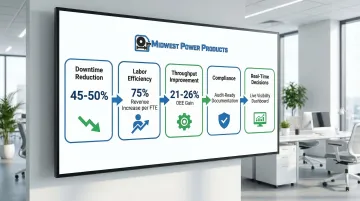
- Reduced downtime: 45-50% reduction in unplanned outages through predictive maintenance
- Lower labor costs: 75% increase in revenue per full-time employee by eliminating manual scheduling and data entry
- Improved throughput: 21-26% OEE improvement and 10-30% productivity gains
- Better compliance: Audit-ready documentation with complete traceability of materials and production conditions
- Data-driven decisions: Real-time visibility replacing end-of-shift reports
Why Operational Efficiency Matters in 2025
The Labor Crisis: The manufacturing sector faces 1.9 million unfilled jobs through 2033, with finding qualified talent 36% harder than in 2018. Automation becomes the only viable path to maintain output with existing headcount.
Rising Operational Costs: Inflationary pressures on energy and materials squeeze margins, necessitating strict control over waste and consumption. Predictive maintenance reduces maintenance costs by 40% compared to reactive or fixed-schedule approaches.
Compliance Requirements: ESG reporting and quality standards demand real-time traceability that manual systems cannot provide. Regulatory audits increasingly require digital documentation with complete production history.
Competitive Pressure: Facilities leveraging smart manufacturing technologies achieve 92% OEE compared to an industry average of 78%, creating a performance gap that manual operations cannot close.
Top Operational Efficiency Software Tools for Industrial Operations
The operational efficiency software market includes hundreds of platforms, from specialized industry solutions to enterprise-wide systems. Selecting the right tool requires evaluating industry relevance, automation capabilities, real-time monitoring, integration flexibility, and proven track records.
The following tools represent different approaches to operational efficiency, each suited to specific operational scales and industry requirements.
Softrol Total Plant Management
Softrol has served textile services and industrial laundry operations for over 35 years, providing integrated automation solutions from sort to finish. Unlike general manufacturing platforms, Softrol's systems are purpose-built for the unique workflows of industrial laundry, uniform services, and healthcare linen operations.
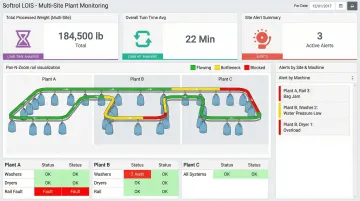
The platform's differentiating capability is comprehensive integration across the entire production flow. LOIS (Laundry Operation Information System) provides remote plant data access with real-time email alerts, enabling managers to monitor multiple sites from any device.
The system integrates wash aisle controls (MicroPulse), chemical dispensing (ChemPulse), and automated sorting into a unified platform that eliminates data silos.
Customer results demonstrate measurable impact. Faultless Linen achieved a 35% increase in Pounds Per Operator Hour within four months, improving from 90 to 140 PPOH. Mission Linen realized a 77% reduction in sorting labor while processing 3,500 garments per hour with just three operators compared to the previous 13 operators.
| Key Features | Total plant data integration, remote monitoring via LOIS, real-time email alerts, Pan-N-Zoom rail visualization, automated garment sorting with image-based code readers | | Best For | Industrial laundries, uniform services, healthcare linen operations, institutional textile processing | | Integration Capabilities | Native integration with wash aisle equipment (Washex, Challenge), chemical dispensing systems, sorting automation, works with 140+ ERP systems via complementary tools |
SAP S/4HANA (Manufacturing Execution)
For large-scale operations requiring enterprise-wide integration, SAP's platform represents a different approach from specialized solutions.
SAP's enterprise resource planning platform with embedded manufacturing execution modules serves large-scale industrial operations requiring deep integration between finance, supply chain, and shop floor execution. The system provides comprehensive ERP integration with advanced analytics, global scalability, and robust compliance capabilities for regulated industries.
SAP S/4HANA excels in complex, multi-site operations where financial consolidation and supply chain visibility must integrate seamlessly with production execution. The platform's strength lies in its extensive native integration with PLCs, SCADA, and other enterprise systems, supported by comprehensive corporate maintenance processes designed to minimize downtime.
| Key Features | End-to-end ERP integration, manufacturing execution system (MES), predictive maintenance, supply chain visibility, financial consolidation | | Best For | Large enterprises with complex multi-site operations, global manufacturers, organizations requiring deep financial integration | | Integration Capabilities | Native SAP ecosystem integration, APIs for third-party systems, extensive partner network for specialized modules |
Asana (Task and Project Management)
Asana provides flexible project management for coordinating operational tasks across teams.
While not a traditional operational efficiency platform, Asana serves a specific role in manufacturing environments for managing human-centric workflows like R&D projects, continuous improvement initiatives, and maintenance scheduling.
Critical limitation: Asana does not integrate directly with PLCs or SCADA for real-time machine control. Its value lies in coordinating the human side of operations—project tracking, task dependencies, and cross-functional collaboration. Viessmann used Asana for digital transformation and R&D project tracking, while KW Automotive centralized work for made-to-order suspension systems.
| Key Features | Task dependencies, timeline views, workload management, custom fields, automated workflows, mobile apps | | Best For | Cross-functional operational projects, maintenance scheduling, continuous improvement initiatives, smaller operations teams | | Integration Capabilities | 200+ app integrations including Slack, Microsoft Teams, Salesforce; API for custom connections |
Odoo (Modular Business Management)
Odoo offers an integrated business management suite with modules for manufacturing, inventory, project management, and accounting. The platform's modular architecture allows customized deployments, making it cost-effective for mid-size operations seeking integrated business management without enterprise ERP costs.
Odoo's API-first architecture supports 100+ integrations and connects with IoT devices including footswitches, calipers, and cameras. Global PackTech achieved a 40% reduction in emergency purchases and cut lead times by 25% after replacing spreadsheets with Odoo.
| Key Features | Manufacturing module, inventory management, quality control, maintenance management, integrated accounting, project tracking | | Best For | Mid-size manufacturers, operations seeking integrated business management without enterprise ERP costs, organizations wanting customization flexibility | | Integration Capabilities | Modular internal integration, REST APIs, large app marketplace, can integrate with existing ERP or operate standalone |
Spreadsheet Server (ERP Reporting)
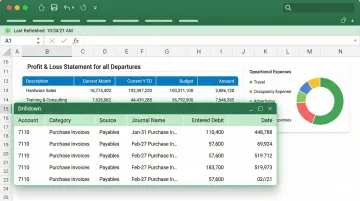
Spreadsheet Server provides Excel-based reporting that connects to 140+ ERP systems for operational data analysis. The platform bridges the gap between operational data and financial reporting without requiring users to leave Excel, making it ideal for plant managers and finance teams who need custom reports without extensive training.
The tool's strength is its familiar Excel interface combined with real-time ERP data access, eliminating manual export/import cycles. Users can drill down into GL and non-GL data (inventory, sales, purchase orders) for real-time analysis while maintaining the flexibility of spreadsheet-based reporting.
| Key Features | Excel-native interface, real-time ERP connectivity, automated report refresh, drill-down capabilities, scheduled report distribution | | Best For | Operations teams already using Excel for reporting, organizations with existing ERP systems needing better reporting, multi-site operations requiring consolidated views | | Integration Capabilities | Connects to 140+ ERP systems including SAP, Oracle, Microsoft Dynamics, Epicor, Sage, and industry-specific platforms |
How to Choose the Right Operational Efficiency Software
Selecting operational efficiency software requires systematic evaluation of your specific needs, existing infrastructure, and long-term operational strategy.
Assess Your Operational Challenges
Begin by identifying whether you need process automation, real-time monitoring, better reporting, or comprehensive plant management.
Prioritize high-impact problems:
- Calculate current downtime costs and frequency
- Quantify manual data entry hours across all shifts
- Identify bottlenecks causing production delays
- Document compliance gaps or audit findings
- Measure current OEE and throughput metrics
Focus on challenges where software can deliver measurable improvement within 6-12 months rather than addressing every inefficiency simultaneously.
Once you've identified your priority challenges, evaluate how well potential solutions integrate with your existing systems.
Evaluate Integration Requirements
Determine how software must connect with existing equipment, control systems, ERP platforms, and operational technology. Integration complexity with legacy equipment represents the primary implementation bottleneck.
Key questions:
- What PLCs, SCADA systems, and machinery brands operate in your facility?
- Does the software vendor have proven connectors for your specific equipment?
- Will the system create new data silos or unify existing information?
- What protocols (OPC, MQTT, REST APIs) does your infrastructure support?
Avoid solutions requiring extensive custom integration work unless you have dedicated IT resources and budget for ongoing maintenance.
Your integration requirements directly influence which industry-specific solutions will work best for your operation.
Consider Industry-Specific Functionality
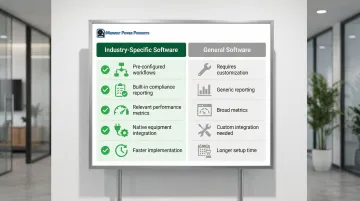
Research whether software understands your industry's workflows, compliance requirements, and performance metrics. Generic tools often require extensive customization to match industry-specific processes.
Industry-specific software provides:
- Pre-configured workflows matching your operational sequence
- Built-in compliance reporting for your regulatory environment
- Performance metrics relevant to your industry (PPOH for laundries, OEE for discrete manufacturing)
- Integration with equipment common in your sector
For specialized industries like industrial laundry, healthcare linen, or uniform services, purpose-built platforms like Softrol's Total Plant Management deliver faster implementation and better operational fit than adapting general manufacturing software.
Analyze Total Cost of Ownership
Calculate not just licensing costs but implementation time, training requirements, ongoing maintenance, and potential productivity loss during transition.
Typical cost components:
- Software licensing (perpetual or subscription)
- Implementation services and integration
- Hardware (sensors, network infrastructure, displays)
- Training and change management
- Ongoing support and maintenance
- System upgrades and expansion
Implementation timelines vary significantly: simple reporting tools deploy in 3-6 months, while comprehensive plant management systems require 6-24 months including integration, training, and optimization. Factor in the opportunity cost of delayed benefits when comparing options.
Verify Vendor Support and Longevity
Investigate the vendor's track record in your industry, customer retention rates, support responsiveness, and financial stability for long-term partnership.
Evaluation criteria:
- Years serving your specific industry
- Customer references with similar operational scale
- Support availability (24/7 vs. business hours)
- Average response time for critical issues
- Financial stability and company ownership structure
- Product roadmap and investment in R&D
Vendors with deep industry expertise understand operational nuances that generalists miss. For example, Softrol has served the textile services industry for over 35 years, providing specialized automation solutions for laundries, uniform services, and healthcare linen operations—experience that translates to faster implementations and better understanding of sector-specific challenges.
Key Benefits of Operational Efficiency Software
Reduced Operational Costs
Operational efficiency software delivers direct cost savings through:
- Automation of manual tasks and elimination of redundant data entry
- Optimized resource allocation across production schedules
- Prevention of costly errors through validation and control systems
MES implementations achieve 75% increases in revenue per full-time employee by removing manual logging of inventory, quality checks, and shift reports.
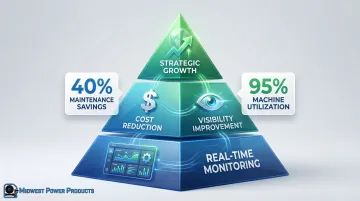
Maintenance cost reductions of 40% are typical when shifting from reactive or fixed-schedule maintenance to predictive approaches enabled by real-time monitoring. Energy and material consumption optimization further reduce operating expenses through precise control and waste elimination.
Improved Visibility and Decision-Making
Beyond cost reduction, operational efficiency software transforms how managers monitor and respond to production challenges.
Real-time performance dashboards replace end-of-shift reports, enabling immediate response to production issues. Automated alerts for exceptions ensure managers address problems within minutes rather than hours or days.
PlantStar customers realized 95% increases in machine utilization by gaining visibility into "hidden" downtime like micro-stops. This transparency allows managers to reclaim lost capacity without capital investment in new equipment.
Beyond real-time monitoring, trend analysis identifies improvement opportunities that manual tracking misses. Digital quality management systems reduce scrap by 35% and improve first-pass yield through statistical process control and automated defect tracking.
Enhanced Scalability and Growth Support
The visibility and data infrastructure these systems provide also enable organizations to scale operations more effectively.
Standardizing processes across multiple sites becomes manageable with centralized monitoring and management. Remote access capabilities allow managers to oversee distributed operations from any location, reducing travel requirements and enabling faster response to issues.
The data infrastructure created by operational efficiency software supports continuous improvement initiatives through objective performance measurement. Organizations can benchmark sites against each other, identify best practices, and replicate success systematically.
Common Implementation Challenges and Solutions
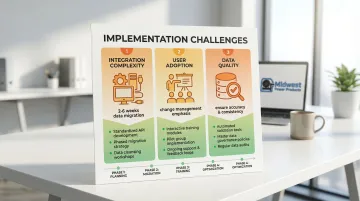
Successful software implementation requires addressing three critical challenge areas: technical integration, user acceptance, and data integrity.
Integration Complexity with Legacy Equipment
Legacy PLCs and SCADA systems often lack modern connectivity, creating integration bottlenecks. Address this challenge by:
- Selecting software with proven connectors for your specific equipment brands
- Planning phased rollouts that start with newer equipment
- Working with vendors experienced in your industry who understand common legacy systems
- Budgeting for protocol converters or edge devices as needed
Data migration alone can take 2-6 weeks for cleaning and transferring master data like BOMs and routings.
User Adoption and Change Management
Beyond technical integration, the human element often determines implementation success. Staff resistance creates significant implementation risk. Overcome this through:
- Early staff involvement in selection process to build buy-in
- Comprehensive training programs with hands-on practice
- Demonstrating quick wins that prove value to skeptical users
- Designating internal champions who advocate for the system
- Providing ongoing support during the transition period
Softrol's touchscreen interfaces minimize training requirements by providing intuitive, visual controls that reduce learning curves compared to complex software interfaces.
Data Quality and Standardization Issues
While technical and human factors receive significant attention, data quality issues can quietly sabotage even well-planned implementations. Inconsistent data definitions and poor quality undermine system effectiveness. Resolve these issues by:
- Conducting data audits before implementation
- Establishing clear data governance policies
- Using implementation as an opportunity to clean up processes
- Defining standard terminology and metrics across the organization
- Building validation rules into the system to prevent bad data entry
Conclusion
Operational efficiency software delivers measurable ROI through automation, real-time visibility, and process optimization. Success depends on choosing solutions that align with your industry's specific requirements.
The divide between manufacturers leveraging data to predict and prevent losses versus those bleeding capital through unplanned downtime continues to widen.
With downtime costs averaging $260,000 per hour according to industry analysis and ongoing labor shortages, operational efficiency software has become essential for sustaining profitability. Target proven ROI benchmarks—21-26% OEE gains, 40% maintenance savings, and 15-30% reductions in manual data tasks—when building business cases for investment.
Start by evaluating your most pressing operational challenges.
Seek software with proven track records in your specific industry. If you operate in industrial laundry and textile services, Softrol's Total Plant Management solutions provide integrated efficiency from sort to finish. With over 35 years specializing in the textile services industry, Softrol has helped customers achieve documented results including 77% labor reductions and 35% productivity improvements.
Frequently Asked Questions
What is operational efficiency software?
Operational efficiency software automates manual processes, provides real-time visibility, and optimizes resource utilization to reduce costs in industrial settings. Unlike general business tools, it integrates directly with production equipment and control systems like PLCs and SCADA.
What are examples of operational efficiency in software?
Concrete examples include automated work order routing that eliminates manual dispatching, real-time equipment monitoring with predictive maintenance alerts, integrated plant data dashboards consolidating information from multiple systems, automated compliance reporting with audit trails, and workflow automation that eliminates manual data transfer between systems.
How does operational efficiency software differ from general business software?
Operational efficiency software integrates with production equipment (PLCs, SCADA) for real-time shop floor monitoring and control, while general business software handles administrative tasks without direct machinery integration.
What ROI can I expect from operational efficiency software?
Typical implementations deliver 15-30% reduction in manual labor, 20-40% faster issue resolution, and 21-26% OEE improvements with 40% maintenance cost reductions. Results vary based on your baseline and implementation approach.
How long does it take to implement operational efficiency software?
Simple tools deploy in 3-6 months, while comprehensive systems require 6-24 months. Cloud MES solutions can pilot in 4-8 weeks, but enterprise on-premise systems need 9-12+ months. Phased rollouts deliver faster value.
Should I choose industry-specific or general operational efficiency software?
Choose industry-specific solutions when available—they require less customization and better understand your workflows, compliance needs, and metrics. General tools work when specialized options don't exist, but expect longer implementation and more extensive customization.