Manufacturing ERP software has evolved from basic record-keeping systems into mission-critical platforms that unify production planning, inventory management, quality control, and financial operations. With the global ERP market reaching $66 billion in 2024 and cloud solutions now accounting for 70% of deployments, manufacturers are replacing legacy infrastructure with modern systems that integrate IoT devices, embed AI capabilities, and deliver measurable ROI through productivity gains of 10-20% and downtime reductions of 30-50%.
TL;DR
- Modern manufacturing ERP systems unify production, inventory, quality, and financials for real-time operational control
- Leading 2025 platforms range from SMB-focused cloud solutions to enterprise-grade systems with industry-specific modules
- Choose based on scalability needs, deployment preferences, integration requirements, and total ownership costs
- Plan for 3-24 month implementations depending on company size—proper planning prevents the 70% failure rate seen in rushed deployments
What is Manufacturing ERP Software?
Manufacturing ERP (Enterprise Resource Planning) is specialized software that unifies all critical manufacturing processes—production planning, shop floor control, inventory management, supply chain operations, quality management, and financial operations—on a single integrated platform.
Manufacturing ERP includes purpose-built modules for bill of materials (BOM) management, production scheduling, capacity planning, shop floor data collection, and manufacturing-specific compliance tracking—capabilities that general business software lacks.
Manufacturing ERP bridges business planning (ISA-95 Level 4) with physical production execution. General ERP manages finance and HR, but manufacturing ERP integrates these functions with the technical requirements of converting raw materials into finished goods.
Core Manufacturing Capabilities
Essential modules include:
- Bill of Materials (BOM): Defines product components, assemblies, and sub-assemblies with precise specifications
- Material Requirements Planning (MRP): Calculates material needs based on demand forecasts, lead times, and current inventory levels
- Capacity Planning: Balances production demand against available machine hours and labor resources
- Shop Floor Control: Manages work orders, tracks labor efficiency, and monitors real-time production status
Evolution to Cloud and Smart Manufacturing
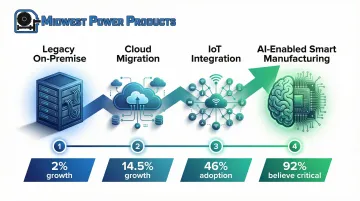
These systems have transformed from legacy on-premise platforms that required heavy IT maintenance and manual upgrades (now growing at just 2% annually according to Gartner) to cloud-native platforms growing at 14.5% yearly.
Modern systems embed AI for predictive maintenance (delivering 300-500% ROI according to McKinsey), integrate directly with IoT devices (used by 46% of manufacturers per MPI Group research), and provide real-time analytics that support Industry 4.0 initiatives. With 92% of manufacturers believing smart manufacturing will drive competitiveness over the next three years, today's ERP platforms function as systems of action rather than passive systems of record.
Top 10 Manufacturing Software Solutions for 2025
These solutions represent the most robust options for manufacturers seeking to modernize operations in 2025, selected for verified market presence and proven performance across diverse manufacturing environments.
NetSuite ERP
Oracle's cloud-native ERP platform serves 37,000+ installations globally, offering comprehensive manufacturing functionality for small to large enterprises across discrete, process, and mixed-mode manufacturing. NetSuite was named a Leader in the 2025 Gartner Magic Quadrant for Cloud ERP.
Key differentiators include:
- Unified data model that eliminates information silos
- Advanced inventory optimization capabilities
- Real-time production visibility across multiple locations
- Robust multi-subsidiary management for growing companies
- Extensive third-party integration ecosystem
- SuiteSuccess implementation methodology for faster time-to-value
| Feature | Details |
|---|---|
| Deployment Options | Cloud-only (SaaS), multi-tenant architecture |
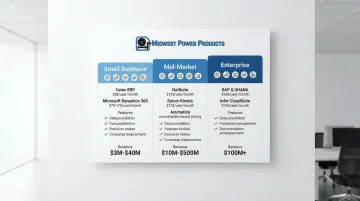
| Best For | Growing manufacturers ($10M-$500M revenue), multi-location operations, companies requiring rapid scalability |
| Starting Price Range | $125/user/month, implementation from $10K-$100K depending on complexity |
Epicor Kinetic
Formerly Epicor ERP, this system serves 23,000+ mid-market discrete manufacturers across 150 countries. Epicor Kinetic was also recognized as a Leader in the 2025 Gartner Magic Quadrant.
The platform excels in automotive, aerospace, industrial machinery, and metal fabrication with deep industry expertise.
Key strengths include:
- Advanced configurator for complex configure-to-order (CTO) and engineer-to-order (ETO) environments
- Comprehensive quality management modules for regulatory compliance
- Flexible deployment options (cloud, on-premise, hybrid)
| Feature | Details |
|---|---|
| Deployment Options | Cloud, on-premise, or hybrid deployment models |
| Best For | Mid-sized discrete manufacturers ($10M-$100M revenue), complex CTO and ETO environments |
| Starting Price Range | $125/user/month, minimum implementation $50K, typical range $100K-$500K |
SAP S/4HANA
Built on SAP's powerful HANA in-memory database platform, S/4HANA serves as the enterprise-grade solution with extensive manufacturing installations suitable for large manufacturers and mid-market companies implementing their first comprehensive ERP system. With SAP's total customer base exceeding 141,000 organizations, the platform offers unmatched global reach.
Key differentiators include:
- Joule AI integration for intelligent automation
- Advanced material requirements planning (MRP) capabilities
- Comprehensive multi-site and multi-currency functionality
- Extensive compliance management for regulated industries
- Deep industry-specific functionality
The in-memory database enables real-time processing of massive data volumes that traditional systems cannot handle.
| Feature | Details |
|---|---|
| Deployment Options | Cloud (public, private), on-premise, available through SAP or partner channels |
| Best For | Large enterprises ($100M+ revenue), global manufacturers, highly regulated industries requiring deep compliance capabilities |
| Starting Price Range | $200/user/month, minimum implementation $75K, typical range $200K-$1M+ for enterprise deployments |
Microsoft Dynamics 365 Business Central
Microsoft's modern cloud-native ERP serves approximately 45,000 cloud customers, offering excellent value for small to mid-sized manufacturers through familiar Microsoft interface, straightforward pricing, and rapid implementation timelines. The platform leverages Microsoft's extensive partner ecosystem for industry-specific extensions.
Advantages include:
- Seamless integration with Microsoft 365 (Office, Teams)
- Power BI analytics and Azure cloud infrastructure
- Strong financial management capabilities
- Flexible customization through Power Platform low-code tools
- Cost-effective subscription models for Microsoft-invested manufacturers
| Feature | Details |
|---|---|
| Deployment Options | Cloud-only (SaaS), built on Microsoft Azure infrastructure |
| Best For | Small to mid-sized manufacturers ($5M-$100M revenue), companies already invested in Microsoft ecosystem |
| Starting Price Range | $70-$175/user/month depending on licensing tier, minimum implementation $35K |
Acumatica Cloud ERP
The fastest-growing cloud ERP with 10,000+ installations since 2008 features unique consumption-based licensing (unlimited users), modern architecture, and strong manufacturing capabilities for discrete and mixed-mode operations. Acumatica was named a Leader in the 2025 Nucleus Research SMB ERP Technology Value Matrix.
Differentiators include:
- Flexible deployment across public, private, or hybrid cloud environments
- Extensive customization capabilities without code through xRP platform
- Strong project manufacturing functionality
- Vendor commitment to innovation (70% of resources in technical roles)
- Consumption-based pricing that eliminates per-user costs
| Feature | Details |
|---|---|
| Deployment Options | Public cloud, private cloud, or hybrid deployment with flexible hosting options |
| Best For | Mid-sized discrete manufacturers ($10M-$50M revenue), project-based manufacturers, growing companies needing scalability |
| Starting Price Range | Consumption-based pricing (not per-user), typical range $7.5K-$150K annually depending on usage |
Infor CloudSuite Industrial (SyteLine)
This comprehensive solution serves manufacturers requiring deep shop floor integration and advanced planning capabilities. Infor's total customer base exceeds 60,000 organizations globally, with CloudSuite Industrial specifically designed for complex discrete and mixed-mode operations.
Key strengths include:
- Industry-specific templates for automotive, aerospace, and industrial equipment
- Advanced finite capacity scheduling that accounts for actual machine constraints
- Integrated quality management modules
- Infor OS platform with Coleman AI for AI-driven insights
- AWS-based cloud infrastructure for reliability and scalability
| Feature | Details |
|---|---|
| Deployment Options | Cloud (AWS-based), on-premise, hybrid models available |
| Best For | Large discrete manufacturers ($50M-$500M revenue), complex mixed-mode operations, multi-site enterprises |
| Starting Price Range | $150/user/month, implementation starting at $25K, typical range $100K-$500K |
QAD Adaptive ERP
Purpose-built manufacturing ERP serving customers in 84 countries features the advanced Champion AI platform that provides autonomous optimization and proactive issue identification. QAD's November 2025 product enhancements introduced agentic AI capabilities that proactively identify and resolve operational issues.
The unique AI-driven approach includes:
- Three agent types (Implementation, Productivity, Business Optimization)
- Deep vertical expertise in automotive, life sciences, food & beverage
- Rapid implementation methodology enabling 90-day deployments
- Strong supply chain planning (DSCP) and global trade capabilities
| Feature | Details |
|---|---|
| Deployment Options | Cloud-native on AWS infrastructure, true multi-tenant SaaS architecture |
| Best For | Manufacturers in regulated industries, automotive supply chain, food & beverage with catch-weight requirements, companies prioritizing AI capabilities |
| Starting Price Range | $250/user/month, minimum implementation $25K, typical range $100K-$500K |
Sage X3
This versatile ERP serves 7,000+ installations globally, handling both discrete and process manufacturing with strong multi-site and multi-national capabilities, scalable to 1,500 users. Sage X3 excels in environments requiring complex financial consolidation across multiple entities and jurisdictions.
Advantages include:
- Flexible deployment options (cloud, on-premise, hybrid)
- Strong financial management powered by Sage Intelligence reporting tools
- Comprehensive workflow capabilities for business process automation
- Excellent fit for international operations with multi-currency and multi-legislation support
| Feature | Details |
|---|---|
| Deployment Options | Cloud, on-premise, hybrid deployment models available |
| Best For | Mid-market manufacturers ($25M-$250M revenue), multi-national operations, companies requiring strong financial consolidation |
| Starting Price Range | $75/user/month, implementation minimum $100K, typical range $100K-$250K |
DELMIAWorks (formerly IQMS)
This unique single-vendor solution combines ERP and Manufacturing Execution System (MES) capabilities in one integrated platform, eliminating the complexity of separate best-of-breed integrations. Part of Dassault Systèmes' 3DEXPERIENCE ecosystem, DELMIAWorks provides seamless integration with SOLIDWORKS and other design tools.
Strengths include:
- "Shop floor first" design philosophy
- Real-time shop floor visibility through native MES functionality
- Comprehensive quality management integration
- Deep expertise in process manufacturing
- 2025 release added 3DEXPERIENCE Bridge for enhanced BOM management and MQTT protocol for IoT integration
| Feature | Details |
|---|---|
| Deployment Options | Cloud (subscription), on-premise (lease), part of 3DEXPERIENCE ecosystem |
| Best For | Process and mixed-mode manufacturers, automotive, plastics, food & beverage requiring tight ERP-MES integration |
| Starting Price Range | $250/user/month, minimum implementation $20K, typical range $50K-$300K |
Cetec ERP
This modern web-native solution represents the most cost-effective option for small to mid-sized manufacturers with zero-cost implementation option and straightforward subscription model. The fully web-based architecture requires no client installation, enabling access from any device with a browser.
Advantages include:
- Comprehensive functionality despite lower price point
- Integrated quality management system (QMS)
- Accessible entry point for first-time ERP implementations
- Transparent pricing without hidden fees
- Ideal for high-mix, low-volume job shops requiring flexibility
| Feature | Details |
|---|---|
| Deployment Options | Cloud-only, fully web-native SaaS platform |
| Best For | Small manufacturers ($3M-$40M revenue), first-time ERP buyers, companies prioritizing cost-effectiveness |
| Starting Price Range | $50/user/month, zero-cost implementation option available, typical total cost $3K-$40K annually |
Key Features to Look for in Manufacturing ERP Software
Production Planning and Scheduling
Effective production planning capabilities should include several core components. Master production scheduling (MPS) translates demand forecasts into production plans, while material requirements planning (MRP) calculates component needs based on BOMs and lead times.
The system should also provide capacity planning that balances demand against available resources, plus what-if scenario modeling for optimizing production flow.
Modern systems distinguish between finite scheduling (accounts for actual machine and labor constraints) and infinite scheduling (assumes unlimited resources).
Finite capacity planning provides more realistic production schedules by considering bottlenecks and resource limitations, essential for complex manufacturing environments.
Inventory and Supply Chain Management
Strong inventory management requires visibility across your entire operation. Key capabilities include:
- Multi-location inventory tracking with real-time visibility
- Lot and serial number traceability for regulatory compliance and quality control
- AI-driven demand forecasting using predictive models
- Supplier management with automated purchase order generation and delivery tracking
- Real-time inventory visibility to minimize carrying costs while preventing stockouts
According to 2024 industry data, supply chain lead times remain 21% higher than pre-pandemic levels, making strong supply chain planning capabilities essential for manufacturers seeking resilience.
Quality Management System (QMS) Integration
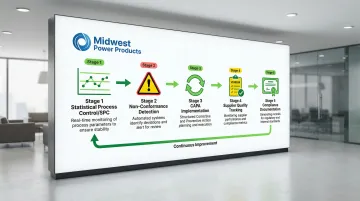
Beyond inventory control, quality management plays a critical role in manufacturing operations. Regulated industries require comprehensive QMS capabilities including:
- Statistical Process Control (SPC): Real-time monitoring of production quality metrics
- Non-conformance Tracking: Documentation and analysis of quality issues
- Corrective and Preventive Actions (CAPA): Systematic approach to resolving quality problems
- Supplier Quality Management: Tracking vendor performance and certifications
- Compliance Documentation: Automated record-keeping for FDA 21 CFR Part 11, ISO 9001, and industry-specific standards
Systems like DELMIAWorks and Cetec ERP offer embedded QMS modules that reduce integration complexity compared to separate best-of-breed solutions.
Shop Floor Control and MES Capabilities
Quality management connects directly to production execution. The boundary between ERP and Manufacturing Execution Systems (MES) continues blurring as modern platforms integrate real-time shop floor functionality:
- Work order management with digital routing and operation sequencing
- Labor tracking with time capture and efficiency monitoring
- Machine monitoring through IoT integration using protocols like MQTT
- Real-time production data collection for immediate visibility
- Downtime tracking and Overall Equipment Effectiveness (OEE) calculation
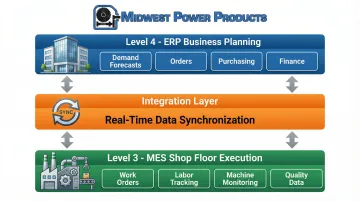
The ISA-95 standard defines effective manufacturing architecture. It requires bidirectional synchronization between Level 4 (ERP business planning) and Level 3 (MES shop floor execution).
This integration ensures data consistency and enables rapid response to production issues.
Reporting and Analytics
Decision-makers require:
- Real-time dashboards with customizable KPIs for production, quality, and financial metrics
- OEE (Overall Equipment Effectiveness) tracking to identify improvement opportunities
- Customizable reports that address specific operational questions
- Business intelligence integration with tools like Power BI or Tableau
- Mobile access enabling managers to monitor operations from anywhere
According to recent manufacturing surveys, 29% of manufacturers now use AI and machine learning capabilities. Advanced analytics that provide predictive insights rather than just historical reporting are now expected features in modern ERP systems.
How to Choose the Right Manufacturing ERP System
Conduct Thorough Requirements Analysis
Begin by documenting current pain points through interviews with stakeholders across production, finance, quality, and IT departments. Identify must-have features (non-negotiable capabilities) versus nice-to-have features (beneficial but not critical).
Map current workflows to understand where automation and integration will deliver maximum value, and establish measurable success criteria tied to business objectives.
This discovery phase takes 4-8 weeks for mid-market manufacturers but pays dividends by preventing scope creep and ensuring alignment between software capabilities and actual business needs.
Structure Your Evaluation Process
Create a weighted scorecard based on your specific requirements, assigning higher values to must-have capabilities. Request vendor demos focused on your manufacturing mode (discrete, process, mixed-mode) rather than generic presentations.
Validate vendor claims through reference checks with similar manufacturers in your industry and revenue range.
Calculate total cost of ownership (TCO) over a 3-5 year period including:
- Software licensing or subscription fees
- Implementation services and consulting
- Customization and integration costs
- Training expenses for end users and administrators
- Ongoing support and maintenance fees
- Infrastructure costs (for on-premise deployments)
According to Panorama Consulting's ERP Report, implementation costs typically range from 1-3x annual software costs, making TCO analysis critical for accurate budgeting.
Evaluate Deployment Models
Once you've established your requirements and evaluation criteria, consider which deployment model best fits your operational needs.
Cloud ERP advantages:
- Lower upfront costs with subscription pricing
- Automatic updates and feature releases
- Accessibility from anywhere with internet connection
- Reduced IT infrastructure requirements
On-premise ERP advantages:
- Greater control over data and security
- No ongoing subscription fees (though maintenance costs apply)
- Ability to customize extensively without vendor restrictions
- No dependency on internet connectivity
According to Gartner, cloud ERP is growing at 14.5% annually compared to just 2% for on-premise systems, with most manufacturers now opting for cloud or hybrid deployments.
However, companies with strict data sovereignty requirements or extensive existing infrastructure may still prefer on-premise solutions.
Plan Implementation Realistically
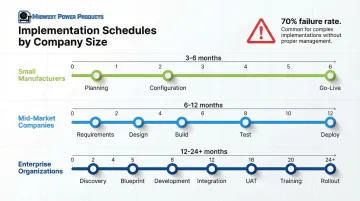
Establish realistic timeline expectations based on company size and complexity:
- Small manufacturers: 3-6 months for straightforward implementations
- Mid-market companies: 6-12 months with moderate customization
- Enterprise organizations: 12-24+ months for multiple sites and complex integrations
Allocate dedicated internal resources for project management. ERP implementations fail when treated as IT-only initiatives rather than business transformation projects. Decide between phased rollout (implementing modules sequentially) versus big-bang approach (going live all at once), with phased implementations offering lower risk but longer timelines.
Budget for comprehensive change management and training. With 70% of ERP projects failing to fully meet their original business goals and 25% failing catastrophically, the human element of adoption often determines success more than technical capabilities.
Conclusion
Selecting the right manufacturing ERP software for 2025 requires careful evaluation of your company's specific manufacturing mode, industry requirements, growth trajectory, and budget constraints. The best system aligns with operational goals rather than choosing the most popular or feature-rich option.
Top solutions by business size:
- Mid-market discrete manufacturers: NetSuite and Epicor Kinetic
- Large enterprises: SAP S/4HANA for global capabilities
- Smaller operations: Microsoft Dynamics 365 Business Central and Cetec ERP
Assess not just initial software costs but total cost of ownership—including implementation, customization, training, ongoing support, and future scalability. Prioritize vendors with proven track records in your specific industry, and validate their claims through reference checks with similar companies.
For manufacturers in specialized industries, vertical-specific solutions often provide better fit than general ERP systems. Textile services and industrial laundry operations, for example, benefit from purpose-built platforms like Softrol's Total Plant Management software.
These specialized systems include capabilities general ERPs lack—real-time production monitoring, garment tracking, chemical dispensing integration, and material handling automation. For operations requiring comprehensive plant management, vertical-specific platforms often deliver better ROI alongside or as alternatives to general ERP systems.
Frequently Asked Questions
What are the manufacturing industry trends in 2025?
Key trends include AI-driven predictive maintenance delivering 300-500% ROI, IIoT adoption reaching 46% of manufacturers, supply chain resilience through nearshoring, and automation investments driven by 622,000 unfilled US manufacturing positions.
What is the future of manufacturing ERP in 2025?
The future centers on cloud-native architectures growing 14.5% annually, embedded AI for autonomous decisions, and composable ERP with microservices architecture. Low-code platforms now enable business users to customize workflows without IT dependency.
What is the best software for manufacturing?
The best solution depends on your company size, manufacturing type, and industry requirements. Mid-market manufacturers ($10M-$100M) typically choose NetSuite or Epicor Kinetic, while small businesses often select Microsoft Dynamics 365 Business Central for cost-effectiveness. Specialized industries benefit from purpose-built solutions like Softrol Total Plant Management for textile services.
How much does manufacturing ERP software cost?
Small manufacturers typically invest $30K-$150K (software plus implementation), mid-market companies $100K-$500K, and enterprises $500K-$2M+. Cloud subscriptions range from $50-$250/user/month, with implementation fees typically 1-3x annual software costs.
What is the difference between ERP and MES systems?
ERP handles business-level planning (finance, orders, purchasing) answering "What should we produce and when?" MES provides real-time shop floor control (work execution, labor tracking, quality data) answering "How are we producing it right now?" Modern platforms increasingly integrate both functions.
How long does it take to implement manufacturing ERP?
Small manufacturers typically need 3-6 months, mid-market companies 6-12 months, and enterprises 12-24 months. Since 70% of implementations fail to meet original goals, adequate planning and stakeholder engagement matter more than aggressive timelines.