Introduction
Industrial laundry operations face a persistent challenge: maintaining consistent cleaning quality across thousands of wash cycles while controlling costs and meeting strict hygiene standards. Many operations managers and plant supervisors encounter rewash rates between 3-5% — a small percentage that can cost facilities over $125,000 annually in wasted labor, chemicals, and energy.
A catalyst chemical system is an integrated setup that uses catalytic chemical agents — delivered through automated dispensing infrastructure — to accelerate and control chemical reactions in an industrial wash process. This guide walks through how these systems work chemically and mechanically, how to evaluate them, and what separates a well-configured system from one that's costing you money.
That definition sounds straightforward, but the term is used loosely across the industry — often without distinguishing between the chemistry involved and the delivery infrastructure. That confusion leads to real consequences: operational errors, inefficient chemical use, fabric damage, and compliance failures that show up in your audit reports and your labor costs.
TL;DR
- A catalyst chemical system delivers chemical agents at precise times, doses, and sequences to accelerate reactions without being consumed in the process
- Properly configured systems reduce chemical waste by 25-40%, protect fabric integrity, and support repeatable results at industrial scale
- Performance depends on chemical concentration, water temperature, contact time, and dispensing precision
- Misconfigured systems drive up rewash rates, accelerate fabric wear, and inflate chemical costs
- Load-specific wash formulas are essential; one-size-fits-all approaches consistently produce under-cleaning or overspending
What Is a Catalyst Chemical System?
A catalyst is a substance that lowers the activation energy of a chemical reaction, making it happen faster or at lower temperatures. Unlike reagents, catalysts aren't consumed in the process — they remain chemically unchanged after the reaction completes.
A "catalyst chemical system" covers both the catalytic chemical agents themselves AND the mechanism by which they are introduced into the process. This includes dosing pumps, timing controls, concentration sensors, and injection points — all working together to deliver precise chemistry at the right moment.
Three Classes of Catalysts in Laundry Operations
Homogeneous catalysts exist in the same phase as the reactants. In laundry, this includes liquid detergent solutions where the catalyst and soil are both dissolved or suspended in water.
Heterogeneous catalysts exist in a different phase than the reactants. These are less common in laundry but appear in specialized applications where solid catalysts interact with liquid or gaseous reactants.
Enzymatic catalysts are biological catalysts used extensively in modern laundry chemistry:
- Proteases break down protein-based soils (blood, sweat, grass, dairy, eggs)
- Amylases target starch molecules (pasta, potato, rice residues)
- Lipases hydrolyze fats and oils (grease, butter, cosmetics)
The Critical Property: Selectivity
A well-chosen catalyst doesn't just speed up any reaction — it directs the reaction toward a desired outcome while limiting unwanted side reactions. For example, proteases specifically break down protein soils without degrading the cellulose fibers in cotton linens. This selectivity is what makes catalyst chemical system design operationally significant — it determines whether a wash formula cleans effectively without shortening linen life.
Without selectivity, you'd accelerate fabric degradation along with soil removal, drastically shortening linen life and increasing replacement costs.
Why Industrial Laundries Rely on Catalyst Chemical Systems
Industrial laundry places extreme demands on chemistry that manual or imprecise dosing cannot meet consistently:
- High throughput requirements (thousands of pounds per shift)
- Variable soil loads (blood, grease, food, industrial oils)
- Mixed fabric types with different tolerance levels
- Regulated hygiene standards (HLAC, TRSA guidelines)
- Tight water and energy efficiency targets
The Cost of Poor Chemical Control
Without a properly functioning catalyst chemical system, operations experience measurable losses across four areas:
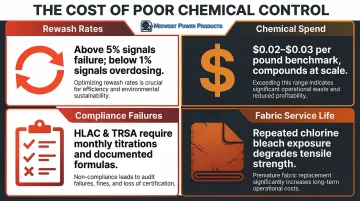
- Rewash rates climb above 5% when soil removal is inconsistent — a threshold that signals significant operational failure. Rates below 1% indicate the opposite problem: chemical overdosing.
- Chemical spend escalates beyond the standard 5-10% of operating costs. Industry benchmarks put chemistry at $0.02-$0.03 per pound in healthcare laundry — small per-unit figures that compound quickly at scale.
- Compliance failures accumulate when cycles are under-dosed. HLAC (2023 Standards) and TRSA Hygienically Clean certification both require monthly titrations, calibrated delivery systems, and documented wash formulas for every textile classification.
- Fabric service life shortens with overdosed cycles. Chlorine bleach causes measurable decreases in tensile strength after repeated exposure — degrading the 98% of linen that arrived clean in the first place.
Compliance Is No Longer Optional
Healthcare and food service linen operations must maintain documented, repeatable wash formulas with verified chemical delivery. Both TRSA and HLAC make this explicit: without a calibrated dispensing system producing auditable records, accreditation is at risk — not just quality.
The Efficiency Advantage
Automated catalyst chemical systems allow plants to run precise wash formulas that optimize chemical spend against cleaning outcomes. That precision cuts both underuse (quality failures) and overuse (cost and environmental impact). Case studies demonstrate that properly configured low-temperature enzymatic systems achieve 25% energy savings and 39% water savings compared to traditional high-temperature programs.
How a Catalyst Chemical System Works
A wash formula specifies which chemicals are needed, in what quantities, and at which points in the wash cycle. The catalyst chemical system reads these parameters and executes dosing automatically, triggered by machine signals or time-based controls.
The Role of Activation Energy
Catalysts allow chemical reactions — such as breaking apart grease or protein soil from fiber surfaces — to occur at lower temperatures or in shorter time windows. This directly supports energy efficiency and cycle time reduction. Modern laundry enzymes deliver optimal performance between 20-40°C (68-104°F), enabling effective cleaning without the energy cost of high-temperature wash cycles.
Catalyst chemical systems are applied throughout the industrial laundry workflow — primarily at the wash aisle (washer-extractors and tunnel washers), but also at:
- Pre-spray and break points
- Carry-over stages
- Final rinse cycles
Each application point requires different chemical types and dosing precision.
Step 1: Signal Detection and Formula Activation
The process begins when the washing machine sends a signal — either a dry contact signal, a serial communication command, or a time-based trigger — indicating which phase of the wash cycle has started. The chemical system reads this against the programmed formula and identifies which chemical(s) to dispense and in what volume.
Signal integration ensures chemicals are introduced at the precise moment when temperature, mechanical action, and water levels are optimized for that specific chemistry.
Step 2: Precise Chemical Measurement and Injection
The system measures and delivers the correct dose using peristaltic pumps, pneumatic pumps, or flow-metered systems that draw chemical from supply containers and inject it into the wash at the designated point. Accuracy at this stage is critical — errors in volume directly affect both cleaning performance and chemical economy.
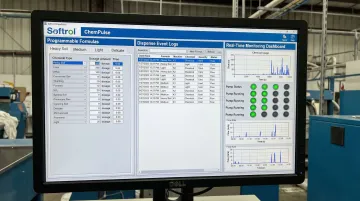
Softrol's ChemPulse chemical dispensing platform automates this step with programmable formula control, eliminating manual measurement variability between operators and shifts. The platform includes:
- Flow meter-based injection for volumetric accuracy
- Water flush verification after each dispense
- Automated alarms for chemical delivery failures
- Real-time feedback for washroom operations
Step 3: Reaction, Monitoring, and Cycle Completion
Once the agent is introduced, the catalyst lowers the activation barrier for the target reaction — soil breakdown, pH adjustment, bleaching — allowing the reaction to proceed efficiently within the available time and temperature window.
After the cycle, advanced systems log the dispense event for traceability and quality audit purposes. Facilities operating under HLAC or TRSA certification rely on these records to meet monthly verification requirements for chemical delivery accuracy.
Key Factors That Affect Catalyst Chemical System Performance in Laundry Operations
Water Quality and Temperature
Hardness interference: Hardness minerals (calcium and magnesium) react with anionic surfactants to form insoluble "lime soap" curds. This prevents lathering and consumes detergent before it can clean, leading to soil redeposition and linen greying.
Critical thresholds:
- Below 3.5 grains per gallon (gpg): Standard detergent formulations work effectively
- Above 10-12 gpg: Commercial water softener or specialty sequestrants required
- Above 12 gpg: Must switch from built detergent to separate break/suds systems
Temperature effects: While catalysts lower the required temperature threshold, they don't eliminate it. A process running below minimum effective temperature will underperform even with correct dosing. Oxygen bleach typically requires temperatures above 180°F (82°C) to activate, whereas low-temperature bleach activators allow efficacy at 140°F (60°C).
Soil Load Variability
A formula calibrated for lightly soiled hotel linens will under-dose on heavily soiled industrial workwear. Effective systems are programmed with multiple formulas, each matched to a specific load classification.
HLAC standards mandate that environmental cleaning textiles (mops, microfiber cloths) be processed in separate wash loads from healthcare textiles intended for patient use. Textiles with hazardous drug contamination require a pre-wash in a separate bag before the main wash.
Equipment and Mechanical Dependencies
The precision of the dispensing system itself directly affects whether the correct chemical reaches the drum in the correct concentration at the correct time:
- Pump calibration: Drift over time leads to under- or over-dosing
- Tubing condition: Degraded tubing can restrict flow or contaminate chemistry
- Check valve integrity: Failed check valves allow chemical backflow and cross-contamination
- Injection port placement: Poor positioning prevents proper chemical distribution
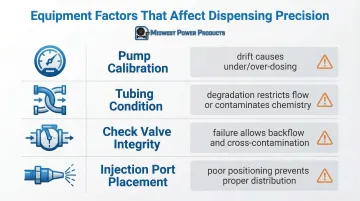
Regular calibration and preventive maintenance keep these components performing to spec — without that discipline, even the best chemistry will fall short.
Common Issues and Misconceptions About Catalyst Chemical Systems
Misconception: "More Chemical = Better Cleaning"
Catalysts work within specific concentration ranges — not on a sliding scale where more equals better. Below that range, the reaction is insufficient. Above it, excess chemical becomes waste and risks fabric damage or rinse compliance failures.
Overdosing does not proportionally improve cleaning. Instead, it leads to residue buildup, leaving linens stiff, rough, and uncomfortable. It also increases water and energy consumption needed for extra rinses and accelerates linen replacement rates due to fiber degradation.
Confusing the Catalyst with the System
Purchasing the right chemical doesn't guarantee results. A correct chemical delivered at the wrong time, wrong dilution, or wrong cycle phase will fail to perform just as reliably as the wrong chemical entirely.
System design and programming matter as much as the chemistry. Facilities with identical chemical suppliers routinely experience vastly different rewash rates and chemical costs — the gap comes down to how the catalyst chemical system is configured and maintained, not what's on the product label.
The Single-Formula Trap
That configuration gap shows up most clearly in formula management. Catalyst chemical systems support differentiated formulas for each load classification — using a single default formula for every load is a sign the system is running on habit rather than design.
This approach typically results in either under-cleaning (for heavily soiled loads) or over-spend on chemistry (for lightly soiled loads). Optimizing for the average means consistently missing both ends — rewash climbs for heavily soiled items while chemistry costs inflate for light loads. Both outcomes are avoidable with properly segmented programming.
Frequently Asked Questions
What is a catalyst system?
A catalyst system is the complete setup — chemical agents, delivery equipment, and controls — that introduces catalytic substances into a process at the right time and concentration. It accelerates a desired reaction without the catalyst itself being consumed.
What do chemical catalysts do?
Chemical catalysts lower the activation energy required for a reaction to occur, allowing it to proceed faster, at lower temperatures, or with greater selectivity toward a desired product — without the catalyst being permanently altered or used up in the process.
What are 5 examples of catalysts?
Five common catalyst examples:
- Enzymes — biological catalysts used in laundry detergents to break down soils
- Alkaline builders — boost surfactant performance in industrial wash formulas
- Manganese dioxide — accelerates hydrogen peroxide decomposition
- Acids and bases — used in ester hydrolysis and pH-sensitive wash steps
- Transition metal oxides — applied in industrial chemical production
How is a catalyst chemical system different from a standard chemical feed system?
A standard chemical feed system may deliver chemicals on a fixed schedule or by manual trigger, while a catalyst chemical system integrates with process equipment to deliver chemicals in response to specific cycle signals, ensuring timing and dose precision that align with the chemistry's activation requirements.
What happens if a catalyst chemical system misdoses or fails during a wash cycle?
Misdosing can cause several problems:
- Inadequate soil removal, leading to costly rewash cycles
- Fabric damage from chemical over-concentration
- Hygiene compliance failures in regulated industries
- Excess chemical discharge into wastewater
System monitoring, calibration, and real-time alerts exist specifically to prevent these outcomes.