For a single production line, an in-house engineering or IT team can often handle the rollout. But plant-wide deployments across legacy equipment usually call for a specialized automation partner who already knows the industry, whether that's textiles, food processing, or general manufacturing.
Poor implementation carries real costs: data blind spots, false alerts, integration failures, and lost ROI. Enterprise IoT project failure during trial or proof-of-concept climbed to 35% in 2021, up from 30% the year before, according to Microsoft's IoT Signals report. This guide walks through the full lifecycle, from planning to validation, so you avoid becoming another statistic.
Key Takeaways
- Treat implementation as a multi-phase project, not a one-day install
- Network audits, protocol checks, and defined KPIs prevent costly rework
- Match sensors, gateways, and platforms to your specific industrial environment
- Validate everything before going live to catch failures early
- Industry-specific vendor partners accelerate time to ROI
Implementation Guide for IoT Industrial Monitoring Systems
The process follows a fairly consistent sequence, and each phase builds on the last:
- Site and infrastructure assessment
- Sensor and device deployment
- System integration
- Dashboard and analytics configuration
- Validation
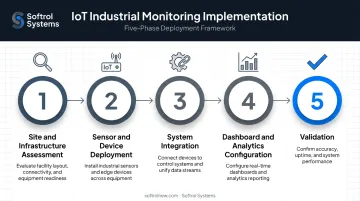
Skipping ahead usually means backtracking later.
Timeline expectations vary widely. A single-line pilot might take a few weeks. A plant-wide rollout with legacy PLCs and multiple production areas can stretch into several months. McKinsey research found that only 15% of industrial IoT initiatives reached scale within a year, while a quarter stayed stuck in pilot mode for more than two years.
These extended timelines often trace back to a skills gap. This work demands a mixed OT/IT skillset, since no single team has the full picture:
- Automation engineers understand the machinery and process flow
- IT teams manage networks, security, and data infrastructure
- Production teams need a seat at the table early, since sensor mounting and testing can disrupt active lines without careful scheduling around shift patterns and maintenance windows
Prerequisites and Planning Considerations
Before ordering a single sensor, confirm your plant is ready to support one.
Site and Network Readiness
Check three things first:
- Network infrastructure — does your wired or wireless bandwidth support continuous sensor traffic without degrading existing systems?
- Power availability — do sensor locations have accessible, reliable power?
- Physical space — is there room for gateways and controllers near the monitoring points, away from excessive heat or vibration?
Compatibility and Protocol Audits
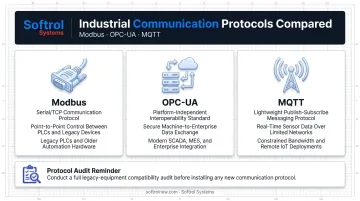
Older PLCs, SCADA systems, and machine controllers often speak different languages than modern IoT platforms. Before selecting sensors or software, audit what protocols your existing equipment actually supports:
- Modbus: a widely used application-layer protocol for client/server communication between industrial devices
- OPC-UA: an interoperability standard built for machine-to-machine and machine-to-enterprise data exchange
- MQTT: a lightweight publish-subscribe protocol suited to constrained bandwidth environments
Rockwell Automation's 2023 survey of over 1,300 manufacturers ranked integrating new technology among the top five internal growth obstacles, with roughly a third reporting outright "technology paralysis" when evaluating options. A full legacy-equipment audit should be your first planning task. It's the single best way to avoid discovering a protocol mismatch halfway through installation.
Safety, Compliance, and Non-Negotiables
Mounting sensors near active machinery introduces electrical safety considerations that need sign-off from plant safety staff. Data handling also needs to meet whatever industry or privacy requirements apply to your operation.
Do not proceed without these three things in place:
- A documented network security plan
- Stakeholder buy-in from both plant operations and IT leadership
- Clearly defined KPIs the system is meant to track
Tools and Technology Stack Required
The core stack is fairly consistent across industries, though the specifics shift depending on what you're monitoring.
Essential components:
- Environmental and process sensors (temperature, vibration, energy, flow)
- Edge gateways or controllers to aggregate and relay sensor data
- Reliable connectivity, wired or industrial wireless
- A cloud or on-premise analytics and dashboard platform
Generic sensor kits and consumer-grade IoT platforms often fall short once you scale to plant-wide monitoring. They weren't built for the interference, heat, and legacy protocol quirks of an industrial floor.
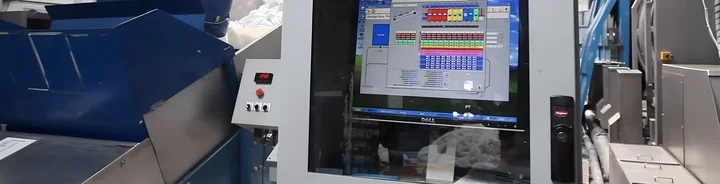
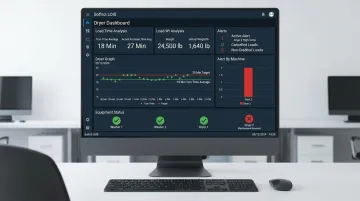
That's where purpose-built industry platforms earn their keep. Softrol's LOIS (Laundry Operation Information System), for example, gives plant managers remote access to real-time performance data built specifically around textile and laundry operations, rather than a generalized template stretched to fit.
What's Essential vs. What Can Wait
| Category | Day-One Essential | Valuable Enhancement |
|---|---|---|
| Data collection | Basic sensors, gateway | Predictive analytics |
| Alerting | Dashboard visibility | Mobile/SMS alerting |
| Visualization | Standard dashboards | Advanced tracking, such as Pan-N-Zoom rail visualization |
| Asset tracking | Manual logging | RFID, barcode, image-based code readers |
Specialized tools like image-based code readers or RFID become necessary once you move into sortation or asset-tracking use cases, where manual tracking simply can't keep pace. When comparing platforms, weigh general-purpose cloud IoT tools against industry-specific vendor platforms based on how much scalability and customization your operation actually needs, not just sticker price.
How to Implement (Step-by-Step)
Implementation follows a defined sequence. Skipping steps, particularly network stress-testing, is a common cause of delayed, hard-to-diagnose failures later.
- Conduct a site and infrastructure assessment. Audit existing equipment, test network capacity under load, and finalize the KPIs the system needs to monitor.
- Deploy sensors and edge devices. Position sensors at critical monitoring points, then securely mount and wire gateways so they're protected from vibration and heat.
- Integrate with existing plant systems. Connect the platform to PLCs, SCADA, or ERP systems, addressing mechanical, electrical, and digital layers together rather than one at a time.
- Configure dashboards, alerts, and analytics. Set realistic thresholds, define real-time alert channels (email or SMS), and assign user access levels by role. Softrol's LOIS platform, for example, gives plant managers this kind of remote visibility into performance data without requiring them to walk the floor.
Once those four steps are complete, don't flip the switch plant-wide. Pilot on a single line or process area first. A phased rollout reduces risk, validates your assumptions about sensor placement and thresholds, and gives you a working reference point before scaling further.
Post-Implementation Checks and Validation
Getting sensors installed isn't the finish line. Validation is where you catch problems before production depends on the system.
Visual and structural checks:
- Confirm sensors are securely mounted and won't shift under vibration
- Verify wiring is intact and properly routed
- Ensure nothing interferes with normal machine operation or maintenance access
Functional testing:
- Confirm data flows to the dashboard in real time, with no lag or dropped readings
- Test that alerts actually trigger at your configured thresholds
- Cross-check sensor readings against manual measurements to confirm accuracy
Skipping this stage tends to produce delayed failures rather than obvious ones. Inconsistent data flow, false alarms, or missed anomalies often don't surface until the system is fully relied upon, which is the worst possible time to discover a gap.
The stakes are high: ABB's 2023 survey of 3,215 plant-maintenance decision-makers found that unplanned downtime costs a typical industrial business nearly $125,000 per hour, with more than two-thirds experiencing outages at least monthly. A monitoring system that hasn't been properly validated can fail at exactly the moment it's needed most.
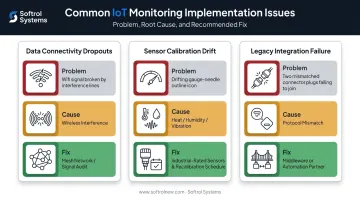
Common Implementation Problems and Fixes
Most implementation headaches fall into three recurring categories.
Issue 1: Data Connectivity and Network Dropouts
Problem: Intermittent data loss between sensors and the dashboard.
Likely cause: Weak wireless coverage or interference from heavy machinery, common in industrial environments with dense metal equipment and motors.
Fix: Use industrial-grade wireless mesh networks or a wired backbone where possible, and run a signal audit before installation, not after.
Issue 2: Sensor Calibration Drift
Problem: Sensor readings gradually diverge from actual conditions.
Likely cause: Heat, humidity, or vibration wearing on sensor accuracy over time, made worse by no recalibration schedule.
Fix: Select industrial-rated sensors matched to your environment, then set a routine recalibration schedule rather than waiting for readings to look obviously wrong.
Issue 3: Integration Failure with Legacy Systems
Problem: The new monitoring platform can't communicate with older PLCs or machine controllers.
Likely cause: Protocol mismatches, outdated firmware, or simply no middleware bridging the two systems.
Fix: Deploy protocol converters or middleware, or bring in an automation provider with a track record integrating legacy industrial equipment, such as Softrol Systems, which has bridged PLCs and OEM controls across textile and manufacturing plants for over 35 years. This is often where in-house teams hit a wall that specialized experience solves quickly.
Pro Tips for Implementing IoT Monitoring Effectively
A few practices separate smooth rollouts from painful ones.
- Sequence by impact. Start with your highest-cost or most energy-intensive process area. Demonstrating ROI there builds the case for expanding elsewhere.
- Match hardware to environment. Ruggedized, industrial-rated equipment built to withstand humidity, heat, and dust holds up far better in manufacturing and textile plants than consumer-grade alternatives.
- Document everything. Log sensor placement and network configuration details, with milestone sign-offs at each phase to keep stakeholders aligned.
- Know when to bring in help. If in-house OT/IT expertise is thin, an experienced automation provider often accelerates rollout, echoing McKinsey's finding that joining an existing industrial IoT ecosystem beats building one from scratch.
Softrol has spent decades building exactly this kind of specialized experience for textile and laundry operations. Its systems, such as LOIS and rail visualization tools like Pan-N-Zoom, are engineered specifically for the equipment and workflows these plants actually run.
Conclusion
Implementation quality determines everything that follows: system reliability, safety, uptime, and the accuracy of the data you'll rely on for years. Rushing the planning phase or skipping validation doesn't save time. It just moves the cost further down the road, usually to a moment when production is already depending on the system.
Careful pre-planning, a disciplined phased rollout, and thorough validation aren't optional extras:
- Pre-planning maps requirements before installation begins
- Phased rollout tests each subsystem before scaling
- Validation catches issues before they affect uptime
Pair this process with a partner who understands your industry's operational realities, such as Softrol Systems' remote monitoring platform, LOIS, and the path to ROI gets noticeably shorter.
Frequently Asked Questions
What is a project monitoring system?
A project monitoring system is a structured process and toolset for tracking progress, performance, and risks against defined KPIs throughout a project's lifecycle. It focuses on plan performance rather than machine condition.
What is the purpose of industrial monitoring?
Industrial monitoring gives real-time visibility into equipment, processes, and environmental conditions. This helps prevent downtime, maintain safety, and improve overall operational efficiency.
What is an example of a monitoring system?
Softrol's LOIS platform is one example. It gives plant managers remote, real-time access to performance data and alerts, built specifically for textile and laundry operations.
How long does it take to implement an IoT industrial monitoring system?
Timelines range from a few weeks for a single-line pilot to several months for plant-wide rollouts involving legacy system integration. Scope and equipment age are the biggest variables.
What's the difference between IoT and IIoT monitoring systems?
IIoT refers specifically to industrial-grade IoT built for durability, safety, and integration with production systems. Consumer IoT is designed for personal or household use and isn't built to withstand industrial conditions.
Should I build an in-house team or hire a specialist vendor?
Smaller pilots can often be handled in-house if you have both OT and IT skillsets available. Plant-wide deployments with legacy systems typically benefit from an experienced, industry-specific automation partner.