Introduction
Poor inventory management costs businesses far more than storage fees. Inventory carrying costs average 20-30% of total inventory value annually, draining working capital through storage, insurance, obsolescence, and tied-up capital. Meanwhile, global stockouts cost retailers approximately $1 trillion each year in lost sales and damaged customer relationships.
These dual pressures—excess inventory draining capital and stockouts losing revenue—demand a systematic solution.
Inventory Control Management (ICM) systems address these challenges by providing strategic oversight of what to stock, when to reorder, and how much to maintain. Unlike basic inventory tracking that simply records what's on hand, ICM systems actively optimize stock levels using data-driven methodologies, automated alerts, and predictive analytics. For industries ranging from retail to manufacturing to textile services, effective ICM delivers measurable results: reduced carrying costs, fewer stockouts, and improved cash flow.
This guide explores how ICM systems work, the core methodologies they employ, implementation strategies, and how to measure ROI across different operational environments.
TLDR: Key Takeaways
- ICM systems reduce carrying costs by 15-30% through real-time visibility and automated replenishment
- EOQ, JIT, and ABC analysis provide frameworks for balancing ordering costs with inventory holding costs
- Modern ICM integrates WMS, ERP, RFID, and barcoding to eliminate manual tracking errors
- Implementation takes 3-12 months, with data prep consuming 20% of timelines
- Applications vary by industry—retail focuses on SKU management while manufacturing synchronizes materials with production
What is Inventory Control Management (ICM)?
Definition and Core Purpose
Inventory Control Management (ICM) is a systematic approach to ordering, storing, tracking, and managing inventory to optimize stock levels while minimizing costs. According to the Association for Supply Chain Management (ASCM), ICM encompasses the activities, systems and procedures used to optimize an organization's inventory levels.
What separates ICM from basic inventory tracking is the control aspect. Inventory tracking passively monitors what exists in warehouses and stores. ICM actively manages the intelligence behind stock decisions—determining optimal quantities, setting reorder triggers, and balancing service levels against carrying costs.
Types of Inventory in ICM
Different inventory types require distinct management approaches:
- Raw materials - Components purchased for manufacturing, managed using supplier lead times and production schedules
- Work-in-progress (WIP) - Partially completed goods in production, tracked through manufacturing stages to minimize cycle time
- Finished goods - Completed products ready for sale, managed based on demand forecasts and customer service targets
- MRO supplies - Maintenance, repair, and operations inventory supporting production equipment and facilities
Why ICM Matters for Business Performance
Effective ICM delivers measurable financial benefits. Research from Deloitte shows that optimizing inventory levels to reduce Days Inventory Outstanding (DIO) by just 10% can release 15-30% of inventory value back into working capital for growth initiatives.
Key business benefits include:
- Reduced carrying costs through optimized stock levels and faster turnover
- Improved cash flow by minimizing capital tied up in excess inventory
- Minimized stockouts that preserve revenue and customer satisfaction
- Enhanced demand forecasting using historical patterns and predictive analytics
- Better supplier relationships through consistent, data-driven ordering patterns
Key Components of an ICM System
Comprehensive ICM systems integrate multiple functional elements:
- Inventory tracking - Monitors stock levels, locations, and movements in real-time across all storage points
- Order management - Automates purchase order creation, tracks supplier performance, and manages receiving processes
- Demand forecasting - Analyzes historical data, seasonal patterns, and market trends to predict future requirements
- Supplier management - Maintains vendor information, lead times, and performance metrics
- Reporting and analytics - Provides visibility into turnover rates, carrying costs, and service levels
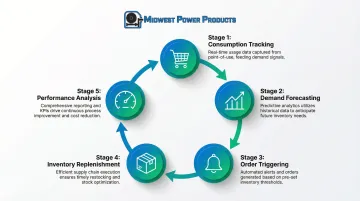
These components create a closed-loop system where actual consumption drives forecasts, forecasts trigger orders, and performance metrics continuously refine parameters.
ICM vs. Related Systems (WMS, ERP)
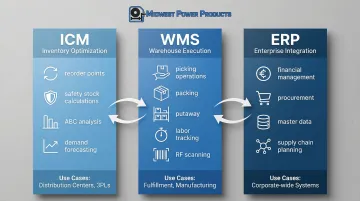
Once you understand ICM's core components, it's helpful to see how it differs from related systems. ICM, Warehouse Management Systems (WMS), and Enterprise Resource Planning (ERP) each serve distinct purposes:
| System Type | Primary Focus | Key Functions |
|---|---|---|
| ICM | Optimization | Reorder points, safety stock, ABC analysis, replenishment logic |
| WMS | Execution | Picking, packing, putaway, labor tracking, physical movement |
| ERP | Integration | Financials, procurement, master data, general ledger connection |
ICM acts as the system of intelligence that balances supply and demand. WMS provides the system of execution for warehouse operations, while ERP serves as the system of record connecting inventory to financial data.
ICM can function as a standalone system for smaller operations or as an integrated module within larger ERP platforms like SAP S/4HANA or Oracle NetSuite.
Core ICM Methodologies and Techniques
Economic Order Quantity (EOQ) Model
The EOQ model calculates the optimal order size that minimizes total inventory costs by balancing ordering costs against holding costs.
Formula: EOQ = √(2DS/H)
Where:
- D = Annual demand in units
- S = Ordering cost per purchase order
- H = Holding cost per unit per year
Example calculation: A retailer sells 10,000 units annually. Ordering costs are $50 per order, and holding costs are $2 per unit per year.
EOQ = √(2 × 10,000 × 50 / 2) = √500,000 = 707 units
This means ordering approximately 707 units at a time minimizes total costs, resulting in about 14 orders per year.
Best practices recommend recalculating EOQ quarterly for volatile SKUs rather than using static values.
Reorder Point (ROP) and Safety Stock Calculations
The Reorder Point determines when to trigger a new order based on lead time demand plus safety stock buffer.
Formula: ROP = (Average Daily Demand × Lead Time in Days) + Safety Stock
Safety stock protects against demand variability and supply chain uncertainties. The calculation considers:
- Demand variability during lead time
- Service level targets (typically 95-99%)
- Lead time variability from suppliers
- Cost of stockouts vs. cost of holding extra inventory
Higher service level targets require more safety stock but reduce stockout risk.
A 95% service level accepts a 5% stockout chance during each replenishment cycle.
ABC Analysis for Inventory Classification
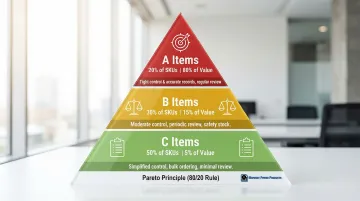
ABC analysis applies the Pareto Principle (80/20 rule) to categorize inventory by value and importance:
- A items - Top 20% of SKUs representing 80% of inventory value; require tight controls, frequent cycle counts, and close supplier relationships
- B items - Middle 30% of SKUs representing 15% of value; require moderate controls and periodic reviews
- C items - Bottom 50% of SKUs representing 5% of value; simplified controls, bulk ordering, and minimal monitoring
This classification directs control resources where they deliver the greatest financial impact.
Just-in-Time (JIT) and Kanban Systems
JIT philosophy minimizes inventory by receiving goods only as needed for production or sales, reducing carrying costs and waste.
Kanban systems use visual signals (physical cards or digital triggers) to support pull-based replenishment. When a production station consumes materials, it signals the previous station to produce more. This creates a self-regulating flow that prevents overproduction and excess WIP inventory.
VED and FSN Analysis Methods
Beyond value-based classification, operations teams use criticality and turnover patterns to prioritize inventory.
VED analysis categorizes inventory by criticality to operations:
- Vital - Essential for operations; stockouts cause immediate production halt
- Essential - Important but short-term alternatives exist
- Desirable - Useful but not critical; stockouts cause minimal disruption
FSN analysis identifies turnover patterns:
- Fast-moving - High turnover requiring frequent replenishment
- Slow-moving - Low turnover needing periodic review
- Non-moving - Obsolete items requiring liquidation or write-off
These methods complement ABC analysis in healthcare and manufacturing, where criticality often matters more than value.
Technology and Tools for ICM
Warehouse Management Systems (WMS)
Modern WMS platforms automate warehouse operations including receiving, putaway, picking, packing, and shipping while providing robust inventory control features.
Key WMS features for inventory control:
- Real-time inventory tracking across all warehouse locations and zones
- Location management with directed putaway and optimized picking paths
- Cycle counting automation with variance reporting and investigation workflows
- Lot and serial number tracking for traceability and expiration management
Leading WMS platforms like Manhattan Associates have expanded beyond execution to include end-to-end inventory visibility across distribution networks. Advanced implementations can improve inventory accuracy to 99%+ through rigorous automated cycle counting.
For specialized industries like textile services, systems like Softrol's Total Plant Management software provide integrated inventory visibility across entire operations.
The platform tracks garments and linens through processing cycles using RFID and barcode technologies, delivering real-time status updates and automated alerts for inventory issues.
ERP System Integration
While WMS solutions excel at warehouse-level control, ERP systems extend inventory management across the entire enterprise. ICM modules within ERP systems (SAP, Oracle, Microsoft Dynamics) provide enterprise-wide inventory visibility and synchronized data across departments.
Integration benefits include:
- Unified data across purchasing, production, sales, and finance departments
- Elimination of data silos that cause discrepancies and manual reconciliation
- Automated financial posting when inventory moves or is consumed
- Coordinated planning between inventory levels and production schedules
SAP S/4HANA includes advanced ICM features such as device integration for barcode scanners during physical inventory counts and real-time process monitoring tools for inventory task management.
These software systems rely on hardware technologies to capture accurate inventory data at the point of transaction.
Barcoding and RFID Technology
Barcode scanning enables accurate, real-time inventory tracking at the item or batch level. Each scan updates system records instantly, eliminating manual entry errors and providing precise location data.
While barcoding remains the standard for most operations, RFID (Radio Frequency Identification) offers significant advantages for high-volume environments:
- Automated tracking without line-of-sight scanning requirements
- Bulk reading capabilities (scanning dozens of items simultaneously)
- Enhanced accuracy with 10-30 percentage point improvement over manual methods
- Reduced counting labor by 15-25%
The trade-off requires higher upfront costs for RFID tags and readers, making the technology most cost-effective for high-value items or operations requiring frequent inventory verification.
Demand Forecasting and Analytics Tools
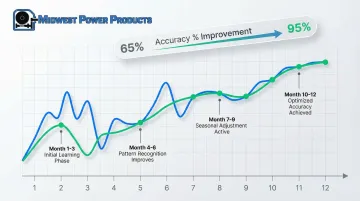
Modern ICM systems leverage historical sales data, seasonal patterns, and external factors to forecast future demand with increasing accuracy.
Advanced forecasting capabilities include:
- Machine learning algorithms that identify complex demand patterns
- Seasonal adjustment factors for predictable fluctuations
- Trend analysis to detect gradual changes in baseline demand
- Promotional impact modeling for planned marketing activities
AI-powered forecasting continuously learns from actual consumption, automatically adjusting parameters to improve accuracy over time. This reduces both stockouts from underestimation and excess inventory from overestimation, creating a foundation for optimized inventory control across your operation.
Key Performance Indicators (KPIs) for ICM
Inventory Turnover Ratio
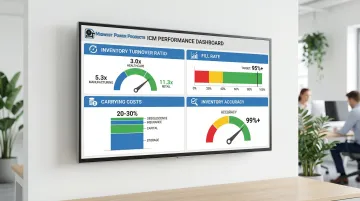
Inventory turnover measures how frequently a business sells and replaces its stock during a specific period. Calculate it by dividing Cost of Goods Sold by Average Inventory.
Industry benchmarks (according to CSIMarket industry analysis):
- Retail: ~11.3x annually
- Manufacturing: ~5.3x annually
- Healthcare: ~3.0x annually
High turnover indicates efficient inventory management with minimal capital tied up in stock. Low turnover suggests excess inventory, obsolescence risk, or weak sales.
Extremely high turnover may signal inadequate stock levels causing stockouts. The goal is finding the optimal balance for your operation.
While turnover measures efficiency, fill rate metrics reveal how well your inventory meets customer demand.
Fill Rate and Service Level Metrics
Fill rate measures the percentage of customer orders fulfilled completely from available stock without backorders or delays.
Best-in-class operations target 95%+ fill rates, balancing customer service against inventory investment.
Service level targets (such as 95% in-stock availability) directly drive safety stock calculations. Higher targets require more buffer inventory but reduce stockout frequency.
Beyond service metrics, understanding the financial impact of holding inventory is essential for profitability.
Carrying Cost and Inventory Accuracy Metrics
Inventory carrying costs typically represent 20-30% of inventory value annually, including:
- Storage costs (warehouse space, utilities, handling equipment)
- Capital costs (interest on funds tied up in inventory)
- Insurance and taxes on inventory assets
- Obsolescence, shrinkage, and damage
Inventory accuracy measures agreement between physical stock and system records. High-performing facilities achieve 99%+ accuracy through rigorous cycle counting programs.
Poor accuracy undermines all other ICM efforts by basing decisions on incorrect information. Without reliable data, even the best inventory strategies fail.
Implementing an ICM System: A Practical Roadmap
Assessment and Requirements Definition
Successful implementation begins with thorough analysis of current state and future needs.
Conduct an inventory management audit:
- Document existing processes from receiving through shipping
- Identify pain points causing delays, errors, or excess costs
- Analyze current performance metrics (turnover, accuracy, fill rates)
- Define specific business requirements and improvement targets
Gather input from stakeholders across warehouse, purchasing, sales, and finance teams—each department brings unique requirements that shape system functionality needs.
Once you've documented your requirements, the next step is finding a system that matches them.
System Selection and Vendor Evaluation
Evaluation criteria should include:
- Functionality fit with documented business requirements
- Scalability to support future growth and complexity
- Integration capabilities with existing systems (ERP, WMS, e-commerce)
- User-friendliness to minimize training requirements and errors
- Vendor support quality and responsiveness
- Total cost of ownership including software, hardware, training, and consulting
Implementation timelines vary significantly:
- Small business cloud solutions: 8-12 weeks
- Mid-market systems: 4-6 months
- Enterprise implementations: 9-18 months
Budget considerations include:
- Software licensing fees
- Hardware (scanners, mobile devices, servers)
- Professional services for configuration and training
- Ongoing maintenance and support fees
After selecting your vendor, implementation moves into the technical execution phase.
Data Migration and System Configuration
Data preparation is often the most underestimated phase. Best practices allocate at least 20% of total implementation timeline specifically to data preparation.
Critical steps include:
- Cleansing existing inventory data (remove duplicates, correct errors, standardize formats)
- Mapping data fields from legacy systems to new platform
- Configuring system parameters (reorder points, lead times, ABC classifications)
- Verifying physical counts before migration to prevent "garbage in, garbage out"
Address data quality issues before go-live, not during peak operational pressure.
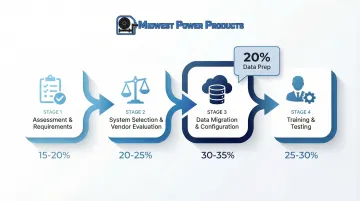
Training, Testing, and Change Management
Comprehensive user training across all affected departments is essential for adoption and success.
Effective change management includes:
- Communicating benefits clearly to address "what's in it for me"
- Addressing resistance through involvement and early wins
- Establishing new workflows and accountability structures
- Conducting parallel testing (running new system alongside legacy processes) before full cutover
Focus on business value and outcomes rather than technical features to build stakeholder buy-in. Role-based training ensures each user understands their specific responsibilities within the new system.
Industry-Specific ICM Applications
Retail and E-commerce Inventory Management
Retailers face unique challenges including massive SKU proliferation (thousands of variants), seasonal demand fluctuations, omnichannel fulfillment complexity, and high return rates.
ICM systems support retail-specific needs through:
- Size/color variant tracking with matrix inventory views
- Distributed inventory visibility across stores, warehouses, and distribution centers
- Real-time availability for "buy online, pick up in store" (BOPIS) workflows
- Returns processing with automated restocking and disposition logic
Real-time inventory visibility enables retailers to promise accurate delivery dates and manage omnichannel customer expectations effectively.
Manufacturing and Supply Chain ICM
While retail focuses on finished goods distribution, manufacturing operations require tracking materials across production stages. Manufacturers manage raw materials, work-in-progress (WIP), and finished goods at once across complex production processes.
Manufacturing ICM requirements:
- Integration with Material Requirements Planning (MRP) to synchronize inventory with production schedules
- Manufacturing Execution System (MES) connectivity for real-time WIP tracking
- Bill of materials (BOM) management linking finished goods to component consumption
- Lot tracking for quality control and recall management
ICM systems calculate component requirements based on production plans, automatically triggering purchase orders when raw material levels fall below reorder points.
Healthcare and Textile Services Industries
Beyond manufacturing and retail, specialized industries face unique compliance and tracking requirements. Healthcare facilities manage medical supplies with strict expiration date tracking and lot traceability for regulatory compliance (FDA UDI requirements). Critical stock availability directly impacts patient care.
Healthcare ICM features:
- First-Expired-First-Out (FEFO) logic for perishable items
- Automated alerts for approaching expiration dates
- Lot and serial number tracking for recalls
- Par level management for nursing stations and procedure rooms
Textile services and industrial laundries track linen and garment inventory through washing, drying, and delivery cycles. Companies like Softrol Systems provide specialized automation solutions including automated sorting systems and real-time garment tracking via RFID and barcode technologies.
Their SofTrak Garment Tracking System provides individual item tracking with complete inventory management throughout the textile processing workflow, capturing real-time return products and creating delivery manifests by item count or weight.
Frequently Asked Questions
What is the full form of ICM in inventory management?
ICM stands for Inventory Control Management, a systematic approach to managing and optimizing inventory levels across the supply chain through data-driven methodologies and automated systems.
What does the inventory management system do?
An inventory management system tracks inventory levels in real-time, automates reordering based on predefined parameters, forecasts demand using historical patterns, manages supplier relationships and lead times, and provides analytics to optimize stock levels and reduce carrying costs.
What are the key components of an ICM system?
Essential components include inventory tracking, order management with automated purchase orders, demand forecasting, supplier management, warehouse management, and reporting/analytics capabilities for monitoring KPIs and trends.
How much does an inventory control management system cost?
Basic cloud solutions range from $50-200/month for small businesses, while mid-market systems cost $1,000-5,000/month. Enterprise implementations often involve upfront costs of $100,000+ plus ongoing maintenance fees.
What's the difference between ICM and a Warehouse Management System (WMS)?
ICM focuses on inventory optimization across the supply chain (what to order, when, and how much), while WMS manages warehouse execution operations like receiving, putaway, picking, and shipping within the facility.
How long does it take to implement an ICM system?
Implementation ranges from 3-12 months depending on complexity. Small operations with cloud solutions may complete setup in 8-12 weeks, while enterprise environments often require 9-18 months.