
Introduction
Enterprises now run on data that never stops moving. Multi-cloud environments, IoT sensors, and streaming transactions generate information every second. Waiting for a nightly batch job to catch up is no longer good enough.
Real-time data integration and monitoring platforms let finance, retail, healthcare, and manufacturing teams catch anomalies as they happen. Teams can flag fraud attempts and keep operations running before small issues turn expensive.
This guide compares the top real-time data integration and monitoring platforms of 2025. You'll learn how to match one to your architecture, whether you're managing enterprise IT pipelines or a plant floor.
TL;DR
- Real-time integration syncs data instantly using CDC (change data capture) or event streaming, unlike batch ETL.
- The best platforms balance speed, monitoring depth, and usability for both technical and business teams.
- This list ranks Striim, Domo, Fivetran, Talend, and Apache Kafka on connector breadth, latency, and monitoring features.
- Manufacturing and textile services need purpose-built plant-level monitoring beyond generic IT platforms.
Overview of Real-Time Data Integration and Monitoring Solutions
Real-time data integration and monitoring gives businesses instant visibility into operations, transactions, and system health, instead of a delayed snapshot from yesterday's batch run.
Adoption is accelerating fast. In Confluent's 2025 Data Streaming Report, which surveyed 4,175 IT leaders across 12 countries, 90% said data streaming platforms enable more product and service innovation. That's a strong signal that streaming architecture is becoming table stakes, not a nice-to-have.
"Real-time" isn't one fixed speed, though. It spans a spectrum:
- Sub-second streaming: event-at-a-time processing, often in milliseconds
- Micro-batch: near-real-time, typically 500 milliseconds to several seconds
- Traditional batch: scheduled intervals, hours or days apart
Monitoring and alerting have also shifted from optional extras to core buying criteria. A pipeline that moves data fast but fails silently is worse than a slower one that flags problems immediately.
The section below ranks the top platforms for 2025 based on integration depth, monitoring capability, and real-world reliability, not just marketing claims.
Top Real-Time Data Integration and Monitoring Solutions for 2025
Each platform below was evaluated on connector and source breadth, CDC and latency support, built-in monitoring and alerting, governance, and overall scalability.
Striim
Striim is a real-time change data capture (CDC) and streaming platform built to move data continuously across databases, applications, and cloud systems. In late 2025, it added Validata, a dedicated tool for data accuracy and reconciliation at scale.
What sets Striim apart:
- Low-code pipeline design for building streaming workflows without heavy coding
- Built-in pipeline health monitoring and alerting baked into the platform, not bolted on
- Broad connector support for cloud data warehouses, including BigQuery, Snowflake, and Azure Synapse
| Category | Description |
|---|---|
| Key Features | CDC-based streaming, Validata for data validation, low-code pipeline builder |
| Deployment Options | On-premises, self-managed cloud, or fully managed Striim Cloud |
| Best For | Teams needing sub-second CDC with dedicated data-accuracy verification |
Domo
Domo combines integration, transformation, and analytics in one cloud platform, backed by over 1,000 pre-built connectors.
Its standout features:
- Dataset alerts that trigger when thresholds are exceeded, checked each time data updates
- An Anomaly Classification AI Agent that detects, classifies, and helps resolve anomalies while reducing false positives
- A Root Cause Analysis AI Agent that diagnoses disruptions and speeds up troubleshooting
- Governance features including lineage tracking and auditing built into the integration layer
| Category | Description |
|---|---|
| Key Features | 1,000+ connectors, AI-driven anomaly and root-cause agents, lineage tracking |
| Deployment Options | Cloud-based SaaS platform |
| Best For | Business teams wanting integration and analytics under one roof with AI-assisted monitoring |
Fivetran
Fivetran is an automated ELT platform with more than 500 pre-built connectors, built around warehouse-first pipelines rather than custom pipeline logic.
Key differentiators:
- Automated schema drift handling, so source changes propagate to the destination without manual fixes
- Log-based CDC for supported transaction-processing databases
- Security credentials including SOC 1, SOC 2, and ISO 27001, plus HIPAA support via a signed Business Associate Agreement
| Category | Description |
|---|---|
| Key Features | 500+ connectors, automated schema drift handling, log-based CDC |
| Deployment Options | Fully managed cloud SaaS |
| Best For | Teams prioritizing hands-off pipeline maintenance and warehouse-centric analytics |
Talend
Now part of Qlik following the 2023 acquisition, Talend (Qlik Talend Cloud) is an end-to-end ETL/ELT platform with data quality checks built directly into the pipeline.
Its differentiators:
- Supports both real-time and batch processing in a single platform
- Low-code interface for building and managing pipelines
- Talend CDC captures insert, update, and delete events for downstream event processing
- Integrated governance and data quality tooling alongside application integration
| Category | Description |
|---|---|
| Key Features | Combined ETL/ELT, native CDC, integrated data quality and governance |
| Deployment Options | Cloud (Qlik Talend Cloud) |
| Best For | Organizations needing both real-time and batch pipelines with strong data quality controls |
Apache Kafka
Kafka is the open-source, distributed event-streaming backbone behind a huge share of real-time architectures. Apache Kafka's official documentation claims latency as low as 2 milliseconds under network-limited conditions - a vendor-published figure, not a universal guarantee.
What makes it distinct:
- High throughput built for large-scale event streams
- Kafka Connect for reliably streaming data between it and external systems
- ksqlDB for building custom streaming SQL logic, including monitoring and alerting layers
- Managed deployment options through Confluent Cloud or Amazon MSK
| Category | Description |
|---|---|
| Key Features | Event streaming core, Kafka Connect, ksqlDB for custom logic |
| Deployment Options | Self-managed, Confluent Cloud, or Amazon MSK |
| Best For | Engineering teams building custom, high-throughput streaming architectures |

How We Chose the Best Solutions
The rankings above weigh five factors: connector and source breadth, CDC and latency support, built-in monitoring and observability, governance and security, and how easy the platform is for both technical and business users.
That latency factor deserves scrutiny, since a common buyer mistake is trusting a vendor's "real-time" label at face value. As Forrester notes, acceptable latency is use-case-specific, and most real-time analytics workloads run "near real time" rather than instantaneously.
Before committing to a platform:
- Test actual p50/p95/p99 latency under your own workload conditions, not the vendor's demo environment
- Weigh monitoring depth as heavily as speed - a fast pipeline that fails silently costs more than a slightly slower one that alerts immediately
- Confirm CDC support matches your source systems, since log-based CDC cuts downtime during migrations well beyond what generic polling achieves
These factors tie directly to business outcomes. Strong CDC support shortens migration windows. Built-in monitoring shortens time-to-detect for pipeline failures, which matters far more than an extra 50 milliseconds of throughput.
Real-Time Monitoring Beyond IT: Industrial and Manufacturing Operations
Most platforms on this list were built for enterprise IT and cloud analytics. But manufacturing plants and textile services facilities need something different: real-time visibility into equipment, throughput, and process-level data on the shop floor, not just business data pipelines.
Plant-level monitoring systems capture sensor and machine data much like the IoT use cases that CDC-based platforms enable. The goal is the same, too: flag anomalies like equipment downtime or process errors before they cause costly downtime.
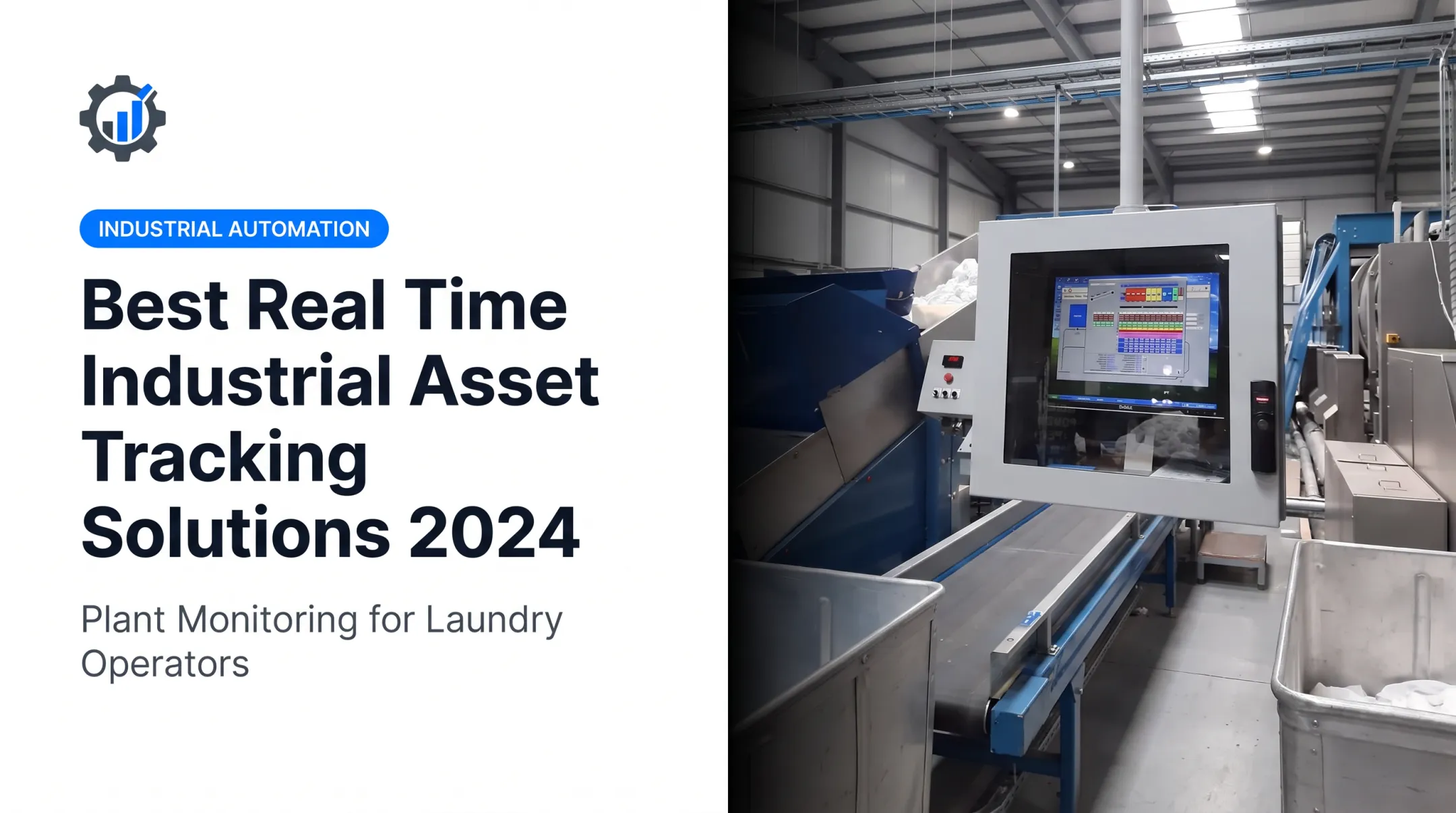
This is where sector-specific tools fill a gap that general-purpose platforms don't cover well. Softrol Systems' LOIS (Laundry Operation Information System) is one example, built specifically for industrial laundries. LOIS gives plant managers:
- Browser-based client workspaces accessible from smartphones, tablets, or PCs, from anywhere
- 24/7 monitoring of important plant functions and employee performance
- Multi-site access through a single account
- Real-time email alerts flagging operational issues
At Aramark Uniform Services' Nashville facility, Softrol installed LOIS Rail with Pan-N-Zoom touchscreen views and PM Tracker for preventive maintenance. A similar deployment at Crown Health Care Laundry Services' Atlanta plant was built for continuous throughput of 13,500 pounds per hour across 12 monorail lines.

Businesses in manufacturing-adjacent sectors need both layers: a general-purpose integration platform for enterprise systems, and a specialized monitoring tool built for their specific shop-floor operations.
Conclusion
The right real-time data integration and monitoring solution comes down to fit: your latency needs, governance requirements, and how deep your monitoring actually needs to go, not brand recognition.
Before finalizing anything, pilot-test scalability, check how alerting responds under real load, and calculate total cost of ownership using your own data, not a vendor demo.
For textile services and industrial laundry operations specifically, Softrol Systems' Total Plant Management and LOIS platforms extend real-time monitoring and remote data visibility straight to the plant floor. A purpose-built system often delivers what a generic IT platform can't.
Frequently Asked Questions
What ETL tools support real-time data integration?
Striim, Talend, and Apache Kafka (via Kafka Connect) all support CDC-based real-time ETL alongside traditional batch processing. Each handles CDC differently, so match the tool to your source database.
Which database is best for real-time data?
Databases like Apache Cassandra, Amazon DynamoDB, and TiDB are common choices for real-time workloads. DynamoDB, for example, delivers consistent single-digit-millisecond read and write performance; the right pick still depends on your consistency and scale needs.
What is the best data integration platform?
There's no single "best" platform. It depends on your latency requirements, governance depth, and team capacity. Striim, Domo, and Fivetran each lead in different categories.
What is the difference between real-time and batch data integration?
Real-time integration syncs data continuously, the moment it changes. Batch integration processes data at scheduled intervals, whether hourly, nightly, or weekly.
Does real-time data integration require a complete infrastructure overhaul?
Not usually. Most modern platforms integrate with existing systems without major re-platforming. Some legacy systems may still need targeted modernization to support CDC.
How is real-time monitoring different in industrial or manufacturing settings versus enterprise IT?
Industrial monitoring focuses on machine and plant-level sensor data, using specialized systems like Softrol's LOIS. Enterprise IT tools, by contrast, are built around business data pipelines and cloud analytics.