
That pressure isn't going away. Rising operational complexity, tighter margins, and a shrinking talent pool are pushing plant operators to find efficiency gains somewhere else.
Business process automation (BPA) software is one answer. It automates repetitive, rule-based tasks across departments, from data entry to scheduling to machine coordination, so teams can do more with fewer hands on deck.
This article covers how BPA drives operational efficiency, its core benefits, how to implement it without disruption, and a real-world look at industrial laundry automation.
Key Takeaways
- BPA software cuts manual work, standardizes workflows, and gives real-time visibility into plant operations
- Industrial laundries adopting automation see measurable gains in throughput and labor efficiency
- Integration with legacy equipment beats a full rip-and-replace approach
- Industrial laundries use BPA to cut sorting labor by up to 70% in documented cases
What Is Business Process Automation Software?
BPA software automates repetitive, rule-based business tasks and workflows that would otherwise require manual handling. IBM defines it as a strategy for using software to automate complex, recurring business processes rather than one-off tasks.
Think scheduling, reporting, data entry between systems, quality checks, and machine coordination.
Common Types of Automation Technology
Three categories typically get lumped together, but they aren't interchangeable:
- RPA (Robotic Process Automation): Task-level automation that mimics human software interactions, such as moving data between two applications
- Workflow automation: Coordinates a sequence of tasks and handoffs, often blending automated steps with human judgment
- AI-driven/intelligent automation: Layers machine learning and analytics on top for prediction and decision support
In industrial settings, BPA rarely stands alone. Industrial laundries and textile services operations, for example, combine physical machine controls, such as wash aisle and chemical dispensing systems, with software for end-to-end plant management, not just office-task automation.
How Business Process Automation Software Improves Operational Efficiency
Eliminating Manual, Repetitive Work
Manual data entry, scheduling, and reporting eat hours every shift. Deloitte's 2025 Smart Manufacturing Survey of 600 large-manufacturer executives found average post-implementation gains of 10-20% in production output and 7-20% in employee productivity.
Automating these tasks frees staff for higher-value work instead of retyping numbers into spreadsheets.
Real-Time Visibility Changes Everything
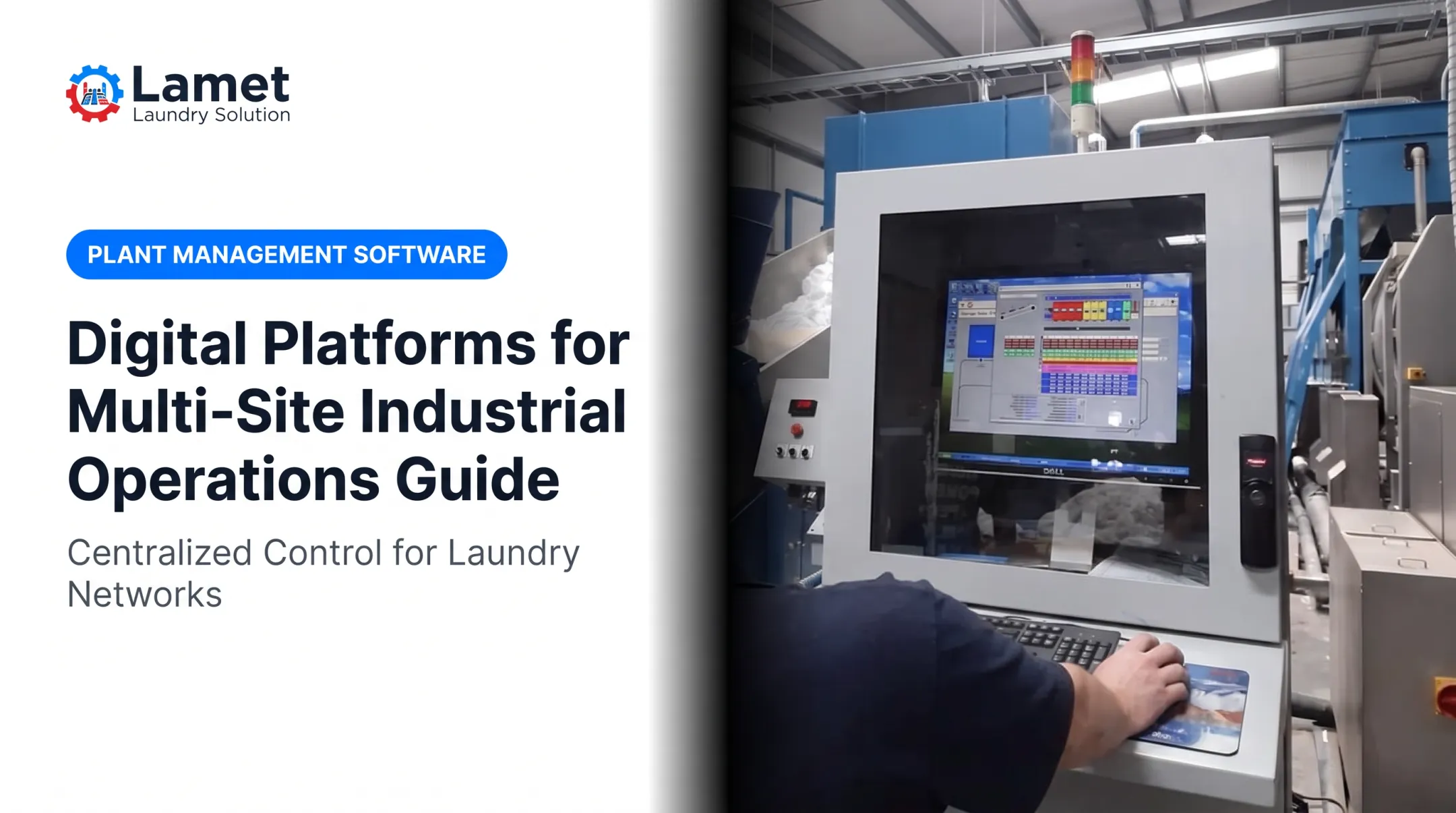
Centralized client workspaces let managers spot bottlenecks before they become full-blown production stoppages. Softrol's LOIS (Laundry Operation Information System) is a working example: it surfaces important plant functions, machine utilization, and throughput data through a browser-based interface accessible on phones, tablets, or PCs.
A documented LOIS dryer client workspace tracked 19-minute average turn times and 24,879 pounds processed, and flagged non-credited loads in real time. That's the kind of granular detail operators need to act before a shift ends, not after.

Automated Alerts Cut Downtime
LOIS delivers real-time alerts directly to email when plant functions deviate from expected performance. Softrol's Catalyst chemical dispensing systems similarly trigger alarms for chemical delivery failures. Faster notification means faster reaction, and less unplanned downtime.
Standardization Reduces Variability
Automation applies consistent logic across shifts and locations instead of relying on individual operator judgment. Softrol's MicroPulse controllers pass processing data from machine to machine, ensuring the correct wash formula follows each load, whether it's 6 a.m. or midnight, whichever operator is on the floor.
Standardized control at the machine level is only part of the picture. Combining these systems into one platform is where the efficiency gains compound.
Integrated Automation Multiplies the Gains
Softrol's Total Plant Management approach ties wash aisle controls, chemical dosing, and sorting into one platform. At Gildan Activewear, ChemPulse delivered 13 chemicals to eight dye machines. At Aramark Uniform Services, SoftSort autosortation reduced sorting labor from 10 employees to two, a 70% workforce reduction, while processing over 40,000 garments daily at above the guaranteed 3,800-per-hour rate.

Key Benefits of Business Process Automation Software
- Reduced labor costs: Automating repetitive tasks shifts staff away from repetitive work and into higher-value roles
- Improved accuracy and compliance: Standardized digital workflows create auditable trails; McKinsey documented a bank automating 70% of record-to-report steps with built-in quality checks
- Faster decision-making: Real-time client workspaces let managers act on data immediately instead of waiting for end-of-shift reports
- Scalability: Wildman Uniform expanded its SoftSort system from 5,000 to 15,000 garments per day using existing equipment, completed over one weekend with zero production loss
- Better customer satisfaction: Faster turnaround and fewer errors translate directly into service-delivery quality
How to Choose and Implement the Right BPA Software
Automating a broken process just makes the mess move faster. Get the sequence right:
- Map current processes first - identify high-impact, repetitive tasks before automating. Fix the workflow, then automate it.
- Prioritize integration over replacement - look for vendors who retrofit existing machinery rather than demanding a full teardown. Softrol's LOIS platform, for example, connects to existing rail and wash-aisle equipment rather than requiring a full system replacement.
- Involve cross-functional stakeholders early - operations, IT, and finance all need buy-in, or adoption stalls.
- Start with a phased rollout - pick one high-impact area, prove the ROI, then scale using KPIs like cycle time and throughput.

Deloitte's research backs this caution: 62% of organizations cite integration difficulty and 52% cite inability to change existing processes as top barriers to scaling intelligent automation.
Industry Spotlight: Automation in Action for Industrial Operations
Industrial laundries and uniform rental operators run some of the most complex automation stacks in manufacturing, combining wash aisle controls, chemical dispensing, and sorting systems under one roof.
Softrol has built turnkey automation for this exact space since 1987, with product lines including MicroPulse (machine controls), ChemPulse (chemical dosing), and PulseNet (management software). The company works with Fortune 500 laundry and textile services clients including Aramark Uniform Services and Crown Health Care Laundry Services.
Results from documented customer cases:
- Faultless Linen: Pounds Per Operator Hour rose 35% in four months after PulseNet installation, from 90 to 140 PPOH
- Aramark: Sorting labor cut from 10 employees to two, throughput exceeding 3,800 garments/hour
- Mission Linen: Labor reduced by 77%, sorting up to 3,500 garments/hour

Across these cases, the consistent thread isn't a single flashy feature. It's a single integrated platform pulling data from sort to finish, giving plant managers one place to see everything.
Common Challenges in Business Process Automation and How to Overcome Them
Employee resistance to change. Nearly half of executives who rate their automation programs successful still name workforce resistance as a top challenge, per McKinsey's research.
- Fix: transparent communication, hands-on training, and framing automation as a role-shift, not a replacement.
Upfront implementation costs. Full plant integration requires significant capital investment.
- Fix: phase the rollout. Start with the highest-impact area, prove ROI, then reinvest gains into the next phase.
Legacy equipment integration. Old machinery doesn't always play nice with new software.
- Fix: pick vendors experienced in retrofitting. Softrol's control retrofits, for instance, range from a single dryer control swap to full wash aisle automation, without requiring new equipment purchases.
Frequently Asked Questions
How does business process automation software improve operational efficiency?
BPA reduces manual work, standardizes workflows across shifts, and gives real-time visibility into operations. This combination cuts delays, reduces errors, and lets managers act on problems immediately instead of after the fact.
What are the benefits of business process automation?
Core benefits include lower labor costs, improved accuracy and compliance, faster decision-making through real-time data, and scalability without proportional headcount growth.
How is BPA software different from Robotic Process Automation (RPA)?
BPA covers end-to-end workflow optimization across departments. RPA is a subset of BPA focused on automating individual, rule-based tasks like data entry between two systems.
What industries benefit most from business process automation software?
Manufacturing, textile and laundry services, healthcare, and finance see the highest impact, largely because they combine high task volume with repetitive, rule-based processes.
How long does it take to implement business process automation software?
Timelines vary by complexity. Simple workflow automation can launch in a few weeks, while full plant integration involving multiple systems typically takes several months.
What should a company look for when selecting BPA software?
Look for integration capability with existing equipment, scalability as operations grow, real-time reporting, and vendor support during and after installation.