
Introduction
Automated systems run more of daily life than most people notice. They route your calls, control the wash cycle at a commercial laundry, and keep factory floors moving without someone standing over every machine.
Process automation ranked as a top-two investment priority for 46% of manufacturing executives, according to Deloitte's 2025 Smart Manufacturing survey. That's no longer a niche investment.
The same survey found 78% of respondents putting more than a fifth of their improvement budget toward smart manufacturing initiatives.
Here's the problem: many operators buy or manage automation without fully understanding how it actually works. That gap leads to underused equipment, mismatched systems, and unrealistic expectations about what "automated" really means.
This guide breaks down what an automated system is, how it functions stage by stage, and where it delivers real value on the plant floor.
TL;DR
- Automated systems use sensors, logic, and controls to run tasks with minimal human input
- They follow a repeatable sequence: initiation, core operation, regulation, and output
- Fixed rules separate automation from autonomy, which learns and adapts on its own
- Automation options include fixed, programmable, and flexible types, each suited to different production needs
- Manufacturing, telecom, retail, and industrial laundry all rely on these systems daily
What Is an Automated System?
An automated system is a computer- or logic-controlled setup that carries out a task, or a sequence of tasks, using sensors, control circuits, and actuators, with little to no manual input while it runs. Give it a defined input, and it produces a consistent, repeatable output every time.
Why does it exist? Manual processes are slow and inconsistent, and errors compound quickly in repetitive, high-volume environments. Automation closes that gap. A wash aisle running 24/7 can't rely on someone manually checking chemical levels every cycle. It needs a system that does it the same way, every time.
Automated vs. Autonomous: An Important Distinction
Automation and autonomy get used interchangeably, but they're not the same thing.
- Automated systems follow fixed, user-defined rules: "do X when Y happens." IEEE describes this as executing a fixed sequence of operations that respond correctly only when conditions match the programmed scenario.
- Autonomous systems, according to NIST, select and execute diverse actions independently, without human intervention, and can adapt based on outcomes.
Rule-based automation remains the backbone of most industrial operations, even as AI-driven tools get more attention. It's predictable, auditable, and cost-effective for well-defined tasks. That's a real advantage when a plant manager needs to know exactly what a system will do under a given condition, not guess at it.
Types of Automated Systems
Automation isn't one-size-fits-all. The right type depends on production volume, product variety, and how often the process needs to change.
| Type | How It Works | Best Fit |
|---|---|---|
| Fixed | Dedicated equipment repeats one operation set | High-volume, unchanging tasks |
| Programmable | Software reconfigures sequences for different runs | Medium-to-high volume with some variety |
| Flexible | High-level commands trigger automatic lower-level adjustments | High-variety batch or job-shop work |
Fixed automation shows up in paint shops, conveyors, and transfer lines. Programmable automation runs paper mills and steel rolling operations.
Flexible automation appears in integrated plant management platforms, like Softrol's Total Plant Management software. It pulls real-time data from multiple production points across a laundry facility, so supervisors can react to bottlenecks as they happen instead of waiting for an end-of-shift report.

How Does an Automated System Work?
Regardless of industry, every automated system moves through the same general sequence: something triggers it, it performs the task, it checks itself along the way, and it produces a result. Understanding these four stages makes it much easier to evaluate any automation purchase.
Initiation
Every cycle starts with a trigger. That trigger can be:
- Manual: an operator presses start
- Automated: a sensor detects a condition and kicks off the process
- Continuous: an ongoing production line that never fully stops
Initiation sounds simple, but it's a common point of failure. Poorly calibrated sensors or unclear trigger logic can delay a start or cause a false one. This shows up often in wash-aisle or chemical dosing environments, where a misread signal can either stall a cycle or start one under the wrong conditions.
Core Operation
Once triggered, the controller takes over. It receives input data, checks it against programmed logic, and directs actuators, motors, or valves to carry out the task.
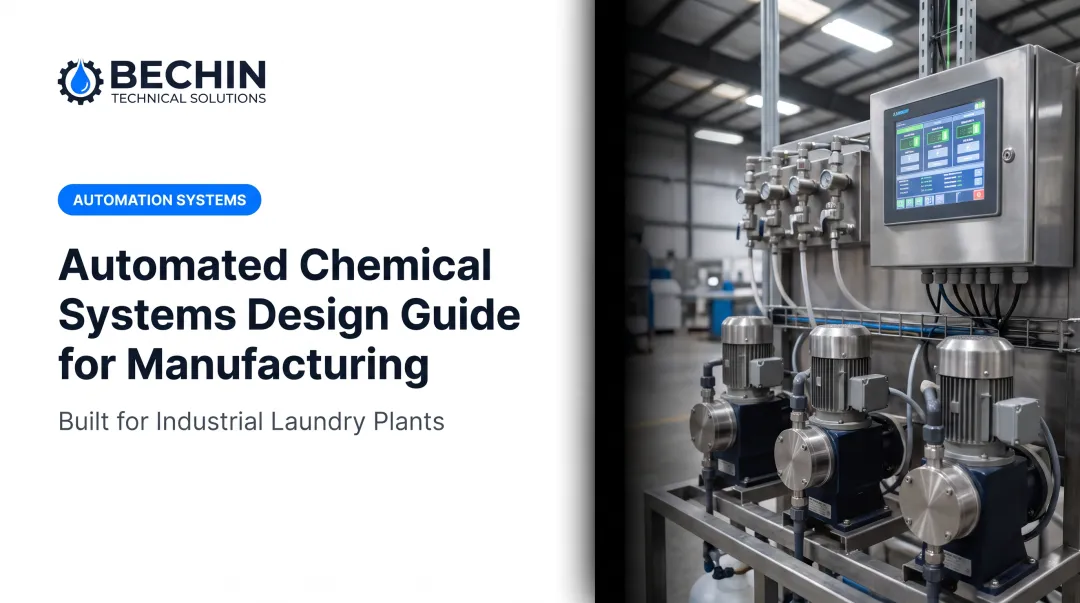
Take chemical dosing as an example. Softrol's Catalyst chemical dispensing systems use flow meter-based injection technology, meaning chemical delivery is measured by actual fluid volume rather than a timed estimate.
The controller confirms the correct volume was injected, verifies the water flush completed properly, and moves on. No guesswork, no timed approximations that drift as pressure or line conditions change.
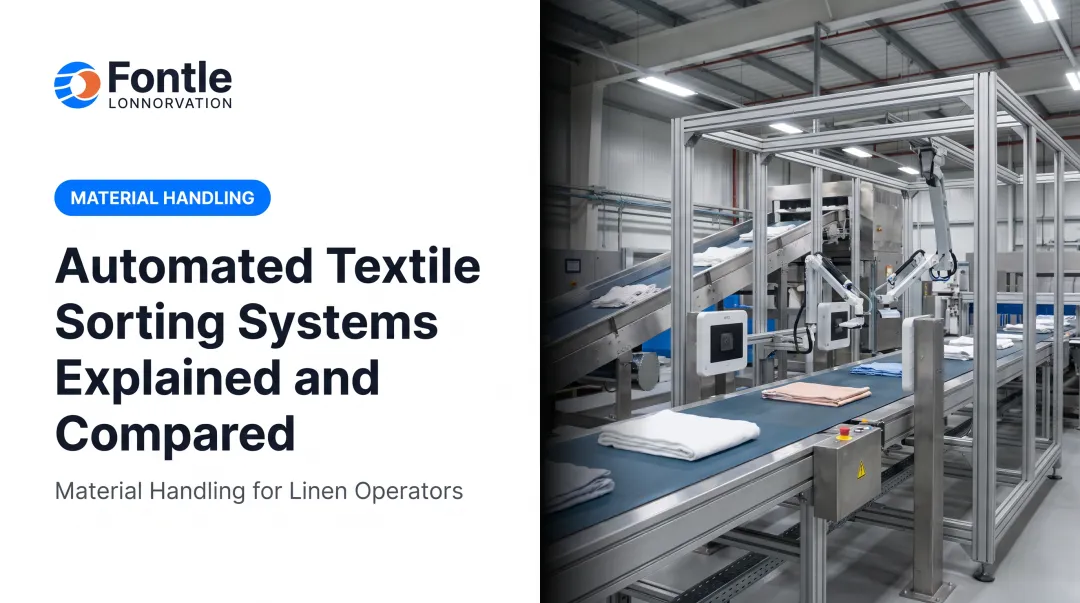
Garment sortation works on a similar principle but with different hardware. Softrol's SoftSort system uses RFID and barcode scanning with "scan-on-the-fly" technology, identifying garments automatically as they move, without requiring a stop for each item. The system processes up to 3,800 garments per hour, and reduces sorting labor by up to 77% compared to manual sorting.
Speed and consistency matter here because they compound. A 2023 NIST case study on Vanamatic's Delphos facility found that automating part loading cut labor requirements by 40% to 50% and generated over $1.5 million in new or retained sales in a single year. That's a reminder that core operation improvements ripple into business outcomes far beyond the machine itself.
Regulation and Control
Machines drift. Line pressure changes, temperatures fluctuate, and parts wear down. The regulation stage is what keeps a system stable despite all that.
This works through feedback loops: sensors report conditions back to the controller, which compares them against expected values and adjusts, or flags a problem. PLC and HMI systems, for example, can collect field-device data, log event history, and issue alerts for conditions like low parts counts or high motor temperature, catching problems before they cause downtime.
Softrol builds this in a few specific ways:
- Alarms for chemical delivery failures, triggered when dosing doesn't match expected parameters
- Water flush verification, a second confirmation step that catches problems before a full cycle is compromised
- LOIS, Softrol's remote monitoring platform, which sends real-time alerts by email and tracks machine utilization, throughput, and utility consumption across a plant
A plant manager with LOIS Rail can zoom into individual rail components to check I/O status and system health remotely, catching a developing issue before it becomes a full stoppage. That kind of visibility is the difference between a five-minute fix and a shift-long delay.
Output and Result
The final stage is what the system actually produces: a finished product, a completed transaction, a processed batch. What matters most is how that output feeds into whatever comes next.
Sorted garments, for instance, don't just stop moving once they're sorted. They flow into overhead storage rails, then into Softrol's SofTrak Garment Tracking System for delivery manifest creation and inventory tracking.
A completed wash cycle works the same way. Formula and load data transfer automatically to the next stage through Softrol's DataFusion integration, so the correct chemistry and cycle parameters carry forward without anyone re-entering data by hand.
Consistent output translates directly into measurable gains. The NIST Vanamatic case reported $20,000 in cost savings and three jobs created or retained after automating part loading, alongside documented improvements in quality, cycle time, and ergonomics. These are case-specific results, not universal guarantees, but they illustrate the pattern: consistent output reduces rework and lowers labor cost per unit processed.

Where Automated Systems Are Used
Automated systems work best in high-volume, repetitive environments where the variables are predictable. Continuous wash-aisle chemical dosing is a good example: the inputs (fabric type, soil level, water volume) fall into a known range, which makes rule-based control reliable.
A typical operational workflow moves through the same general stages regardless of industry:
- Production: the core task itself, whether that's wash cycles, part loading, or call handling
- Sorting: organizing output for the next step, like garment sortation feeding into delivery prep
- Quality control: catching deviations before they become defects
- Data reporting: feeding performance data back to management for decisions
The specifics vary by industry:
- Telecom relies on IVR systems for call routing by voice or keypad selection, without a live agent for every call
- Retail uses RFID for near-real-time inventory tracking, boosting accuracy from 95% to 99% across 500+ stores in a 2025 rollout
- Industrial laundry uses rail and sortation systems, like Softrol's, to move linen from intake through wash, sort, and delivery without manual handoffs
Each of these looks different on the surface, but the underlying logic (trigger, process, regulate, output) stays the same.
Conclusion
An automated system works through a consistent logic no matter where it's deployed: something triggers it, a controller processes that trigger against defined rules, feedback loops keep it stable, and it produces a repeatable output.
Businesses evaluating automation should start by asking three questions before selecting a system:
- What triggers initiation?
- What control and feedback do we need to catch problems early?
- What output are we actually trying to achieve?
Get those answers right, and the system choice becomes straightforward. That same logic drives Softrol's control systems, chemical dispensing, and rail automation.
Frequently Asked Questions
What is an automated system?
An automated system is a computer- or logic-controlled setup that performs tasks using sensors, actuators, and predefined rules with minimal human input. It follows fixed logic rather than making independent decisions.
What are examples of automated systems?
Common examples include automated phone systems (IVR), PLC-controlled manufacturing lines, chemical dosing systems like Softrol's ChemPulse line, and automated garment sortation used in industrial laundries.
What are the four types of automation systems?
Fixed automation runs one repeated task, programmable automation can be reconfigured via software, flexible automation adapts sequences using high-level commands, and integrated automation ties multiple systems together for plant-wide visibility.
How is an automated system different from an autonomous system?
Automated systems follow fixed, predefined rules ("do X when Y happens"). Autonomous systems can sense conditions, learn from outcomes, and adapt their actions independently over time.
What industries rely most on automated systems?
Manufacturing, telecom, and retail are heavy adopters, along with industrial services like textile care and laundry processing, where high-volume, repetitive tasks make automation especially cost-effective.
Can an automated system fail without human oversight?
Yes. Because automated systems follow fixed rules, errors can compound quickly if left unmonitored. That's why regulation and feedback stages, like real-time alerts, are important to catching problems early.